
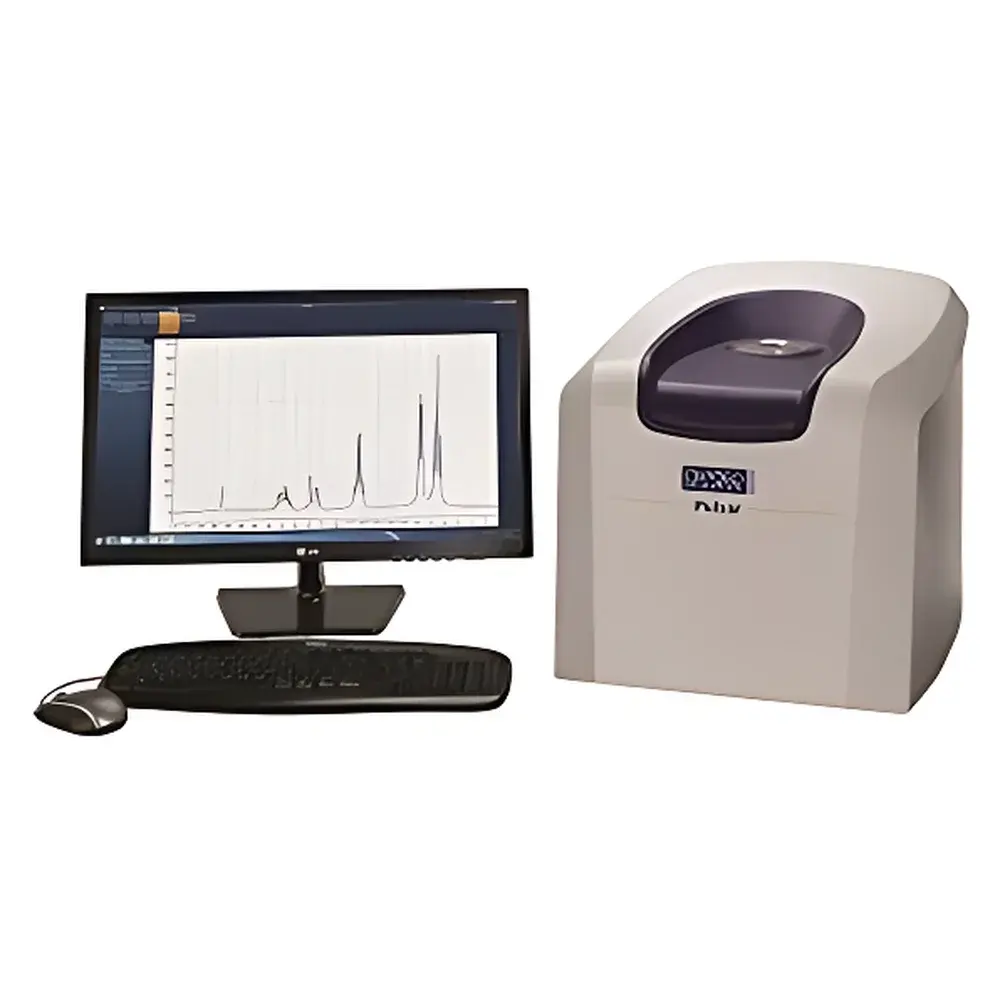
Oxford Instruments Pulsar 60 MHz Benchtop Nuclear Magnetic Resonance (NMR) Spectrometer
| Brand | Oxford Instruments |
|---|---|
| Origin | United Kingdom |
| Model | NMR Pulsar |
| Instrument Type | Low-Field Benchtop NMR Analyzer |
| Sample Compatibility | Solid and Liquid Samples |
| Sensitivity | High |
| Resolution | < 0.5 Hz (1H, in D2O or CDCl3) |
| Operating Frequency | 60 MHz (¹H) |
| Magnet Type | Permanent Rare-Earth Magnet |
| Cryogen-Free Operation | Yes (No Liquid He or N2 Required) |
| Probe Configuration | Single-Tuned or Dual-Tuned (¹H/¹⁹F |
| Field Homogeneity | Automated Shimming System for High Spectral Uniformity |
Overview
The Oxford Instruments Pulsar 60 MHz Benchtop Nuclear Magnetic Resonance (NMR) Spectrometer is a compact, cryogen-free analytical platform engineered for routine high-resolution NMR spectroscopy in resource-constrained environments. Based on permanent rare-earth magnet technology, the Pulsar operates at a proton Larmor frequency of 60 MHz and delivers robust performance without reliance on liquid helium or liquid nitrogen — eliminating infrastructure dependencies, operational downtime, and long-term cryogenic maintenance costs. Its core measurement principle follows the fundamental quantum mechanical behavior of nuclear spins under static magnetic fields and precisely timed radiofrequency (RF) pulses, enabling quantitative and qualitative structural analysis via chemical shift dispersion, J-coupling patterns, and relaxation time characterization. Designed for accessibility without compromise, the Pulsar supports both 1D and 2D NMR experiments (including COSY, HSQC, and DEPT variants) across multiple nuclei — primarily 1H, 19F, 13C, and 31P — making it suitable for academic teaching laboratories, quality control workflows in fine chemical synthesis, polymer characterization, pharmaceutical excipient verification, and materials science research where rapid, non-destructive molecular fingerprinting is required.
Key Features
- Cryogen-free operation enabled by a stable, temperature-compensated 60 MHz permanent magnet — no liquid helium or nitrogen infrastructure needed
- Automated shimming system ensures field homogeneity < 0.5 Hz linewidth (measured on 1H signal of CHCl3 in CDCl3), supporting high-fidelity spectral resolution
- Single-tuned probe optimized for 1H/19F detection; optional dual-tuned probe configurations available for 13C and 31P capability
- Integrated RF electronics with digital pulse generation, precise timing control (sub-microsecond resolution), and broadband excitation coverage
- Pre-installed pulse sequence library compliant with standard IUPAC nomenclature and widely adopted experimental protocols (e.g., zg, noesy, hsqc, deptq)
- Compact footprint (≤ 0.7 m2) and low power consumption (< 500 W) enable deployment on standard lab benches without dedicated shielding rooms
Sample Compatibility & Compliance
The Pulsar accommodates both liquid and solid-state samples without requiring specialized sample preparation beyond standard NMR practice. Liquid samples may be analyzed neat or diluted in deuterated (e.g., CDCl3, D2O) or non-deuterated solvents. Solid samples are compatible via solution-state analysis after dissolution or through limited solid-state experiments using basic CP/MAS sequences (subject to probe configuration). The instrument meets electromagnetic compatibility (EMC) requirements per EN 61326-1:2013 and safety standards per EN 61010-1:2010. While not certified for GMP-regulated production environments out-of-the-box, its data acquisition and processing architecture supports audit-trail-enabled workflows when integrated with validated Mnova software (v14+), facilitating alignment with GLP documentation practices and internal QA/QC traceability requirements.
Software & Data Management
The Pulsar is controlled via proprietary Oxford Instruments acquisition software, featuring an intuitive graphical interface with guided experiment setup, real-time spectrum preview, and parameter optimization wizards. All raw FID data are stored in vendor-neutral formats (e.g., JCAMP-DX, NMRPipe-compatible SER files) to ensure long-term archival integrity and third-party interoperability. Data processing leverages Mestrelab Research’s Mnova NMR software — licensed and preconfigured — offering advanced phasing, baseline correction, peak integration, structure prediction tools, and batch-processing capabilities. Mnova supports 21 CFR Part 11-compliant electronic signatures and audit trail logging when deployed in validated network environments. Export options include publication-ready vector graphics (SVG, EPS), tabular metadata (CSV), and searchable spectral libraries compatible with institutional LIMS integrations.
Applications
- Organic synthesis monitoring: reaction progress tracking, intermediate identification, and purity assessment via 1H and 19F NMR
- Pharmaceutical QC: excipient verification, polymorph screening, and residual solvent quantification (ICH Q2(R2)-aligned)
- Materials science: crosslink density estimation in elastomers, moisture content mapping in hydrogels, and polymer tacticity analysis
- Academic instruction: hands-on NMR pedagogy with real-time spectral acquisition, pulse sequence modification, and spin dynamics visualization
- Food & agrochemical analysis: adulteration detection, fatty acid profile determination, and pesticide residue confirmation
FAQ
Does the Pulsar require cryogens or external cooling systems?
No. It uses a permanently magnetized rare-earth core with active temperature stabilization — zero liquid helium, liquid nitrogen, or chiller units required.
Can I run 2D experiments such as HSQC or COSY on the Pulsar?
Yes. The system includes a full suite of 2D pulse sequences, and all experiments are accessible via the graphical acquisition interface without command-line scripting.
Is the Pulsar suitable for regulatory submissions or GMP environments?
While the hardware itself is not FDA-validated, its data handling pipeline — when combined with Mnova’s Part 11-compliant configuration and documented SOPs — supports use in regulated QA/QC labs under internal validation protocols.
What sample volume is required for routine 1H analysis?
Standard 5 mm OD NMR tubes with 0.6 mL sample volume yield optimal signal-to-noise; smaller volumes (down to 0.2 mL) are supported with minor sensitivity trade-offs.
How is field homogeneity maintained over time?
Through a closed-loop automated shimming system that performs real-time gradient optimization before each acquisition, compensating for thermal drift and mechanical perturbations.






