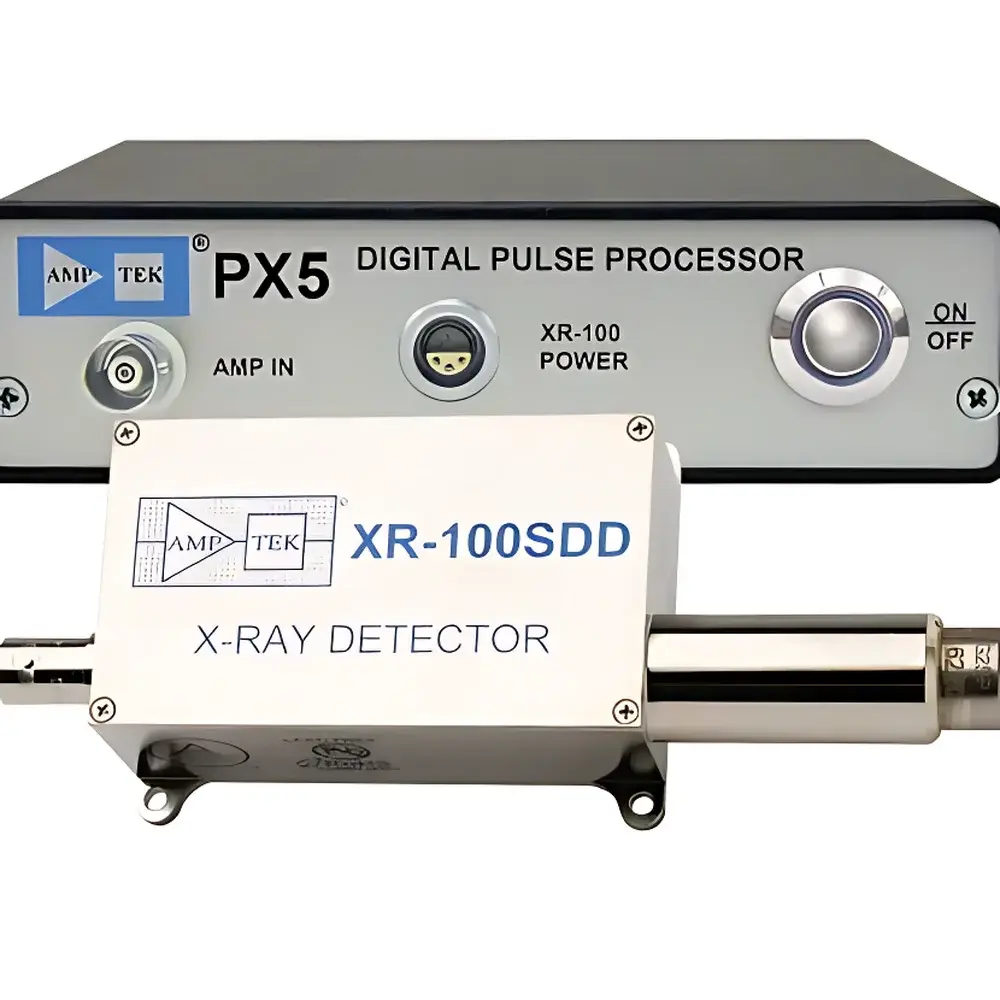
Auniontech XR-100 Series X-ray Detector
| Brand | Auniontech |
|---|---|
| Model | XR-100 |
| Detector Type | Thermoelectrically Cooled Si-PIN or Silicon Drift Detector (SDD) |
| Energy Resolution (5.9 keV ⁵⁵Fe) | 145 eV (Si-PIN), 122 eV (FAST SDD) |
| Active Area | 6–25 mm² |
| Detector Thickness | 500 µm |
| Beryllium Window Thickness | 0.3–1.0 mil (C1/C2 windows available) |
| Integrated Collimator | Yes |
| Package | Hermetically Sealed TO-8 |
| Preamp Architecture | External JFET-based (SDD), Monolithic CMOS/MOSFET (FAST SDD) |
Overview
The Auniontech XR-100 Series X-ray Detector is a high-performance, thermoelectrically cooled solid-state detector engineered for precision energy-dispersive X-ray spectroscopy (EDS/EDX) in laboratory, industrial, and research-grade analytical systems. Built around either silicon p-i-n (Si-PIN) or silicon drift detector (SDD) sensor architectures, the XR-100 delivers exceptional energy resolution, low electronic noise, and stable spectral fidelity across extended acquisition periods. Its core measurement principle relies on the photoelectric absorption of incident X-ray photons in high-purity silicon, generating charge carriers proportional to photon energy; this charge is collected, amplified, and digitized to produce high-fidelity pulse-height spectra. The series supports both standard SDD configurations—featuring a discrete JFET preamplifier in a hermetically sealed TO-8 package—and FAST SDD variants, which integrate a monolithic CMOS preamplifier with a MOSFET input stage directly within the detector housing. This architecture significantly reduces capacitance and signal path length, enabling higher count-rate capability (>500 kcps typical), improved timing resolution, and sub-125 eV energy resolution at 5.9 keV (⁵⁵Fe), meeting stringent requirements for elemental quantification in SEM-EDS, handheld XRF, micro-XRF, and synchrotron beamline applications.
Key Features
- Thermoelectric (Peltier) cooling to –20 °C nominal, eliminating need for liquid nitrogen while maintaining optimal leakage current and energy resolution
- Multiple active area options: 6 mm², 13 mm², and 25 mm²—optimized for sensitivity vs. count-rate trade-offs in different excitation geometries
- Uniform 500 µm thick high-resistivity silicon sensor layer, ensuring consistent quantum efficiency across the 1–20 keV range
- Adjustable beryllium entrance window thicknesses (0.3 mil, 0.5 mil, 1.0 mil) and C1/C2 polymer-coated ultra-thin windows for enhanced low-energy response (down to ~0.1 keV)
- Factory-integrated precision collimators for spatially resolved measurements and reduced scatter contribution
- TO-8 hermetic packaging with gold-plated ceramic base and low-outgassing internal materials—compatible with UHV and high-reliability vacuum environments
- Standard analog output (shaped pulse) and digital interface options (LVDS, SPI-compatible control lines) for seamless integration with third-party multichannel analyzers (MCAs) and OEM spectrometers
Sample Compatibility & Compliance
The XR-100 series is compatible with a broad range of sample types—including conductive metals, insulating ceramics, biological thin sections, geological powders, and coated substrates—when coupled with appropriate excitation sources (e.g., 5–50 kV electron beams, 10–100 kV X-ray tubes, or radioactive isotopes). Its low-noise front-end design enables reliable detection of trace elements (detection limits <100 ppm typical at 100 s live time) and accurate peak deconvolution in complex multi-element matrices. All detectors comply with RoHS Directive 2011/65/EU and meet IEC 61000-6-3 (EMI emission) and IEC 61000-6-2 (immunity) standards. For regulated environments, the detector’s stable gain and linear response support GLP/GMP-compliant workflows when paired with FDA 21 CFR Part 11–enabled MCA software featuring audit trails, user access controls, and electronic signature capabilities.
Software & Data Management
XR-100 detectors operate natively with industry-standard spectroscopy platforms including Amptek’s DPPMCA, Canberra’s Genie 2000, and open-source libraries such as PyMCA and SpecTcl. Auniontech provides full SDK documentation (C/C++, Python bindings) for OEM integration, including register-level control of bias voltage, temperature setpoint, shaping time, and test pulse calibration. Spectral data are output in standard formats (ASCII, binary .spe, .cnf) compliant with ISO 14156 and ASTM E1301 for inter-laboratory comparability. Real-time dead-time correction, pile-up rejection, and escape peak modeling are supported via firmware-upgradable digital pulse processing modules.
Applications
- Scanning electron microscopy (SEM-EDS) for phase identification and compositional mapping
- Portable and benchtop X-ray fluorescence (XRF) analyzers for alloy verification, mining assays, and environmental soil screening
- Micro-XRF microprobes for cultural heritage artifact analysis and semiconductor wafer defect characterization
- Synchrotron radiation facilities requiring high count-rate stability under intense beam flux
- Academic and national lab research in materials science, nuclear physics, and planetary geochemistry
FAQ
What is the recommended operating temperature range for long-term stability?
The detector is rated for continuous operation at –15 °C to –25 °C (setpoint); ambient temperature should remain below 35 °C with adequate airflow.
Can the XR-100 be used in vacuum environments?
Yes—hermetic TO-8 packaging and low-outgassing materials permit direct mounting in high-vacuum chambers (≤10⁻⁶ mbar) without additional shielding.
Is energy calibration traceable to NIST standards?
Calibration is performed using certified ⁵⁵Fe, ²⁴¹Am, and ¹⁰⁹Cd reference sources; full calibration reports include uncertainty budgets per ISO/IEC 17025 guidelines.
Does the FAST SDD variant support real-time spectrum streaming?
Yes—LVDS output enables >1 MHz pulse throughput with sub-microsecond timing resolution, suitable for time-resolved EDS and pump-probe experiments.
Are custom window materials or geometries available?
Custom Be, Al, or polymer windows (e.g., Si₃N₄) and aperture-defined collimation patterns can be engineered under NDA for specialized OEM applications.