
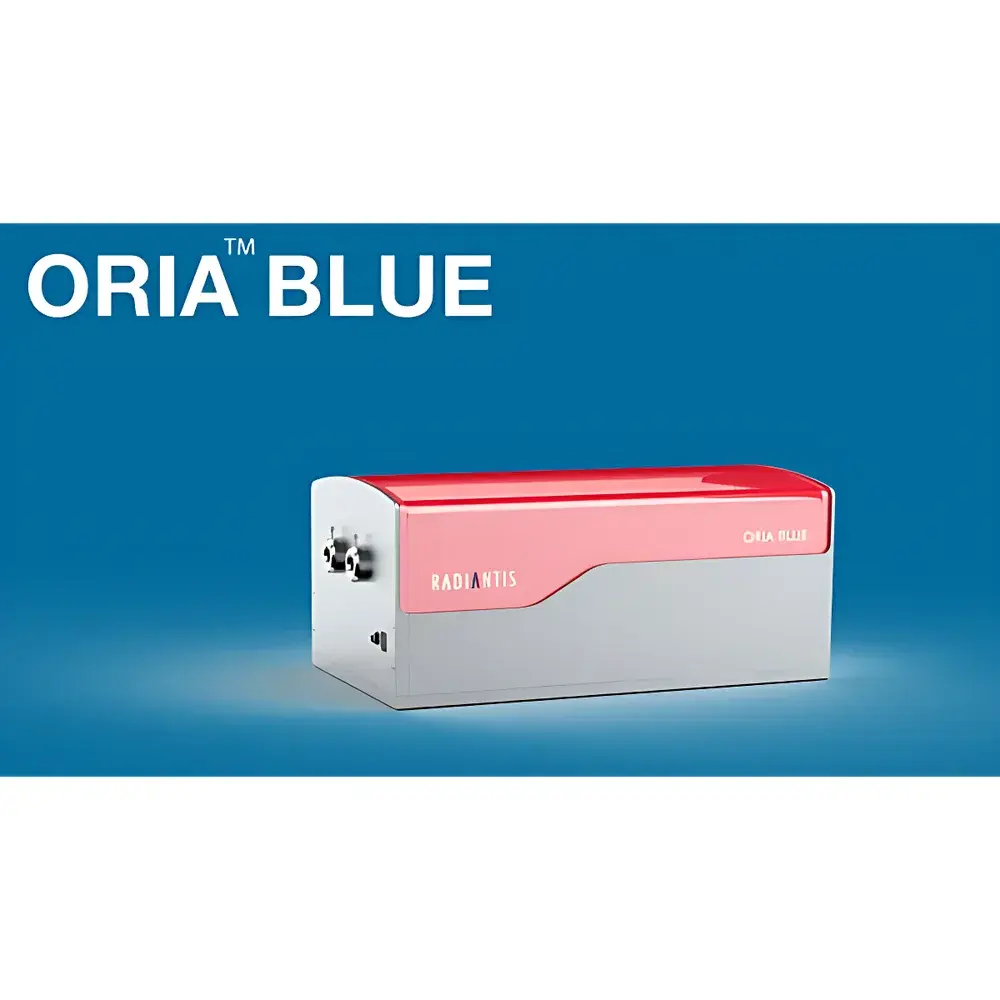
Radiantis Oria Blue Femtosecond and Picosecond Second-Harmonic Generation (SHG) Module
| Brand | Radiantis |
|---|---|
| Origin | Spain |
| Model | Oria Blue SHG Module for Ti:Sapphire Oscillators |
| Tuning Range | 340–550 nm (from 680–1080 nm fundamental) |
| Avg. Output Power | >1.2 W @ 410 nm |
| Pulse Width Preservation | <150 fs (fs regime), <180 fs (ps regime) |
| Repetition Rate | 80 MHz |
| Beam Mode | TEM₀₀ |
| Dimensions | 200 × 364 × 155 mm |
| Compliance | CE, RoHS |
| Software Control | Oria Blue Control Suite (Windows-based, USB interface) |
| Mounting | Kinematic, alignment-free platform compatible with standard optical tables |
Overview
The Radiantis Oria Blue is a high-performance, compact second-harmonic generation (SHG) module engineered for ultrafast laser laboratories requiring reliable, wavelength-converted output across the ultraviolet-to-visible (UV–VIS) spectrum. Operating on the principle of type-I or type-II phase-matched second-order nonlinear optical frequency doubling in bulk birefringent crystals (e.g., BBO or LBO), the Oria Blue converts femtosecond and picosecond pulses from commercially available Ti:sapphire oscillators (680–1080 nm fundamental) into coherent radiation spanning 340–550 nm. Unlike conventional SHG stages requiring manual crystal angle tuning and realignment for each wavelength, the Oria Blue integrates a patented multi-crystal, motorized angular and translational stage architecture that enables continuous, repeatable, and hysteresis-free spectral tuning — all while preserving temporal pulse integrity and spatial beam quality. Its design targets applications demanding simultaneous IR + UV output, sub-150-fs pulse fidelity, and long-term stability under MHz-repetition-rate operation.
Key Features
- High conversion efficiency (>45% typical, >1.2 W average power at 410 nm when pumped with 2.8–3.3 W Ti:sapphire oscillator output)
- Single-module broadband coverage: 340–550 nm SHG output from 680–1080 nm fundamental input — no crystal swaps required
- Minimal pulse broadening: <150 fs (fs-pumped) and <180 fs (ps-pumped) residual pulse duration measured at 860 nm fundamental → 430 nm SHG
- TEM₀₀ spatial mode preservation with M² < 1.1 across full tuning range — critical for nonlinear microscopy and quantum interference experiments
- Alignment-free kinematic mounting system compatible with standard 1/4″-20 and M6 optical table posts; integrated reference beams for rapid setup verification
- Dual-operation flexibility: manually tunable version for teaching labs and prototyping; fully automated version with closed-loop stepper control and encoder feedback for integration into automated spectroscopy platforms
Sample Compatibility & Compliance
The Oria Blue is specifically optimized for pump sources meeting industry-standard Ti:sapphire oscillator specifications: 70–100 MHz repetition rate, average power ≥2.5 W, pulse duration 90–200 fs, and beam diameter 1.0–2.5 mm (1/e²). It maintains full compatibility with commercial oscillators from Coherent (Chameleon), Spectra-Physics (Mai Tai), Light Conversion (Pharos), and others. All optical components are certified to ISO 10110 surface quality standards (scratch-dig 10–5), and the housing conforms to IEC 61000-6-3 EMC emission limits. The device carries CE marking and complies with RoHS 2011/65/EU directive. For GLP/GMP-aligned environments, the automated version supports audit-trail logging via the Oria Blue Control Suite, enabling traceability of tuning parameters, timestamps, and user IDs — consistent with FDA 21 CFR Part 11 data integrity requirements where applicable.
Software & Data Management
The Oria Blue Control Suite is a native Windows application (64-bit, .NET Framework 4.8+) providing intuitive graphical interface for wavelength selection, power monitoring, and motorized stage calibration. Key software capabilities include: (i) wavelength-swept acquisition mode with programmable step size (0.1 nm resolution) and dwell time (10 ms–5 s); (ii) real-time SHG power normalization against incident fundamental intensity using integrated photodiode feedback; (iii) batch export of spectral scans in CSV and HDF5 formats compliant with FAIR data principles; (iv) remote API (DLL and Python bindings) for integration into LabVIEW, MATLAB, or custom Python-based experiment control frameworks; (v) firmware update capability over USB 2.0 with rollback protection. No cloud dependency or mandatory online activation is required.
Applications
The Oria Blue serves as a core enabling tool in multiple advanced photonics domains. In ultrafast spectroscopy, it delivers tunable UV pulses for transient absorption studies of DNA photodamage, charge-transfer dynamics in perovskites, and excited-state proton transfer in biological chromophores. In quantum optics, its high spatial coherence and low timing jitter (<100 fs RMS) support spontaneous parametric down-conversion (SPDC) seeding and Hong–Ou–Mandel interferometry. Within bioimaging, the 340–420 nm output enables label-free two-photon excited fluorescence (TPEF) of NAD(P)H and tryptophan, while the preserved femtosecond duration ensures minimal thermal load in live-tissue imaging. Additional use cases include photoelectron spectroscopy pump-probe setups, UV-Raman excitation, and precision metrology requiring stable, narrow-linewidth visible/UV sources traceable to primary standards.
FAQ
Is the Oria Blue compatible with amplified laser systems?
No — the Oria Blue is designed exclusively for oscillator-level average powers (2.5–4.0 W) and pulse energies ≤10 nJ. Amplified systems require harmonic generation architectures with chirped-pulse or cavity-enhanced configurations.
Can the module be retrofitted with custom nonlinear crystals?
Not without voiding warranty and calibration certification. Radiantis pre-characterizes each unit with factory-optimized crystal sets; third-party crystal insertion compromises phase-matching bandwidth and thermal stability.
What is the long-term power stability specification?
When operated within ambient temperature stability ±0.5 °C and with proper warm-up (>30 min), RMS power drift is ≤1.2% over 8 hours at fixed wavelength and pump conditions.
Does the automated version support external TTL triggering for synchronization?
Yes — the motor controller accepts 5 V TTL signals for start/stop commands and provides synchronous status outputs (BUSY, READY) for integration into master-slave timing architectures.
Is vacuum or purged operation supported?
The standard housing is air-sealed but not vacuum-rated. Optional nitrogen purge ports (NPP-1) are available upon request for deep-UV applications below 350 nm where oxygen absorption becomes significant.





