
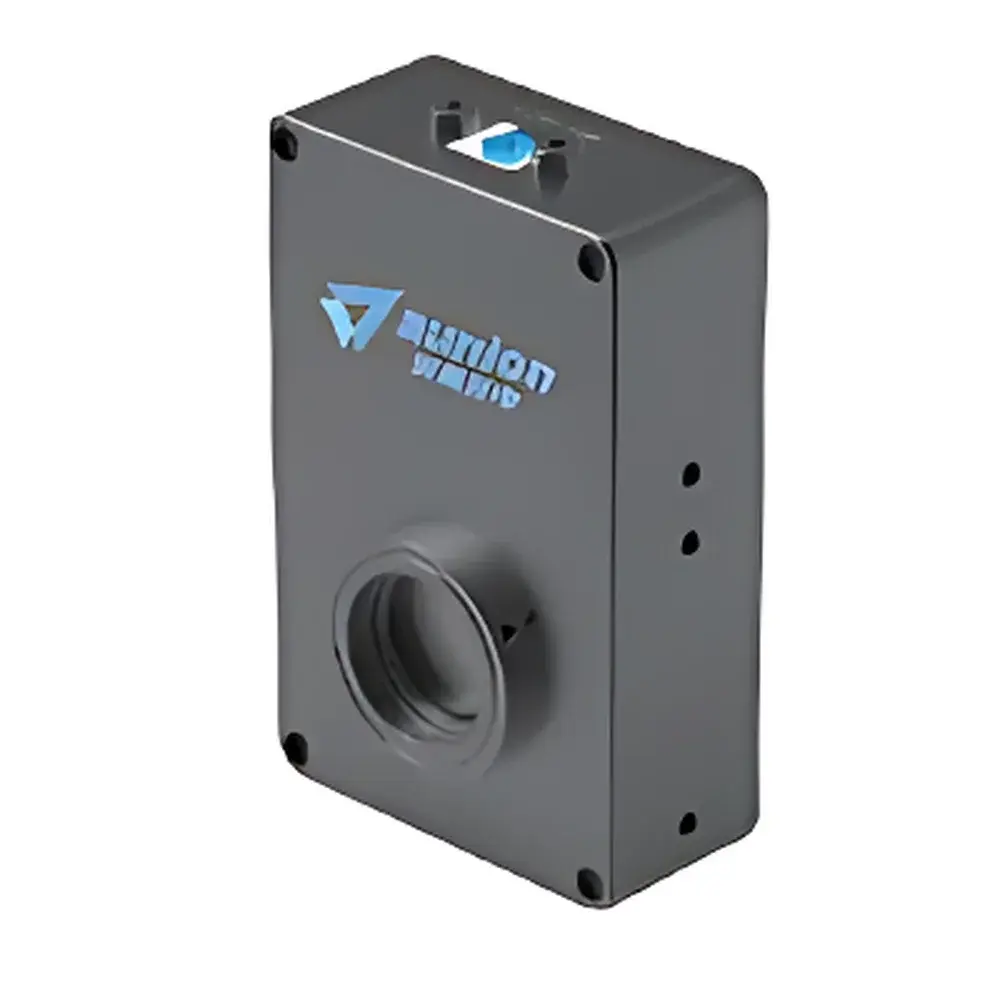
Auniontech AUT-LCV10 / AUT-LCN20 / AUT-LCS10 Liquid Crystal Tunable Filter (LCTF)
| Brand | Auniontech |
|---|---|
| Origin | Shanghai, China |
| Model | AUT-LCV10 / AUT-LCN20 / AUT-LCS10 |
| Spectral Range | 420–750 nm / 450–950 nm / 920–1700 nm |
| FWHM | 10 nm @ 550 nm / 10 nm @ 550 nm / 15 nm @ 1200 nm |
| Tuning Resolution | 1 nm |
| Center Wavelength Accuracy | ≤±2 nm / ≤±1 nm / ≤±2 nm |
| Max Polarization-Dependent Transmission | ≥36% / ≥32% / ≥32% |
| Out-of-Band Rejection | ≥OD2.5 / ≥OD3 / ≥OD2.5 |
| Response Time | 10–200 ms / <100 ms / 10–200 ms |
| Field-of-View Compensation | ±5° |
| Interface | USB 2.0 Type B (locking) |
| Software | SetLCTF GUI + SDK (C/C++ compatible) |
| Operating Temperature | 0–45 °C |
| Dimensions (W×H×D) | 98.5×63×30 mm / 124.5×84×36.5 mm / 98.5×67×40 mm |
Overview
The Auniontech AUT-LCV10, AUT-LCN20, and AUT-LCS10 Liquid Crystal Tunable Filters (LCTFs) are electronically controlled, polarization-sensitive optical bandpass filters engineered for high-fidelity spectral selection in demanding imaging and spectroscopic applications. Based on the electro-optic birefringence effect in nematic liquid crystal layers and interference of polarized light in a cascaded retarder architecture, these LCTFs enable precise, stepwise or continuous wavelength selection across broad spectral bands—without mechanical movement. Each model is optimized for distinct operational windows: visible (420–750 nm), visible–NIR (450–950 nm), and SWIR (920–1700 nm). The core design integrates calibrated liquid crystal phase retarders with integrated temperature and angular compensation algorithms, ensuring stable center wavelength performance under varying environmental and optical alignment conditions. Unlike filter wheels or acousto-optic tunable filters (AOTFs), LCTFs provide intrinsic polarization selectivity, high out-of-band rejection, and low power consumption—making them ideal for integration into compact, field-deployable hyperspectral imaging systems.
Key Features
- Electronically tunable narrowband filtering with 1 nm wavelength resolution and programmable scan parameters (start/stop wavelength, step size, dwell time, custom sequences)
- Cascaded liquid crystal retarder architecture delivering high transmission efficiency (≥36% for AUT-LCV10 at peak polarization) and minimal polarization-dependent loss
- Factory-calibrated spectral response with built-in temperature compensation—mitigating thermal drift of center wavelength across 0–45 °C operating range
- Field-angle compensation algorithm leveraging pre-measured calibration database to correct spectral shift induced by off-axis illumination up to ±5° FOV
- Optical density ≥OD2.5 (AUT-LCV10/AUT-LCS10) and ≥OD3 (AUT-LCN20) for robust suppression of adjacent spectral orders and stray light
- Compact, lightweight form factor (as small as 98.5 × 63 × 30 mm) with low power draw—suitable for UAV-mounted, portable, or embedded OEM systems
- USB 2.0 Type B (locking connector) interface with real-time command-response protocol; compatible with Windows/Linux via provided SDK (C/C++ API)
Sample Compatibility & Compliance
These LCTFs are designed for integration with standard imaging optics and detectors—including C-mount and M42-threaded lenses, CMOS, sCMOS, InGaAs, and extended-range SWIR sensors. No optical alignment tools or recalibration are required post-integration due to factory-aligned collimation and beam deviation control. While not certified to ISO/IEC 17025 or FDA 21 CFR Part 11 out-of-box, the firmware and SDK support audit-trail logging, parameter versioning, and deterministic command sequencing—enabling users to implement GLP/GMP-compliant workflows when paired with validated host software. All models comply with CE EMC Directive 2014/30/EU and RoHS 2011/65/EU requirements for commercial laboratory instrumentation.
Software & Data Management
The included SetLCTF control software provides an intuitive GUI for real-time wavelength tuning, multi-point spectral scanning, and acquisition synchronization with external cameras via TTL trigger input/output. Advanced users leverage the cross-platform SDK to embed LCTF control within custom Python, MATLAB, or LabVIEW environments—or integrate into automated test benches requiring deterministic timing (e.g., synchronized with shutter, stage motion, or laser pulsing). The SDK exposes low-level register access, enabling fine-grained optimization of drive voltage waveforms for specific LC cell aging profiles or ambient temperature gradients. All spectral configuration parameters—including user-defined calibration offsets—are stored non-volatilely in onboard memory and persist across power cycles.
Applications
- Hyperspectral imaging for agricultural phenotyping, mineral identification, and food quality inspection
- Fluorescence lifetime and spectral unmixing in biomedical microscopy (e.g., multiplexed immunofluorescence, autofluorescence mapping)
- Remote sensing payloads in CubeSats and stratospheric balloon platforms where size, weight, and power (SWaP) constraints are critical
- In-line process monitoring of thin-film deposition, coating uniformity, and semiconductor wafer inspection
- Defense-related multispectral surveillance systems requiring rapid spectral agility and low RF signature
- Quantum optics experiments requiring polarization-resolved, narrowband spectral filtering of single-photon sources
FAQ
What is the maximum frame rate achievable when scanning across a spectral range?
Frame rate depends on both LCTF settling time and camera readout. For AUT-LCN20 (fastest model, <100 ms response), full 100-step scans can be completed in ~10–15 seconds with adequate stabilization time per step; real-time video-rate tuning is not supported.
Can the LCTF be used with unpolarized light sources?
Yes—but throughput will be reduced by ~50% due to inherent polarization selectivity. A broadband polarizer upstream is recommended to maximize signal-to-noise ratio and ensure repeatable spectral shape.
Is firmware upgrade capability available?
Yes—firmware updates are delivered via USB using the SetLCTF utility and preserve all user calibration data and settings.
Does the SDK support Linux ARM64 platforms (e.g., NVIDIA Jetson)?
The C-language SDK is architecture-agnostic and has been successfully deployed on ARM64-based embedded hosts with appropriate compiler toolchains and USB stack support.
How is spectral calibration traceability maintained?
Each unit ships with a NIST-traceable spectral calibration certificate referencing measurements performed against a calibrated CCD spectrometer and stabilized halogen/deuterium lamp source. Calibration data is embedded in device firmware and accessible via SDK query commands.




