
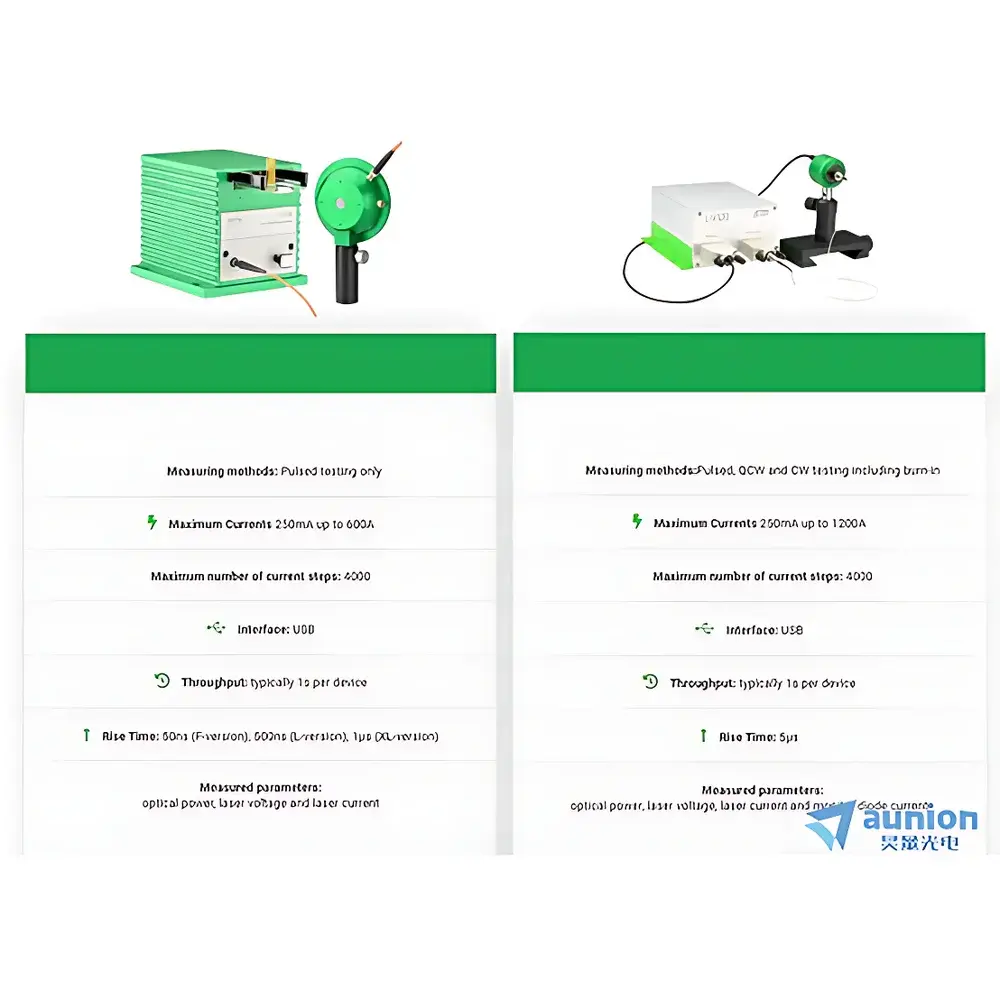
Auniontech LED LIV Test System
| Brand | Auniontech |
|---|---|
| Model | LED LIV |
| Type | Laser Diode & LED Light-Current-Voltage Characterization System |
| Current Range | 250 mA to 1200 A (customizable) |
| Pulse Width | 150 ns – 2000 µs |
| Rise/Fall Time | ≤50 ns (at 60 A) |
| Operation Modes | Pulsed, CW, QCW |
| Control Interface | USB |
| Compliance | Designed for ISO/IEC 17025-aligned lab environments, supports GLP/GMP audit trails via software logging |
Overview
The Auniontech LED LIV Test System is a precision-engineered optical characterization platform designed for comprehensive light-current-voltage (LIV) analysis of laser diodes and high-brightness LEDs—whether in unpackaged die form or fully packaged modules. Built upon a modular architecture combining programmable current sourcing, calibrated optical power detection, and synchronized timing electronics, the system implements pulsed and continuous-wave (CW) measurement paradigms grounded in fundamental semiconductor optoelectronic principles. Its core functionality enables accurate extraction of threshold current (Ith), slope efficiency (dP/dI), series resistance (Rs), quantum efficiency, and thermal rollover behavior—parameters critical for device qualification, process monitoring, and reliability assessment in R&D and production settings. The system operates under controlled electro-optical conditions where photodiode-based optical power sensors are traceably calibrated against NIST-traceable standards, ensuring metrological integrity across measurement cycles.
Key Features
- Digitally programmable analog terminal stage delivering high-fidelity current control with <100 ppm linearity and sub-microsecond settling time.
- Wide dynamic current range: standard configurations support 250 mA to 1200 A; custom extensions available for specialized high-power bar or stack testing.
- Ultrafast pulse generation: adjustable pulse widths from 150 ns to 2000 µs; fast-rise variant achieves ≤50 ns rise/fall times at 60 A—minimizing joule heating and enabling true chip-level transient characterization without thermal saturation.
- Dual-mode operation: seamless switching between pulsed, quasi-CW (QCW), and continuous-wave (CW) modes—including extended-duration aging tests with real-time parameter logging.
- Fully autonomous measurement execution: parameter sets uploaded via USB; system executes full LIV sweeps—including forward bias ramping, optical power sampling, voltage feedback acquisition, and thermal stabilization pauses—without host intervention.
- Modular probe interface: compatible with custom-designed stripline fixtures and contact cards for wafer-level, bar-level, and TO-can/module-level DUT interfacing.
Sample Compatibility & Compliance
The system accommodates diverse physical formats including bare dies (on submount or heatsink), single-emitter TO packages, multi-emitter arrays, fiber-coupled modules, and bar-mounted devices. Mechanical interfaces are configurable to meet industry-standard probe station footprints (e.g., Cascade Microtech, MPI). All optical power measurements comply with ISO 11146-1:2019 (laser beam parameters) and IEC 62613-1:2013 (LED optical testing). Electrical safety design conforms to IEC 61010-1:2012. Software-generated reports include timestamped metadata, instrument calibration status, environmental ambient logs (optional sensor integration), and digital signatures—supporting compliance with FDA 21 CFR Part 11 requirements when deployed in regulated manufacturing environments.
Software & Data Management
The native control suite runs on Windows-based host PCs and provides a deterministic, scriptable API (LabVIEW, Python, C++ SDKs included). Each measurement session generates structured HDF5 files containing raw voltage, current, and photodetector output traces alongside derived metrics (e.g., differential quantum efficiency, wall-plug efficiency, thermal resistance θja). Data export supports CSV, MATLAB .mat, and XML formats. Audit trail functionality records operator ID, parameter changes, calibration events, and firmware revisions—enabling full traceability per ISO/IEC 17025 Clause 7.7. Optional cloud-sync module allows secure, encrypted upload to centralized QA databases for cross-site correlation and SPC charting.
Applications
- Pre- and post-packaging LIV screening for laser diode foundries and LED epitaxy fabs.
- Incoming inspection of OEM-sourced emitters in medical laser systems, industrial pumping modules, and automotive LiDAR transmitters.
- Process development feedback for MOCVD/MBE growth optimization and facet passivation studies.
- Accelerated life testing (ALT) and burn-in validation under controlled thermal boundary conditions.
- Support for advanced characterization workflows: near-field/far-field profiling synchronization, spectral emission mapping (when integrated with monochromators), and smile distortion analysis via spatially resolved LIV mapping.
FAQ
Does the system support automated wafer-level probing?
Yes—via optional integration with semi-automated probe stations using TTL-triggered coordinate positioning and vacuum chuck control signals.
Can I perform temperature-dependent LIV measurements?
Yes—when paired with thermoelectric coolers (TECs) or liquid-cooled heat sinks equipped with calibrated RTD or thermistor feedback channels; temperature ramping profiles are programmable within the test sequence.
Is calibration traceable to national standards?
All optical power sensors ship with individual NIST-traceable calibration certificates; electrical current sources are verified annually per ISO/IEC 17025-accredited procedures.
What level of data security does the software provide for regulated environments?
Role-based access control, electronic signatures, immutable audit logs, and encrypted local storage meet baseline requirements for FDA 21 CFR Part 11 and EU Annex 11 compliance.
Do you offer application-specific fixture design services?
Yes—Auniontech provides engineering consultation and mechanical CAD support for custom striplines, RF-compatible contact cards, and thermal interface solutions tailored to customer DUT geometries and test protocols.




