
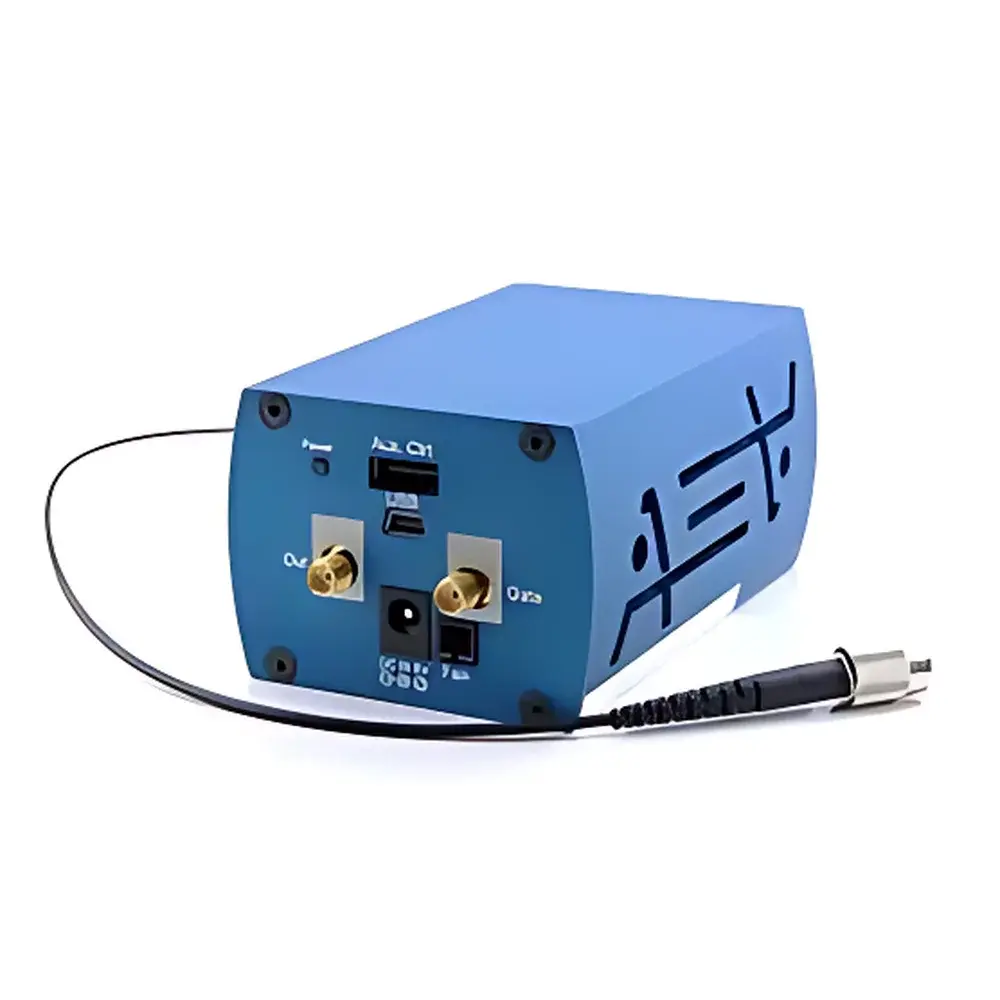
Aurea Technology SPD_NIR_OEM_120MHz Ultrafast Near-Infrared Single-Photon Counting OEM Module
| Brand | Aurea Technology |
|---|---|
| Origin | France |
| Model | SPD_NIR_OEM_120MHz |
| Spectral Range | 900–1700 nm |
| Max. Trigger Rate | 120 MHz |
| Quantum Efficiency | Adjustable 5–30% (5% steps) |
| Timing Jitter | <150 ps @ 30% QE |
| Dark Count Rate | <5.0 × 10⁻⁶ per ns @ 10% QE (SMF) |
| Dead Time | Adjustable 500 ns – 999 µs |
| Cooling | Integrated Thermoelectric Cooler (TEC) |
| Interface | USB 2.0 |
| Fiber Compatibility | SMF or MMF |
| TEC Stabilization Time | <2 min @ 25 °C |
Overview
The Aurea Technology SPD_NIR_OEM_120MHz is an ultrafast, thermoelectrically cooled single-photon counting module engineered for demanding time-resolved photonic applications in the near-infrared (NIR) spectral band. Based on a gated Geiger-mode InGaAs avalanche photodiode (APD), this OEM-grade detector operates with high temporal fidelity across 900–1700 nm—covering key telecom and molecular fingerprint windows. Its architecture implements active quenching and recharging circuitry optimized for sub-nanosecond timing resolution and sustained operation at repetition rates up to 120 MHz. Unlike conventional NIR photomultiplier tubes (PMTs) or microchannel plate (MCP) detectors, the SPD_NIR_OEM_120MHz delivers superior photon detection efficiency (PDE), low afterpulsing probability (<0.1% under 100 kHz gating), and intrinsic compatibility with fiber-coupled optical systems. The module is designed for integration into turnkey instruments requiring robust, compact, and factory-calibrated single-photon sensitivity without external cryogenic infrastructure.
Key Features
- Geiger-mode InGaAs APD with integrated thermoelectric cooler (TEC) for stable operation at −30 °C to −40 °C
- Adjustable quantum efficiency from 5% to 30% in 5% increments—enabling trade-off optimization between PDE and dark count rate
- Timing jitter <150 ps (FWHM) at maximum QE setting, supporting high-resolution time-correlated single-photon counting (TCSPC)
- Programmable dead time from 500 ns to 999 µs—configurable via software to accommodate varying photon flux and pile-up conditions
- Low dark count density: <5.0 × 10⁻⁶ counts/ns at 10% QE with single-mode fiber input
- USB 2.0 interface with vendor-provided SDK (C/C++, Python bindings) and LabVIEW-compatible drivers for seamless system integration
- OEM-optimized mechanical footprint (76 × 58 × 28 mm) with SMA-905 or FC/PC fiber port options and standardized mounting holes
Sample Compatibility & Compliance
The SPD_NIR_OEM_120MHz accepts both single-mode (SMF-28, SMF-28e+) and multimode (62.5/125 µm or 50/125 µm) optical fibers, enabling flexible coupling to laser sources, spectrometers, or interferometric setups. Its spectral response aligns with ITU-T G.652.D and IEC 60793-2-50 standards for telecom-grade fiber transmission. While not certified for medical or industrial safety compliance (e.g., IEC 61010-1), the module meets CE marking requirements for electromagnetic compatibility (EN 61326-1) and low-voltage directive (2014/35/EU). Its firmware supports audit-trail logging of configuration changes and acquisition parameters—facilitating GLP-compliant experimental documentation when deployed in regulated research environments.
Software & Data Management
The module ships with a cross-platform GUI application (Windows/macOS/Linux) providing real-time histogramming, gate parameter tuning, live count-rate monitoring, and TCSPC histogram export in standard formats (ASCII, HDF5, .ptu). All acquisition metadata—including timestamp resolution, dead time, QE setting, TEC temperature, and fiber type—are embedded in exported files. The SDK exposes low-level register access for advanced users implementing custom synchronization protocols (e.g., TTL-gated acquisition, NIM-triggered start-stop logic). Data streams support streaming mode at full 120 MHz event rate with hardware timestamping resolution down to 10 ps (via optional external time-to-digital converter interface). No proprietary runtime or license activation is required; binaries are statically linked and deployable in headless server environments.
Applications
- Time-resolved fluorescence lifetime imaging (FLIM) and decay analysis in biological tissues and quantum dot emitters
- Quantum key distribution (QKD) systems operating at 1310 nm and 1550 nm wavelengths
- Optical time-domain reflectometry (OTDR) for fault localization in long-haul fiber networks
- Single-photon source characterization—including g⁽²⁾(0) measurement and heralding efficiency quantification
- Ultrafast laser diagnostics: pulse duration estimation via intensity autocorrelation and FROG variants
- NIR absorption and luminescence spectroscopy in condensed-phase chemistry and semiconductor physics
FAQ
What is the typical cooling stabilization time?
The integrated TEC achieves thermal equilibrium within <2 minutes from ambient (25 °C) to operational setpoint (−35 °C), verified by onboard temperature sensor with ±0.2 °C accuracy.
Can the module operate continuously at 120 MHz trigger rate?
Yes—provided the average photon flux remains below the saturation limit defined by the configured dead time and QE setting. Sustained operation requires adequate heat dissipation via conduction-cooled mounting or forced-air ventilation.
Is fiber alignment required during installation?
No—factory-aligned and permanently fixed fiber coupling eliminates user alignment. SMF versions use precision ceramic ferrules; MMF versions feature molded polymer connectors compatible with standard patch cables.
Does the module support external clock synchronization?
Yes—via LVDS input for master-slave timing distribution in multi-detector arrays or pump-probe experiments requiring sub-100 ps inter-channel skew.
Are calibration certificates traceable to national standards available?
Upon request, Aurea provides NIST-traceable responsivity calibration reports (wavelength-specific PDE curves) and timing jitter verification data acquired using a calibrated picosecond pulsed laser reference source.




