
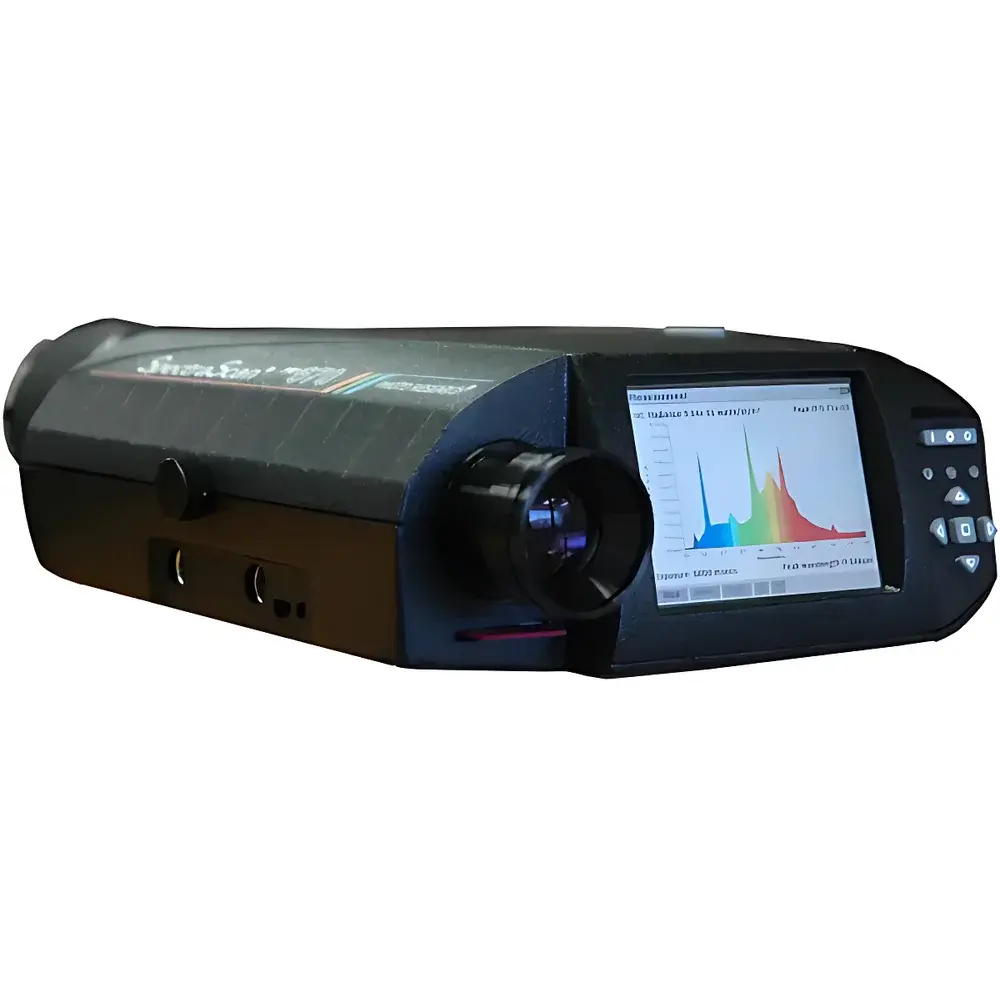
Photo Research PR-670 Multi-Aperture Spectroradiometer
| Brand | Photo Research |
|---|---|
| Model | PR-670 |
| Spectral Resolution | 1.56 nm/pixel |
| Detector Array | 256-element CCD |
| Apertures | 1°, 0.5°, 0.25°, 0.125° (motorized) |
| Display | 2.25" × 3" full-color touchscreen |
| Battery Life | up to 12 hours (rechargeable Li-ion) |
| Data Storage | SD card (thousands of spectra) |
| Interface | USB 2.0, Bluetooth (optional), RS-232 emulation (driver-supported) |
| Sync | AutoSync for flicker-free measurement at variable refresh rates |
| Remote Trigger | TTL-compatible input |
| Compliance | CIE 127, ISO/CIE 11664, ASTM E308, USP <1033>, GLP/GMP-ready data logging |
Overview
The Photo Research PR-670 Multi-Aperture Spectroradiometer is a portable, battery-powered spectroradiometric instrument engineered for high-fidelity spectral radiance and luminance measurements across display technologies, lighting systems, and reflective/transmissive materials. It operates on the principle of scanning monochromator-based spectroscopy, utilizing a 256-element linear CCD array with fixed grating optics to deliver calibrated spectral data from 380 nm to 780 nm at 1.56 nm spectral sampling intervals. Unlike filter-based colorimeters, the PR-670 captures full spectral power distributions (SPDs) in a single scan—enabling traceable derivation of photometric (e.g., cd/m², lux), colorimetric (CIE XYZ, xy, u’v’), and chromaticity metrics (CCT, Duv, CRI Ra/R9, TM-30 Rf/Rg, dominant wavelength, purity) without interpolation or calibration drift. Its compact, rugged architecture supports field-deployable operation in production labs, clinical environments, and outdoor testing scenarios where portability and self-contained functionality are critical.
Key Features
- Four motorized field-of-view apertures (1°, 0.5°, 0.25°, 0.125°) enabling precise spatial resolution scaling without manual lens swaps
- AutoSync technology dynamically locks acquisition timing to source flicker frequency (e.g., 50/60 Hz, 120 Hz, PWM-driven LEDs), eliminating aliasing artifacts in pulsed-light measurements
- Integrated rechargeable lithium-ion battery supporting ≥12 hours of continuous operation—validated per IEC 62133 for safety and cycle stability
- Onboard 2.25″ × 3″ high-resolution color touchscreen with intuitive menu navigation; no external PC required for basic operation or real-time spectral visualization
- Dual-mode communication: native USB 2.0 interface for high-speed data transfer and firmware updates; optional Bluetooth 4.2 module for wireless telemetry and remote command execution
- RS-232 emulation driver provided for legacy ATE integration, supporting ASCII command protocol for automated test sequences in manufacturing QA workflows
- SD card slot compliant with SDHC Class 10 specifications, storing >5,000 full-spectrum datasets with embedded metadata (timestamp, aperture, integration time, calibration ID)
Sample Compatibility & Compliance
The PR-670 accommodates diverse optical geometries via interchangeable accessories—including cosine-corrected irradiance probes (for illuminance and irradiance), LR-127 LED measurement modules (per CIE 127:2007 Annex B), fiber-optic bundles for inaccessible or hazardous locations, and micro-lens attachments for sub-millimeter spot analysis (down to ~0.3 mm at 30 cm working distance). All accessories maintain NIST-traceable calibration chains documented per ISO/IEC 17025 requirements. The instrument’s firmware implements CIE S 014-2/E:2022 spectral weighting functions and supports user-defined custom curves. Measurement uncertainty budgets conform to GUM (JCGM 100:2008) methodology, with typical k=2 expanded uncertainties of ±2.5% for luminance (cd/m²) and ±0.003 Δuv for chromaticity under controlled lab conditions. Data export formats include CSV, XML, and CIE 15:2018-compliant .cie files for third-party analysis.
Software & Data Management
SpectraWin v6.x software (Windows 10/11 compatible) provides full instrument control, spectral visualization, comparative analysis, and report generation—including FDA 21 CFR Part 11–compliant audit trails, electronic signatures, and role-based access controls. Raw spectral data are stored with immutable metadata: calibration certificate ID, operator ID, environmental temperature/humidity tags, and instrument serial number. Export options include PDF reports with embedded CIE 1931 chromaticity diagrams, spectral overlays, and pass/fail thresholds aligned with IEC 62341-6-3 (OLED displays) or ENERGY STAR Luminous Efficacy requirements. For integration into enterprise QA systems, RESTful API endpoints enable direct ingestion into LIMS or MES platforms via HTTPS POST requests with JSON payloads.
Applications
- Display metrology: OLED, microLED, LCD, and projection system uniformity mapping (luminance, chromaticity, gamma, contrast ratio)
- Lighting validation: SSL product certification per ENERGY STAR, DLC, and IES LM-79-19 protocols
- Clinical dentistry and dermatology: objective shade matching using CIELAB ΔE₀₀ against VITA Classical/3D-Master standards
- Print & packaging QC: spectral reflectance analysis of inks, substrates, and security features per ISO 13655:2017
- Automotive HMI testing: glare evaluation, HUD brightness compliance (SAE J1757-2), and ambient light sensor calibration
- Human factors research: mesopic photometry, circadian stimulus (CS) modeling per CLA 2013, and scotopic/photopic ratio quantification
FAQ
Does the PR-670 require annual recalibration?
Yes. Photo Research recommends NIST-traceable recalibration every 12 months or after 200 hours of cumulative use—whichever occurs first—to maintain compliance with ISO/IEC 17025 and internal quality management systems.
Can the PR-670 measure pulsed or modulated light sources?
Yes. AutoSync mode automatically detects and synchronizes to AC mains frequency, PWM carrier frequencies up to 20 kHz, and arbitrary periodic waveforms via the external trigger input.
Is SpectraWin software included with the instrument?
Yes. A perpetual license for SpectraWin v6.x is bundled with each PR-670 unit, including all core analysis modules and firmware update entitlements for two years.
What is the minimum measurable luminance level?
In extended sensitivity mode with 1/8° aperture and 10-second integration time, the PR-670 achieves a noise floor of 0.001 cd/m² (typical), suitable for low-light display characterization and night-vision device testing.
Are remote probe options compatible with existing PR-650 accessories?
Yes. All PR-650 optical accessories—including the PR-127 LED module, PR-180 cosine corrector, and fiber optic probes—are mechanically and electrically compatible with the PR-670 platform.





