
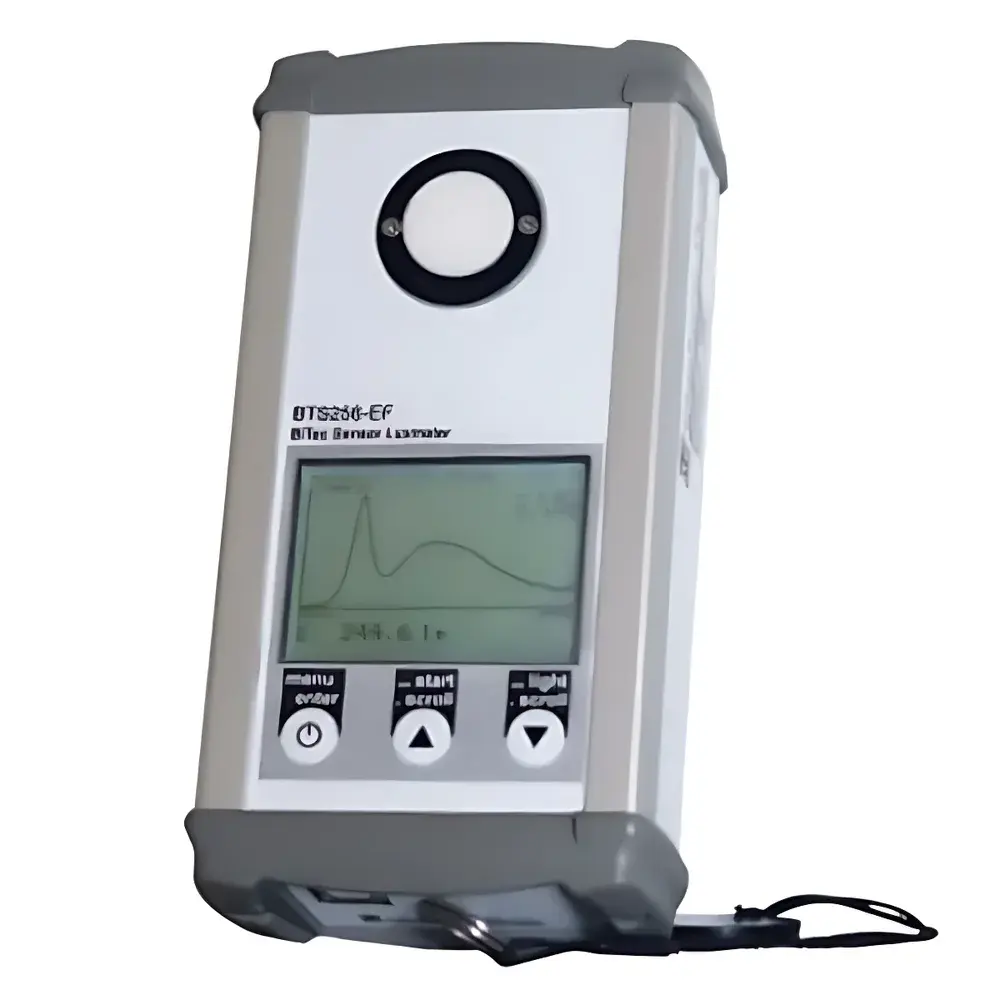
Gigahertz Optik BTS256-EF Flicker and Spectroradiometric Colorimeter
| Brand | Gigahertz Optik |
|---|---|
| Origin | Shanghai, China |
| Distributor Type | Authorized Distributor |
| Country of Manufacture | Germany (designed & calibrated in Germany |
| Model | BTS256-EF |
| Measurement Range | 1–199,999 lx (illuminance), 360–830 nm (spectral range) |
| Spectral Bandwidth | 10 nm (CIE 214-compliant adaptive optical bandwidth correction) |
| Cosine Error | ≤3% (f₂) |
| Flicker Frequency Range | 0.25 Hz – 200 kHz |
| Integration Time | 5.2–30,000 ms |
| ADC Resolution | 12-bit |
| Power Supply | 5 V DC / 450 mA via USB |
| Temperature Compensation | Integrated thermistor for photodiode and spectrometer units |
| Calibration Uncertainty | ±2.2% (luminance), f₁′ ≤3% (with spectral correction), stray light <6×10⁻⁴ (LED-specific) |
Overview
The Gigahertz Optik BTS256-EF is a high-precision, dual-sensor flicker and spectroradiometric colorimeter engineered for metrologically rigorous characterization of time-varying light sources. Unlike conventional illuminance meters or basic photometers, the BTS256-EF implements a BiTec (Bifunctional Technology) sensor architecture—comprising a V(λ)-filtered silicon photodiode and a high-stability CCD-based spectroradiometer—enabling simultaneous, traceable measurement of photometric, radiometric, chromatic, and temporal light parameters. Its core principle relies on synchronized high-speed spectral acquisition (up to 200 kHz flicker analysis) combined with real-time CIE 1931 color space computation, enabling full compliance with IEC TR 61547-1, IEEE 1789-2015, ENERGY STAR Lamps V2.1, and CIE TN 006:2022 for flicker assessment. Designed for R&D labs, lighting OEMs, and third-party test houses, the instrument delivers primary-standard-grade linearity (<0.1% deviation over 6 decades), thermal stability (active diode temperature compensation), and spectral fidelity validated against NIST-traceable reference lamps.
Key Features
- BiTec dual-sensor architecture: Independent operation and cross-calibration of V(λ) photodiode and 360–830 nm spectroradiometer ensure redundancy, extended dynamic range (1–199,999 lx), and minimized spectral mismatch error (f₁′ ≤3% with automatic correction)
- Flicker analysis up to 200 kHz: Captures PWM duty cycles, transient thermal effects, and driver-induced modulation with 5.2 ms minimum integration time and sub-millisecond timing resolution
- CIE-compliant photometry: Measures photopic, scotopic, melanopic (EML), PAR (400–700 nm), CCT (1700–17000 K), CRI (Ra + R₁–R₁₅), and TM-30 metrics—all traceable to CIE S 026/E:2018 and ISO/CIE 13370
- Adaptive spectral bandwidth correction: Real-time application of CIE 214:2022 mathematical bandpass correction ensures accurate spectral irradiance weighting across LED, OLED, and hybrid source spectra
- Low stray light performance: <6×10⁻⁴ at ±100 nm from LED peak wavelengths (blue/green/red/white), critical for narrow-band source evaluation and flicker waveform integrity
- USB-powered operation with embedded 16-bit microcontroller: Enables portable, noise-immune measurements without external power supplies; supports continuous streaming and trigger-synchronized acquisition
Sample Compatibility & Compliance
The BTS256-EF accommodates diverse lighting geometries—including downlights, linear modules, automotive headlamps, and horticultural arrays—via its 20 mm cosine-corrected diffuser (f₂ error ≤3%). It meets EMC immunity requirements per EN 61547 and supports safety-critical flicker evaluation under IEC 62471 (Photobiological Safety). All firmware and calibration data comply with FDA 21 CFR Part 11 (audit trail, electronic signature support), GLP/GMP documentation workflows, and ISO/IEC 17025 traceability frameworks. Factory calibration certificates include uncertainty budgets aligned with EURAMET cg-19 and GUM guidelines.
Software & Data Management
Controlled via Gigahertz Optik’s BTS256 Control Software (Windows/macOS/Linux), the instrument supports raw spectral data export (ASCII, CSV, JPK), flicker waveform visualization (time-domain + FFT), and automated report generation compliant with IES LM-79-19 Annex L and CIE 025/E:2015. The software implements full audit trail logging, user role management, and calibration history tracking. Raw spectral datasets are compatible with MATLAB, Python (via provided SDK), and industry tools including LightTools and TracePro for optical system validation.
Applications
- LED driver design validation: Quantification of PWM-induced flicker, current ripple coupling, and thermal drift in constant-current drivers
- Horticultural lighting certification: PAR mapping, phytochrome photostationary state (PSS) calculation, and spectral stability monitoring under thermal load
- Automotive interior/exterior lighting: ECE R149 and SAE J1383-compliant flicker testing for adaptive driving beams and cabin ambient systems
- Medical and circadian lighting R&D: Melanopic EDI (Equivalent Daylight Illuminance) and α-opic irradiance modeling per CIE S 026
- Energy efficiency labeling: Pre-compliance testing for EU Ecodesign Regulation (EU) 2019/2020 and DLC Premium v5.1 flicker thresholds
- Display backlight characterization: Temporal uniformity analysis for mini-LED and micro-LED backlit LCDs and direct-view panels
FAQ
Is the BTS256-EF calibrated to NIST-traceable standards?
Yes—each unit ships with a factory calibration certificate referencing NIST SRM 2020, 2021, and 2030, with full uncertainty budget per ISO/IEC 17025:2017.
Can it measure flicker from pulsed laser illumination?
No—the BTS256-EF is optimized for broadband incoherent sources (LEDs, fluorescents, incandescents); coherent or nanosecond-pulsed lasers require dedicated photodetector systems with GHz bandwidth.
Does it support automated pass/fail testing per IEEE 1789-2015?
Yes—software includes configurable thresholds for Percent Flicker, Flicker Index, SVM (Stroboscopic Visibility Measure), and frequency-weighted PstLM metrics with exportable compliance reports.
How often is recalibration recommended?
Annually under normal lab conditions; every 6 months for production-line QA environments or after mechanical shock exposure.
Is spectral data usable for optical simulation inputs?
Yes—exported .spc files contain absolute spectral irradiance (W/m²/nm) with CIE 1931 color matching functions applied, directly importable into Zemax, FRED, and ASAP for source modeling.





