

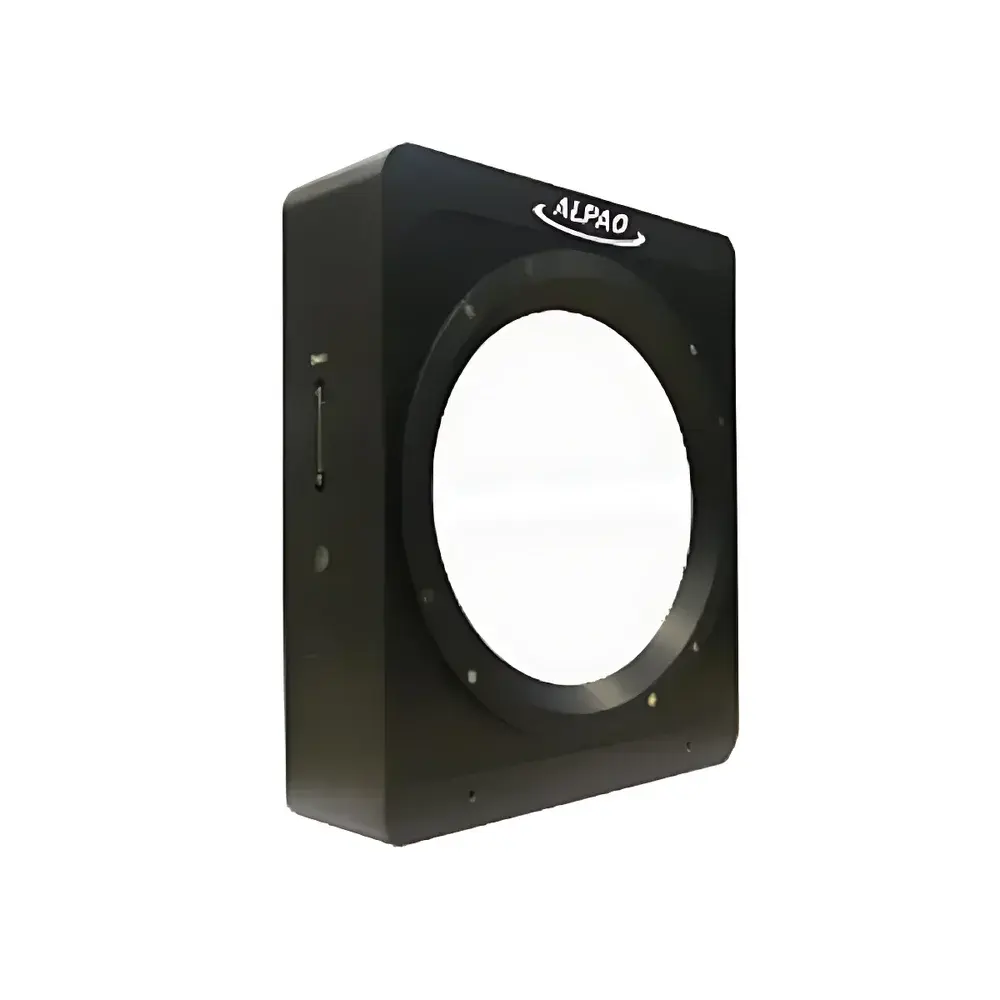
ALPAO 240 mm High-Speed Continuous Deformable Mirror
| Brand | ALPAO |
|---|---|
| Aperture | 240 mm |
| Actuation Principle | Electromagnetic |
| Surface Type | Continuous Membrane (Silicon) |
| Wavefront Stroke | > 40 µm PV (typ.) |
| Response Time | < 300 µs (full stroke) |
| Linearity | > 98% |
| Operating Wavelength Range | 250–1100 nm |
| Compliance | ISO 9001 certified manufacturing |
| Mounting Interface | Customizable kinematic flange (CF-200 or CF-250 compatible) |
| Environmental Rating | Cleanroom-compatible, vacuum-compatible (optional) |
Overview
The ALPAO 240 mm High-Speed Continuous Deformable Mirror is an engineered adaptive optics component designed for precision wavefront correction in demanding scientific and industrial applications. Based on a monolithic silicon continuous membrane actuated by an array of electromagnetic drivers, this mirror delivers high-fidelity, real-time phase modulation with exceptional linearity and repeatability. Its operational principle relies on Lorentz-force-driven displacement: current applied to embedded copper coils interacts with permanent magnetic fields to induce controlled, sub-millisecond deformation of the reflective surface. This architecture avoids hysteresis and creep inherent in piezoelectric or electrostatic alternatives—critical for closed-loop stability in high-bandwidth adaptive optics systems. The 240 mm clear aperture supports large-beam wavefront control in astronomical telescope secondary mirrors, high-NA multiphoton microscopy beam shaping, and atmospheric turbulence compensation in free-space optical links. Designed and manufactured in Grenoble, France, the device complies with ISO 9001 quality management standards and is routinely integrated into systems requiring GLP-aligned calibration traceability.
Key Features
- 240 mm clear optical aperture with λ/20 surface flatness (RMS) pre-deformation
- Electromagnetic actuation enabling > 98% static linearity and negligible hysteresis
- Full-stroke response time < 300 µs, supporting closed-loop bandwidths up to 3.3 kHz
- Wavefront stroke exceeding 40 µm peak-to-valley (PV) for high-order Zernike mode correction
- UV–NIR spectral range coverage (250–1100 nm) with customizable dielectric coatings
- Vacuum-compatible construction (optional bake-out rated to 80 °C) and cleanroom-assembled
- Kinematic mounting interface compliant with standard CF-200 or CF-250 flanges
Sample Compatibility & Compliance
The ALPAO 240 mm deformable mirror is compatible with collimated or mildly convergent beams (f-number ≥ 4). It interfaces seamlessly with Shack–Hartmann and pyramid wavefront sensors, including EMCCD-based systems operating at >1 kHz frame rates. All units undergo factory calibration using interferometric metrology traceable to national standards (LNE, France), with full Zernike coefficient matrices and actuator coupling maps delivered per unit. The system meets mechanical and electrical safety requirements per IEC 61000-6-2/6-4 and is RoHS-compliant. For regulated environments—including clinical ophthalmic instrumentation and semiconductor metrology tools—the mirror’s deterministic behavior and absence of outgassing materials support compliance with ISO 13485 and SEMI F20 guidelines.
Software & Data Management
ALPAO provides the DMC (Deformable Mirror Controller) software suite, compatible with Windows and Linux platforms, offering real-time command-and-control via TCP/IP or PCIe interface. The API supports integration into LabVIEW, MATLAB, Python (via ctypes), and C/C++ environments. All control signals are timestamped with microsecond resolution, enabling synchronization with external acquisition hardware. Audit trails, configuration versioning, and user-access logging are implemented in accordance with FDA 21 CFR Part 11 requirements when deployed in GxP workflows. Firmware updates preserve calibration integrity through non-volatile parameter storage and automatic reinitialization of actuator gain matrices.
Applications
- Astronomy: Secondary mirror replacement in 4–8 m class telescopes; MCAO (multi-conjugate AO) systems for ESO VLT and ELT pathfinder instruments
- Biomedical imaging: Aberration correction in two-photon and three-photon fluorescence microscopy, especially for deep-tissue brain imaging in vivo
- Ophthalmology: Dynamic correction of higher-order aberrations in confocal scanning laser ophthalmoscopy (cSLO) and adaptive optics OCT
- Free-space optical communications: Real-time atmospheric scintillation mitigation in ground-to-satellite and inter-satellite links
- Semiconductor lithography: Wavefront stabilization in EUV and DUV metrology tools for mask inspection and wafer alignment
- Ultrafast laser physics: Pulse front tilt correction and spatial mode cleaning in CPA and OPCPA systems
FAQ
What is the maximum achievable closed-loop bandwidth with this mirror?
Closed-loop bandwidth depends on sensor latency and control algorithm efficiency; typical operation achieves 1–2.5 kHz with EMCCD-based wavefront sensors and optimized matrix-vector multiplication on FPGA or GPU platforms.
Is vacuum operation supported without modification?
Standard units are cleanroom-assembled and compatible with UHV environments (<10⁻⁶ mbar); optional vacuum-rated versions include low-outgassing adhesives and extended bake-out certification.
Can the mirror be customized for non-standard coatings or mounts?
Yes—ALPAO offers custom AR/HR coatings across UV–MIR ranges and mechanical interfaces tailored to OEM integration, subject to minimum order quantities and lead time validation.
How is calibration data delivered and maintained?
Each unit ships with a calibrated actuator influence function (AIF) matrix, Zernike decomposition coefficients, and thermal drift characterization report; recalibration services are available through ALPAO’s Grenoble facility.
Does the system support deterministic wavefront reconstruction protocols?
Yes—the DMC controller implements singular-value decomposition (SVD)-based modal control and supports direct slope-to-command mapping for Shack–Hartmann sensors, ensuring reproducible, physics-based correction strategies.





