
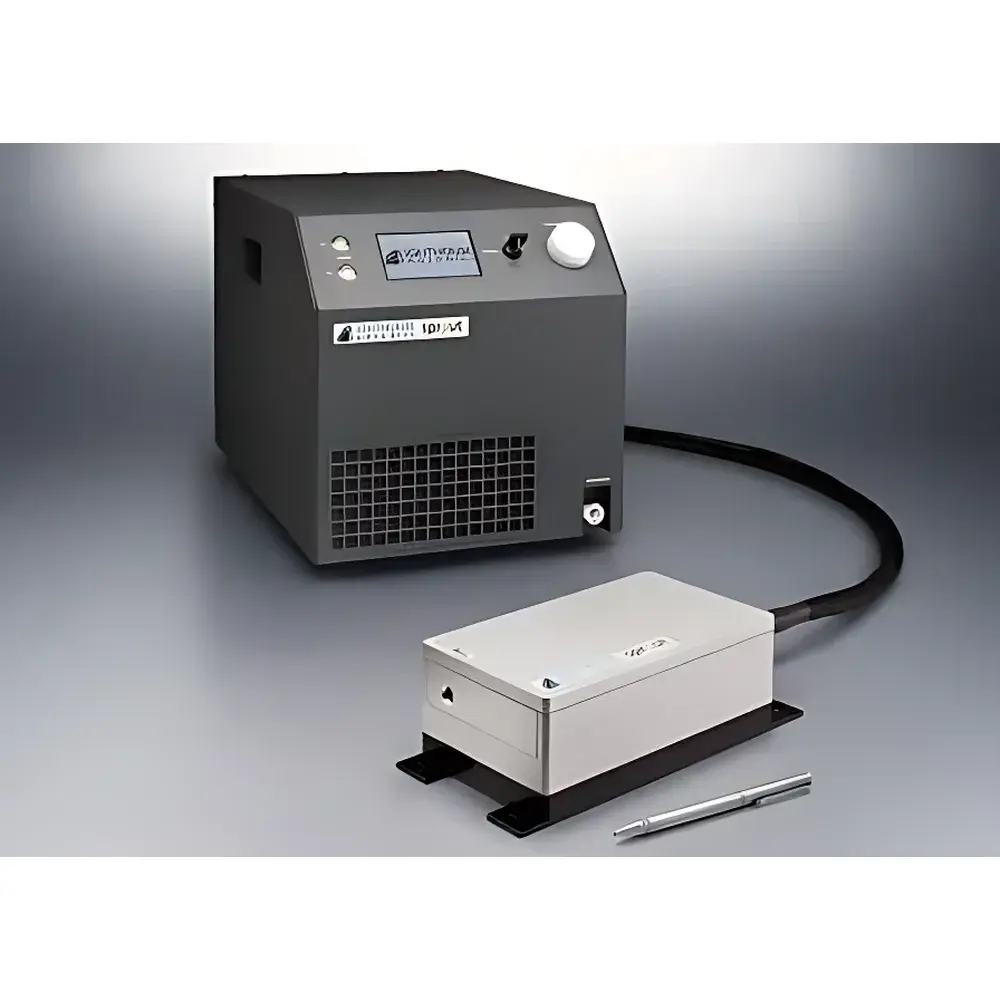
Lighthouse Photonics Sprout-H Series 532 nm High-Power Diode-Pumped Solid-State (DPSS) Laser
| Brand | Lighthouse Photonics |
|---|---|
| Model | Sprout-H |
| Wavelength | 532 nm |
| Output Power Options | 5–20 W (selectable in 1 W increments: 5, 6, 8, 10, 12, 15, 18, 20 W) |
| Beam Mode | TEM₀₀ |
| Beam Quality (M²) | 1.0–1.1 |
| Spectral Purity | >99.9% |
| Polarization Ratio | >100:1 (vertical standard |
| Beam Diameter | 2.3 mm ±10% |
| Beam Divergence | <0.5 mrad |
| Pointing Stability | ≤2 µrad/°C |
| Power Stability | <±0.25% RMS (24 h, closed-loop) |
| Intensity Noise | Standard: <0.1% RMS |
| Low-Noise (NET) Version | <0.02% RMS |
| Cooling | Integrated TEC-based chiller in power supply unit |
| Control Interfaces | USB, RS-232, Ethernet |
| Pump Source Lifetime | >50,000 h |
| Enclosure | Hermetically sealed laser head with Seal™ and Lock™ technologies |
| Cable | Detachable 3 m flexible control cable |
| Compliance | Designed for ISO 13847-compliant optical alignment environments |
Overview
The Lighthouse Photonics Sprout-H Series is a high-power, continuous-wave (CW), diode-pumped solid-state (DPSS) laser engineered for demanding scientific and industrial applications requiring stable, spectrally pure 532 nm green light. Operating on the fundamental frequency of a Nd:YVO₄ crystal intracavity-doubled by a nonlinear KTP crystal, the Sprout-H delivers diffraction-limited TEM₀₀ output with exceptional spatial coherence and minimal wavefront distortion. Its monolithic, three-dimensional mechanical architecture integrates the laser resonator, harmonic generation stage, and beam conditioning optics into a single compact, rigid housing—eliminating sensitivity to thermal drift and mechanical perturbation. The system is designed for turnkey deployment in environments where long-term reliability, ultra-low amplitude noise, and maintenance-free operation are critical, including pump-probe spectroscopy, ultrafast amplifier seeding, and precision metrology.
Key Features
- Hermetic Seal™ encapsulation isolates internal optics from ambient particulates, humidity, and hydrocarbon contamination—enabling >50,000-hour operational life without cleaning or realignment.
- Lock™ optical mounting technology permanently fixes all critical cavity components, ensuring lifelong beam pointing stability (<2 µrad/°C) and collimation integrity.
- Integrated thermoelectric cooler (TEC)-based chiller housed within the power supply eliminates external chillers, reduces footprint, and improves thermal management repeatability.
- Low-noise electronic architecture achieves <0.02% RMS intensity noise (NET version), meeting stringent requirements for interferometric sensing and quantum optics experiments.
- Fiber-coupled pump diodes decouple thermal load from the laser head, enhancing mechanical stability and reducing thermal lensing effects.
- Full digital control suite via USB, RS-232, and Ethernet enables remote monitoring, closed-loop power regulation, firmware updates, and diagnostic logging compliant with FDA 21 CFR Part 11 audit trails.
Sample Compatibility & Compliance
The Sprout-H is compatible with a wide range of optical components and experimental configurations—including fiber coupling (with optional mode-matching optics), free-space beam delivery, and integration into OEM laser systems. Its high spectral purity (>99.9%) and polarization extinction ratio (>100:1) ensure compatibility with polarizing beam splitters, electro-optic modulators, and nonlinear frequency conversion stages. The system adheres to IEC 60825-1:2014 Class 4 laser safety standards and incorporates interlock circuits, emission indicators, and key-switched enable logic. For regulated laboratories, its deterministic control interface supports GLP/GMP documentation workflows, including timestamped parameter logs, user-access authentication, and tamper-evident configuration history.
Software & Data Management
The Sprout-H ships with Lighthouse’s proprietary LaserControl Suite—a cross-platform application supporting real-time power monitoring, setpoint ramping, temperature profiling, and noise spectrum analysis. All communication follows a documented ASCII command protocol over serial or TCP/IP, enabling seamless integration into LabVIEW, Python (PySerial/Socket), MATLAB, or custom SCADA environments. Data export supports CSV and HDF5 formats, with metadata tagging for wavelength, power, date/time, operator ID, and environmental sensor readings (optional integrated thermistor/hygrometer). Firmware updates retain full backward compatibility and include cryptographic signature verification to meet cybersecurity best practices for research infrastructure.
Applications
- Pumping Ti:sapphire and dye lasers in ultrafast oscillator and amplifier systems.
- Seeding optical parametric amplifiers (OPAs) and optical parametric oscillators (OPOs) requiring narrow linewidth and low phase noise.
- Particle image velocimetry (PIV) and laser-induced fluorescence (LIF) in fluid dynamics research.
- Flow cytometry illumination where beam uniformity, stability, and low pulse-to-pulse jitter are essential for accurate cell classification.
- Raman spectroscopy excitation sources benefiting from high spectral purity and minimal spontaneous emission background.
- OEM integration into analytical instrumentation, such as confocal microscopes and semiconductor inspection tools, where space-constrained, air-cooled green lasers are preferred.
FAQ
What cooling method does the Sprout-H use?
The Sprout-H employs an integrated thermoelectric cooler (TEC)-based chiller housed entirely within the power supply unit—no external water chiller required.
Is the laser head separable from the power supply?
Yes—the laser head connects to the power supply via a detachable, flexible 3-meter control cable, enabling spatially distributed system layouts.
Can polarization orientation be customized?
Standard configuration provides vertical linear polarization; horizontal polarization is available as a factory-configured option.
Does the system support automated power stabilization?
Yes—closed-loop analog and digital power regulation maintains output within ±0.25% RMS over 24 hours, with user-selectable setpoints and ramp profiles.
How is long-term alignment stability ensured?
Through Lock™ optical mounting and Seal™ hermetic packaging—both proprietary mechanical design principles validated over >15 years of field deployment across academic and industrial labs.
What regulatory documentation is provided?
Each unit ships with CE/UKCA declarations of conformity, IEC 60825-1 laser safety reports, RoHS compliance certificates, and a traceable calibration record per ISO/IEC 17025-accredited process.






