
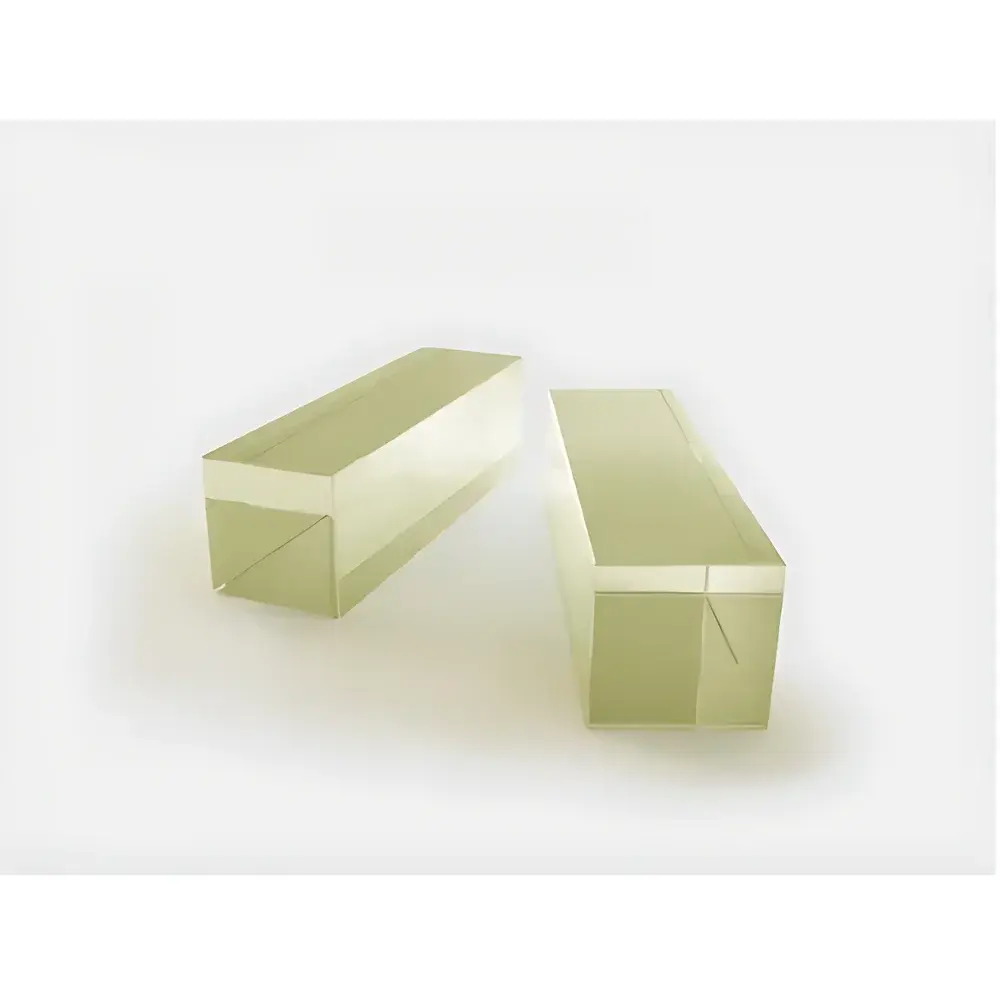
Auniontech SBN Crystal (Strontium Barium Niobate)
| Brand | Auniontech |
|---|---|
| Origin | Imported |
| Manufacturer Type | Authorized Distributor |
| Model | SBN |
| Crystal Composition | Strontium Barium Niobate (SrₓBa₁₋ₓNb₂O₆, x = 0.60, 0.61, or 0.75) |
| Doping Options | Ce, Cr, Co, Fe |
| Poling | Available upon request |
| Optical Homogeneity | High (no growth striations, inclusions, or refractive index inhomogeneities) |
| Application Domain | Photorefractive, electro-optic, acousto-optic, pyroelectric, and holographic applications |
Overview
The Auniontech SBN Crystal (Strontium Barium Niobate, SrxBa1−xNb2O6) is a high-performance, stoichiometrically tunable photorefractive ferroelectric oxide crystal engineered for precision nonlinear optical applications. Its inherent non-centrosymmetric structure enables strong electro-optic (Pockels), acousto-optic, pyroelectric, and photorefractive responses—making it a foundational material for dynamic holography, real-time interferometry, phase conjugation, and adaptive optical signal processing. Unlike conventional linear optical components, SBN operates via light-induced charge redistribution and subsequent space-charge field formation, resulting in reversible refractive index modulation (Δn ~ 10−3–10−2) under low-intensity coherent illumination (e.g., He–Ne or diode lasers). The crystal’s wide transparency window (400–5000 nm), high optical damage threshold (>1 GW/cm² for ns pulses), and large electro-optic coefficients (r33 ≈ 100–150 pm/V depending on composition and doping) support robust operation in both CW and pulsed regimes across visible and near-infrared spectral bands.
Key Features
- Available compositions: SBN:60 (x = 0.60), SBN:61 (x = 0.61), and SBN:75 (x = 0.75), each optimized for distinct Curie temperature (TC ≈ 50–115 °C), photorefractive sensitivity, and domain stability
- Doping variants with Ce, Cr, Co, or Fe to enhance photoconductivity, response speed, or dark conductivity control—enabling tailored temporal dynamics for holographic storage or real-time correction
- Optically homogeneous bulk growth using high-precision Czochralski or flux methods; verified by Nomarski differential interference contrast (DIC) microscopy and laser scatter mapping
- Customizable crystal orientation (e.g., c-cut, a-cut, or b-cut) and surface finish (λ/10 flatness, super-polished AR-coated faces available)
- Optional electric-field poling (up to ±8 kV/mm) for domain engineering, enabling quasi-phase-matching configurations in second-harmonic generation (SHG) or electro-optic modulation setups
- Compliant with ISO 10110-7 (optical element surface quality) and MIL-PRF-13830B (scratch-dig specification) for critical-path optical systems
Sample Compatibility & Compliance
SBN crystals are supplied as polished wafers or prisms (standard thicknesses: 1–5 mm; custom dimensions up to 20 × 20 mm) with parallelism ≤3 arcsec and surface quality ≤20–10 scratch-dig. All materials undergo full traceability documentation, including batch-specific refractive index dispersion data (Sellmeier coefficients), Curie temperature verification, and photorefractive gain coefficient (Γ) characterization at 633 nm. Crystals meet EU RoHS Directive 2011/65/EU compliance for restricted substances and are certified for use in Class I laser safety environments per IEC 60825-1. For regulated research environments—including GLP-compliant optical metrology labs and FDA-regulated biophotonics instrumentation—SBN batches include full material certification (CoC) and optional audit-ready manufacturing records.
Software & Data Management
While SBN is a passive optical component, its integration into automated optical systems benefits from compatibility with industry-standard control frameworks. Users deploying SBN in closed-loop holographic interferometers or adaptive optics testbeds may interface via LabVIEW™ (NI-DAQmx drivers), MATLAB® (Instrument Control Toolbox), or Python (PyVISA, NumPy) for synchronized actuation of bias fields, temperature stabilization (via integrated Peltier mounts), and real-time diffraction efficiency monitoring. Auniontech provides application notes detailing calibration procedures for quantitative phase shift measurement (e.g., using Mach–Zehnder or Sagnac interferometric readout), along with uncertainty budgets aligned with ISO/IEC 17025 requirements for metrological traceability.
Applications
- Dynamic holographic recording and reconstruction for vibration analysis, non-destructive testing (NDT), and optical encryption
- Self-pumped and doubly pumped phase-conjugate mirrors (PCMs) in resonator stabilization and aberration compensation
- High-speed electro-optic modulators and Q-switches operating at MHz bandwidths in Ti:sapphire and fiber laser systems
- Pyroelectric detectors for mid-IR radiation sensing (3–5 µm and 8–12 µm atmospheric windows), leveraging SBN’s large pyroelectric coefficient (p ≈ 3.5 × 10⁻⁴ C/m²·K)
- Photorefractive beam coupling and two-wave mixing for optical amplification and image processing in analog photonic computing architectures
FAQ
What is the typical Curie temperature range for SBN:60 vs. SBN:75?
SBN:60 exhibits a Curie temperature of approximately 50–60 °C, while SBN:75 reaches 105–115 °C—directly influencing operational thermal stability and domain retention in high-power or ambient-variable environments.
Can SBN crystals be AR-coated for specific wavelengths?
Yes—single-layer or broadband MgF₂/TiO₂-based coatings are available for 532 nm, 633 nm, 780 nm, 1064 nm, and 1550 nm bands, with residual reflectivity 500 MW/cm² (10 ns, 10 Hz).
Is poling required for all photorefractive applications?
No—native photorefractivity occurs without external poling; however, controlled poling enhances uniformity of space-charge fields and enables deterministic domain patterning for quasi-phase-matched nonlinear interactions.
How is crystal orientation specified for optimal electro-optic performance?
For maximum r33 utilization, c-cut wafers with electrodes deposited on ±c-faces are recommended; for transverse EO modulation, a-cut geometry with lateral field application is standard.
Do you provide mounting solutions or temperature-controlled holders?
Yes—custom kinematic mounts with integrated Pt100 sensors and PID-controlled Peltier stages (±0.1 °C stability) are available for long-duration holographic experiments requiring thermal drift suppression.




