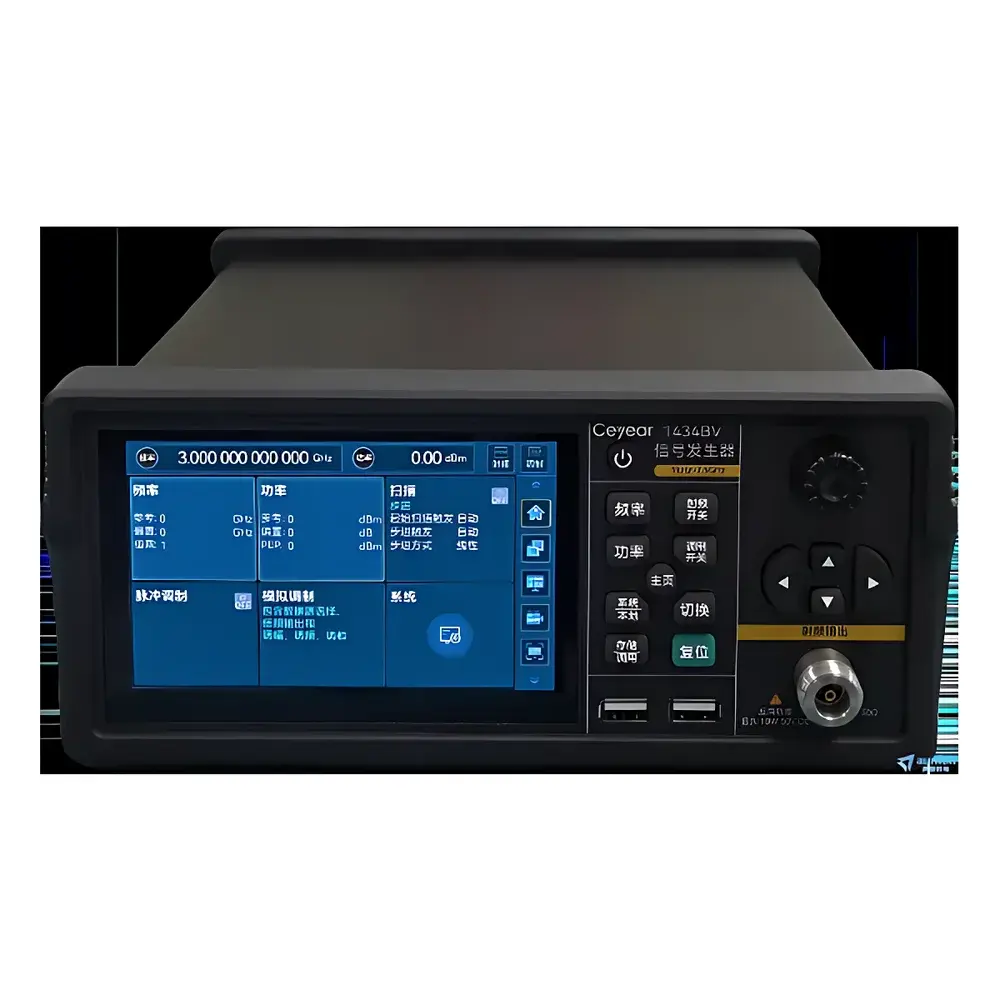
Auniontech VSG-3G/6G/7.5G Economic Vector Signal Generator
| Brand | Auniontech |
|---|---|
| Origin | Shanghai, China |
| Model | VSG-3G/6G/7.5G Economic Vector Signal Generator |
| Frequency Range | 9 kHz to 3 GHz / 6 GHz / 7.5 GHz |
| Max Modulation Bandwidth | 240 MHz |
| Output Power Range | –120 dBm to +25 dBm |
| EVM | 0.5% (5G NR @ 3.5 GHz) |
| ACLR | –55 dBc (5G NR @ 3.5 GHz) |
| Standard Digital Modulations | >30 formats including BPSK, QPSK, 16–4096QAM, FSK, MSK, APSK, OQPSK, π/4-DQPSK, 8PSK |
| Supported Protocols | 5G NR (FR1), LTE, WCDMA, GSM, WLAN (802.11a/b/g/n/ac/ax), Bluetooth 5.x, LoRa |
| Interface | USB 2.0, 10/100/1000BASE-T LAN |
| Form Factor | 2U (88.9 mm H × 482.6 mm W × 380 mm D), 4 kg |
| Compliance | SCPI 1999 compliant, IEEE 488.2, USBTMC, LXI Class C |
Overview
The Auniontech VSG-3G/6G/7.5G Economic Vector Signal Generator is a high-performance, cost-optimized RF instrumentation platform engineered for precision vector modulation synthesis across communications R&D, production test, academic research, and industrial validation environments. Based on direct digital synthesis (DDS) and high-speed IQ upconversion architecture, it delivers stable, low-phase-noise carrier generation from 9 kHz to 7.5 GHz with full vector modulation capability. Its core design emphasizes reproducible spectral fidelity, calibrated amplitude linearity, and deterministic timing alignment—critical for validating transceiver performance against 3GPP-defined conformance requirements (e.g., TS 38.141-1 for 5G NR base station testing). Unlike arbitrary waveform-based signal sources, this generator employs real-time digital modulation engines to synthesize standards-compliant waveforms without waveform file loading latency, enabling rapid parametric sweeps and production-line throughput optimization.
Key Features
- Three frequency variants: 3 GHz, 6 GHz, and 7.5 GHz maximum carrier frequency—selectable at point of order to match application-specific spectrum coverage needs.
- 240 MHz instantaneous modulation bandwidth (configurable down to 120 MHz), supporting wideband 5G NR FR1 (100 MHz channel), IEEE 802.11ax (160 MHz), and multi-carrier LTE-A Pro deployments.
- Output power range from –120 dBm to +25 dBm with < ±0.5 dB absolute accuracy (calibrated, 25 °C, after internal power sensor compensation), achieved via a high-reliability solid-state electronic attenuator stage.
- Vector modulation error vector magnitude (EVM) of ≤0.5% measured under 5G NR FR1 conditions (100 MHz bandwidth, 256-QAM, 30 kHz subcarrier spacing, 3.5 GHz carrier), verified per 3GPP TR 38.803 methodology.
- Adjacent channel leakage ratio (ACLR) of ≤–55 dBc for 5G NR signals (same configuration), meeting baseline transmitter linearity requirements for base station and UE component validation.
- Built-in real-time modulator supports over 30 standardized digital modulation schemes—including BPSK, QPSK variants (OQPSK, π/4-DQPSK), 16–4096-QAM, 2–64-FSK, 16/32-APSK, MSK, and custom IQ data playback—without external waveform files.
- Integrated reverse-power protection rated to DC–50 V and AC 50 W (1 GHz), safeguarding the RF output stage during mismatched load or accidental DC injection scenarios.
- Remote control via SCPI-compliant USBTMC and LAN (LXI Class C) interfaces; includes embedded web server for browser-based instrument configuration and status monitoring.
- SCPI command recording utility generates ready-to-compile code examples in Qt, C#, and C++—accelerating automated test system integration and reducing driver development effort.
- Compact 2U (88.9 mm height) 19-inch rack-mount form factor; dual units fit side-by-side in standard cabinets; total mass ≤4 kg for lab mobility and benchtop deployment.
Sample Compatibility & Compliance
The VSG-3G/6G/7.5G is designed for interoperability with industry-standard RF test ecosystems. It natively accepts calibration data from third-party USB power sensors (e.g., Keysight U2000 series, Rohde & Schwarz NRP series) to perform on-the-fly output power flatness correction across its full frequency band. Its firmware implements full IEEE 488.2 and SCPI 1999 command sets, ensuring compatibility with legacy ATE platforms and modern Python/LabVIEW-based test sequences. While not certified to ISO/IEC 17025 or FDA 21 CFR Part 11 out-of-box, the device supports audit-ready operation when deployed within validated test procedures: all SCPI commands are logged via optional remote syslog, and firmware version, calibration date, and user ID can be programmatically queried for GLP/GMP traceability. It meets CE marking requirements for EMC (EN 61326-1) and safety (EN 61010-1), and operates reliably within ambient temperatures of 0–40 °C and relative humidity ≤80% non-condensing.
Software & Data Management
Auniontech provides a cross-platform signal simulation suite compatible with Windows, Linux, and macOS. This software enables protocol-aware waveform generation for 5G NR (Release 15/16), LTE Release 10–16, WCDMA R99–HSPA+, GSM/EDGE, IEEE 802.11a/b/g/n/ac/ax, Bluetooth LE 5.0–5.3, and LoRaWAN PHY layers. Waveforms are generated in real time and streamed directly to the instrument’s baseband engine—eliminating disk I/O bottlenecks and supporting dynamic parameter changes during playback (e.g., TDD frame structure switching, adaptive MCS selection). The software exports metadata-rich .vsgcfg project files containing full modulation parameters, timing markers, and calibration offsets. For automated test environments, the instrument supports raw IQ binary upload via TCP socket or USB bulk transfer, with configurable sample rate (up to 480 MSa/s) and bit depth (16-bit signed integer). All firmware updates are delivered as signed binaries with SHA-256 checksums to ensure integrity.
Applications
- 5G NR FR1 transceiver characterization: ACLR, EVM, spectral emission mask (SEM), and spurious emissions testing per 3GPP TS 38.141-1.
- LTE eNodeB and UE RF conformance: TM1/3/4 signal generation for receiver sensitivity, blocking, and intermodulation tests.
- Wi-Fi 6/6E chipset validation: OFDMA resource unit (RU) mapping, MU-MIMO pilot tone generation, and HE-SIG field synthesis.
- Bluetooth LE PHY layer verification: Coded PHY (S=2/S=8), advertising channel hopping, and connection event timing compliance.
- Radar and EW system stimulus: chirp-based FMCW signals, pulsed LFM waveforms, and phase-coded sequences using arbitrary IQ mode.
- Academic wireless research: prototyping novel modulation schemes, MIMO channel emulation input, and real-time SDR co-simulation (e.g., with GNU Radio or MATLAB).
- Production line burn-in and functional test: high-throughput pass/fail evaluation of PA linearity, filter group delay, and synthesizer lock time.
FAQ
What frequency options are available, and how do I select one?
The VSG series offers three fixed upper-frequency limits: 3 GHz, 6 GHz, and 7.5 GHz. Selection is made at time of order; hardware is factory-configured and not field-upgradeable.
Does the instrument support external clock reference inputs?
Yes—it accepts 10 MHz sine or TTL-level reference signals via a dedicated BNC connector, enabling phase-coherent multi-instrument synchronization.
Can I perform power calibration without an external power meter?
No. Internal power sensing is used only for closed-loop attenuation control. Full power flatness calibration requires connection to a compatible USB power sensor.
Is firmware upgrade supported over LAN?
Yes. Firmware updates are performed via HTTP POST upload through the embedded web interface or programmatically using cURL or Python requests.
What is the minimum guaranteed modulation update rate for real-time QAM reconfiguration?
The baseband engine supports symbol-rate updates ≥10 kHz with sub-microsecond latency, sufficient for dynamic link adaptation in 5G NR TDD configurations.
Related Products