
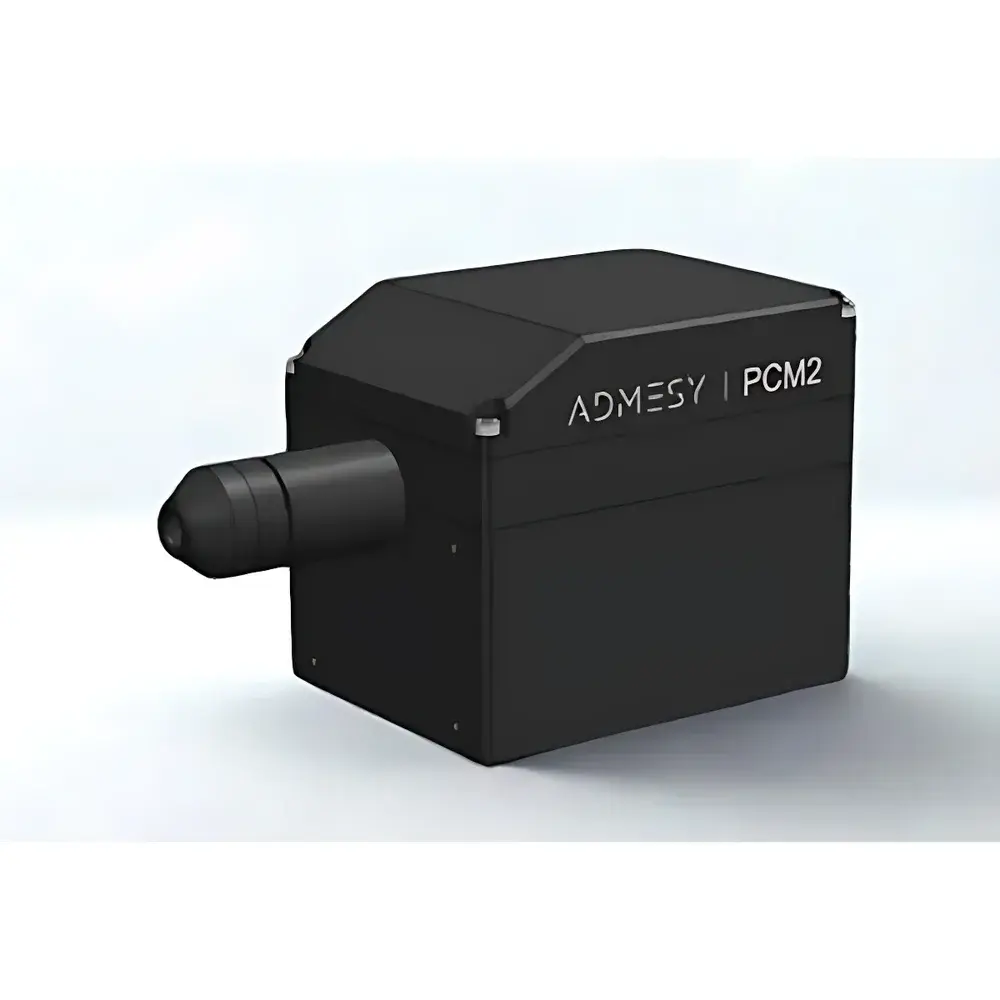
Admesy PCM2-051 Colorimeter
| Brand | Admesy |
|---|---|
| Origin | Shanghai, China |
| Manufacturer Type | Authorized Distributor |
| Country of Origin | China |
| Model | PCM2-051 |
| Brightness Range | 0.0003–15,000 cd/m² (UHL mode up to 95,000 cd/m²) |
| Chromaticity Range | 0.003–15,000 cd/m² |
| Measurement Spot Size | 5 mm (at 5 mm working distance ±2 mm) |
| Field of View | ±6° |
| Sampling Rate | 2000 / 3000 / 3125 Hz |
| CIE Standard Observer | 2° CIE 1931 & CIE 170-2:2015 |
| Flicker Calculation | Internal JEITA-compliant (custom algorithms supported) |
| Shutter | Mechanical, USB-MTC compliant |
| OS Compatibility | Windows, Linux, macOS |
| Software Integration | VISA-compatible for LabVIEW, LabWindows/CVI, Visual Studio |
Overview
The Admesy PCM2-051 Colorimeter is a high-precision photometric and colorimetric instrument engineered for rapid, repeatable characterization of emissive displays—including OLED, microLED, LCD, and AMOLED panels—during production calibration, R&D validation, and quality assurance testing. It operates on the principle of spectral-filtered photometry, utilizing calibrated silicon photodiodes with CIE 1931 2° standard observer spectral response curves (and extended support for CIE 170-2:2015), enabling traceable luminance (Y) and chromaticity (x, y or u′, v′) measurements in accordance with ISO/CIE metrological guidelines. Its optical architecture features a fixed 5 mm measurement spot size at a nominal 5 mm working distance, optimized for contactless, non-invasive evaluation of pixel-level uniformity and grayscale tracking without requiring spatial scanning. The device’s compact form factor (85 × 55 × 45 mm) and low thermal drift design ensure stable operation in automated test environments, including inline display manufacturing cells and environmental chambers.
Key Features
- Sub-second measurement cycle: Full tristimulus output delivered in ≤1 s across full dynamic range
- Ultra-low luminance detection limit of 0.0003 cd/m², supporting HDR and dark-state verification protocols
- Extended high-luminance (UHL) mode enabling reliable measurement up to 95,000 cd/m²—critical for next-generation automotive and outdoor signage displays
- Integrated mechanical shutter compliant with USB-MTC (Measurement Test Class) standards, ensuring precise exposure timing and eliminating ambient light contamination
- Triple selectable sampling rates (2000 / 3000 / 3125 Hz) for synchronized flicker analysis per JEITA CP-1500a and IEC TR 62778
- Onboard MCU executing real-time flicker metrics (FMA, SVM, Percent Flicker) with configurable weighting functions and temporal windowing
- Auto-ranging photometric gain control maintaining <±2% linearity across six orders of magnitude
Sample Compatibility & Compliance
The PCM2-051 is designed for direct, non-contact measurement of planar emissive surfaces with minimal geometric constraints. Its ±6° acceptance angle and 5 mm spot geometry accommodate curved displays (R ≥ 100 mm) and tilted viewing conditions typical in automotive HUD and VR/AR near-eye testing. Calibration is NIST-traceable and certified per ISO 11664-4:2019 (colorimetry) and CIE Publication 170-2:2015 (display metrology). The instrument meets CE marking requirements for electromagnetic compatibility (EN 61326-1) and safety (EN 61010-1). Firmware and data logging workflows support audit-ready documentation aligned with GLP and ISO/IEC 17025 laboratory accreditation frameworks. Mechanical shutter actuation and timestamped metadata generation comply with FDA 21 CFR Part 11 electronic record integrity requirements when used with validated host software.
Software & Data Management
The PCM2-051 communicates via high-speed USB 2.0 using SCPI-over-VISA protocol, enabling native integration into industrial automation platforms and scientific programming environments. Official drivers and example code are provided for LabVIEW (2015+), LabWindows/CVI, and Microsoft Visual Studio (.NET Framework 4.7.2+). Raw photodiode signals, corrected XYZ values, and derived metrics (ΔE₀₀, CCT, dominant wavelength, flicker index) are streamed in real time or logged to CSV/JSON with millisecond-resolution timestamps. Optional Admesy SpectraSuite software provides GUI-based configuration, multi-sensor synchronization, pass/fail threshold mapping, and automated report generation compliant with IPC-A-630 and ISO 9241-307 display evaluation standards. All firmware updates and calibration certificates are digitally signed and version-controlled.
Applications
- Display factory line calibration: White point alignment, gamma curve verification, and uniformity mapping for TFT, OLED, and QD-LCD modules
- R&D characterization of emissive materials: Quantum dot efficiency, phosphor decay kinetics, and microLED binning under pulsed drive conditions
- Automotive HMI validation: Sunlight-readable brightness verification, viewing angle dependency analysis, and flicker assessment per UNECE R121
- Medical display QA: DICOM GSDF compliance checking and luminance stability monitoring over 8-hour thermal soak cycles
- AR/VR waveguide testing: Exit pupil luminance profiling and chromatic aberration quantification at defined eyebox positions
FAQ
What is the minimum measurable luminance level, and under what conditions is it achieved?
The specified lower limit of 0.0003 cd/m² is guaranteed under controlled ambient conditions (dark room, <0.01 lux), using the mechanical shutter and longest integration time setting. Achievable sensitivity depends on surface emissivity and spectral power distribution.
Does the PCM2-051 support CIE 10-degree observer or custom color matching functions?
No—the device implements only the CIE 1931 2° standard observer and CIE 170-2:2015 observer model. Custom CMFs require post-processing of raw spectral responsivity data, which is not accessible via standard interface.
Can multiple PCM2-051 units be synchronized for spatially distributed measurements?
Yes—via external trigger input (TTL) and shared system clock reference, enabling sub-millisecond inter-unit timing alignment for array-based uniformity analysis.
Is calibration certificate included, and how often is recalibration recommended?
Each unit ships with a factory calibration certificate traceable to NIST SRM 2242. Admesy recommends annual recalibration or after any mechanical shock exceeding 50 g; optional on-site recalibration services are available through authorized partners.
How is flicker data processed—onboard or externally?
All JEITA-compliant flicker calculations (including SVM and FMA) are executed onboard by the integrated MCU. Raw time-series photodiode data can also be streamed externally for custom algorithm development.





