
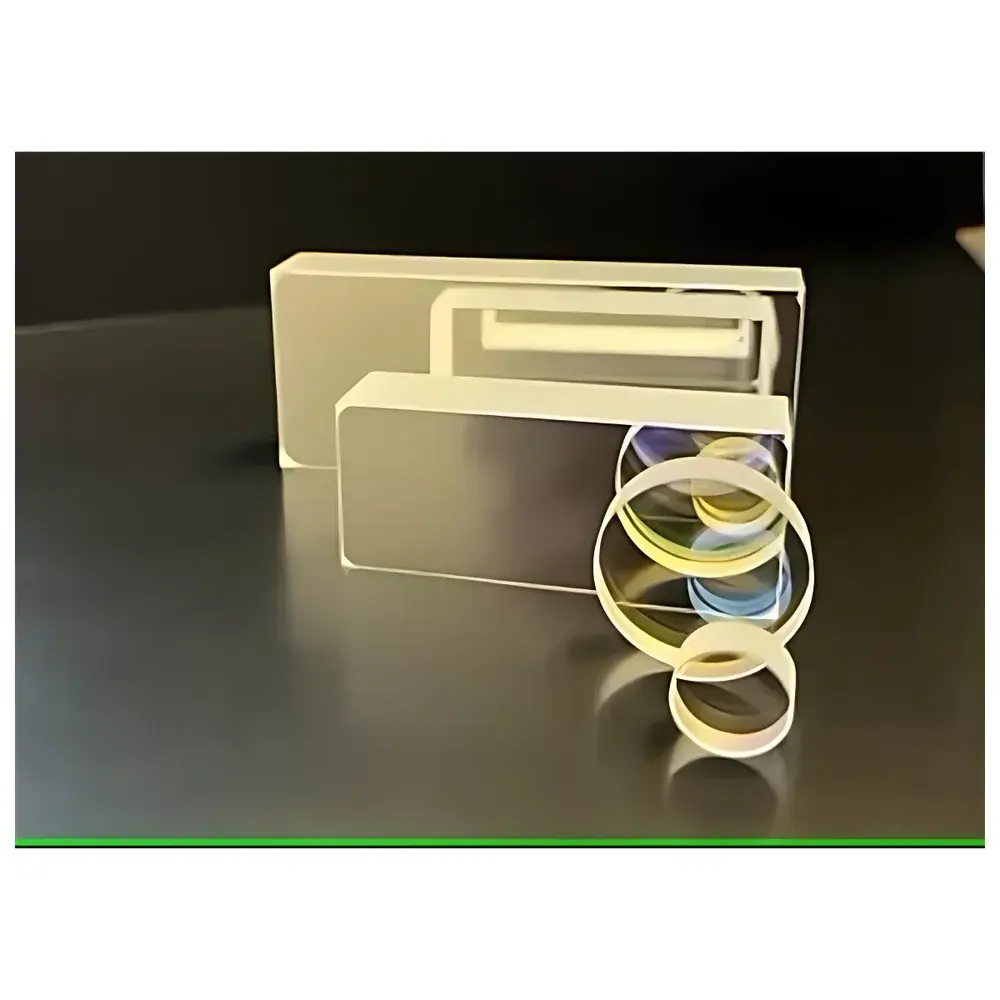
Auniontech Ultrafast Chirped Mirrors
| Brand | Auniontech |
|---|---|
| Substrate Material | Fused Silica |
| Center Wavelengths | 266 nm, 515 nm, 800 nm, 1030 nm, 1450 nm |
| GDD Range | −30 fs² to −500 fs² |
| Reflectance (HR) | >99.0%–99.95% across specified bands |
| Surface Flatness | λ/10 @ 533 nm |
| Surface Quality | 10–5 Scratch-Dig |
| Clear Aperture | >85% |
| Wedge | <5 arcmin |
| Incident Angles | 0°–20° (model-dependent) |
| Available Sizes | Ø1/2″ to 85×35 mm |
| Pairing Options | Yes (for matched dispersion compensation) |
Overview
Auniontech Ultrafast Chirped Mirrors are precision-engineered dielectric mirrors designed for dispersion control and pulse compression in ultrafast laser systems. Based on the principle of controlled group delay dispersion (GDD) via chirped multilayer thin-film architecture, these mirrors introduce wavelength-dependent phase delays upon reflection—shorter wavelengths penetrate deeper into the coating stack and experience longer optical path lengths than longer wavelengths. This engineered spectral phase response enables precise compensation of positive material dispersion accumulated in Ti:sapphire oscillators, Yb-based amplifiers, or fiber lasers. Unlike standard high-reflectivity mirrors, chirped mirrors deliver broadband reflectivity with tailored negative GDD (typically −30 fs² to −500 fs²), making them essential components in few-cycle pulse generation, carrier-envelope phase stabilization, and dispersion-managed oscillator cavities.
Key Features
- Multiple center-wavelength variants optimized for key ultrafast laser lines: 266 nm (deep-UV), 515 nm (frequency-doubled green), 800 nm (Ti:sapphire fundamental), 1030 nm (Yb:fiber/Yb:YAG), and 1450 nm (Er-fiber and mid-IR parametric sources)
- High-reflectivity (HR) coatings with >99.0% average reflectance over defined bandwidths—up to >99.95% at 1030 nm (1010–1060 nm band)
- Precision GDD tuning: discrete values including −34 fs² @ 515 nm, −40 fs² @ 800 nm, −50 fs² / −200 fs² / −500 fs² @ 1030 nm (depending on spectral bandwidth and design), and −30 fs² @ 1450 nm
- Fused silica substrates with λ/10 surface flatness @ 533 nm and 10–5 scratch-dig surface quality ensure wavefront fidelity and low scatter in demanding interferometric and cavity applications
- Standard clear aperture >85%, tight dimensional tolerances (+0/−0.1 mm diameter), and wedge <5 arcmin support alignment stability in multi-pass compressors and folded cavities
- Available as matched mirror pairs (e.g., for double-pass or Treacy-type compressors) or single elements—clearly labeled per application requirements
Sample Compatibility & Compliance
These mirrors are compatible with femtosecond and sub-10-fs laser sources operating in both oscillator and amplifier configurations. They meet stringent optical surface specifications required for ISO 10110–7 (surface imperfections) and ISO 10110–8 (surface form tolerance). All fused silica substrates comply with ASTM F796 for optical grade fused silica. Coating durability is validated per MIL-C-48497A for environmental robustness. While not certified under FDA 21 CFR Part 11 (as a passive optical component), full traceability documentation—including spectral reflectance curves, GDD maps, and surface metrology reports—is provided for GLP/GMP-aligned labs performing laser system qualification per ISO/IEC 17025.
Software & Data Management
Auniontech supplies comprehensive technical datasheets containing measured reflectance spectra (200–1700 nm), calculated GDD vs. wavelength curves, and angular sensitivity plots for each mirror variant. Spectral data is delivered in ASCII and CSV formats compatible with MATLAB, Python (NumPy), and commercial dispersion modeling tools such as RP Resonator or OptiScan. For system integrators, we provide application-specific GDD matching reports when ordering mirror pairs—ensuring inter-element dispersion uniformity within ±3% across the operational bandwidth. No proprietary software is required; all performance validation is based on industry-standard metrology using white-light interferometry and spectral phase retrieval (SPIDER/FROG-compatible setups).
Applications
- Pulse compression in Ti:sapphire, Yb-doped, Er-doped, and Cr:ZnSe laser systems
- Dispersion compensation in multipass grating compressors and prism sequences
- Ultrabroadband oscillator design (e.g., sub-5-fs pulses at 800 nm)
- Biomedical multiphoton microscopy requiring stable, low-jitter excitation pulses
- Attosecond science beamlines where CEP stability depends on residual dispersion control
- Laser micromachining with high-repetition-rate ultrafast sources (e.g., 1030 nm industrial Yb amplifiers)
- Mid-IR OPCPA pump stages utilizing 1450 nm compression optics
FAQ
What is the difference between a chirped mirror and a standard HR mirror?
A standard HR mirror provides uniform phase shift across its bandwidth, whereas a chirped mirror introduces a controlled, wavelength-dependent group delay—enabling net negative dispersion without introducing significant higher-order terms (e.g., TOD) when properly designed and paired.
Can I use a single chirped mirror for pulse compression?
Yes—but optimal compression typically requires a matched pair (or set) to balance dispersion and minimize residual third-order dispersion. Single-mirror use is common in oscillator cavities where dispersion per round-trip must be precisely tuned.
Do these mirrors support non-normal incidence?
Yes. Incident angles range from 0° to 20° depending on design (e.g., 20° for 266 nm mirrors to suppress ghost reflections); GDD values are specified at the designated angle and must be recalculated for off-design angles using thin-film modeling tools.
Are custom GDD values or bandwidths available?
Yes. Auniontech offers custom coating design services for non-standard center wavelengths, extended bandwidths (e.g., 600–1300 nm), or targeted TOD management—subject to minimum order quantities and lead-time negotiation.
How is surface quality verified?
Each batch undergoes automated dark-field inspection per ISO 10110–7 and interferometric flatness measurement using a Zygo Verifire™ or equivalent, with full certification included in the delivery package.




