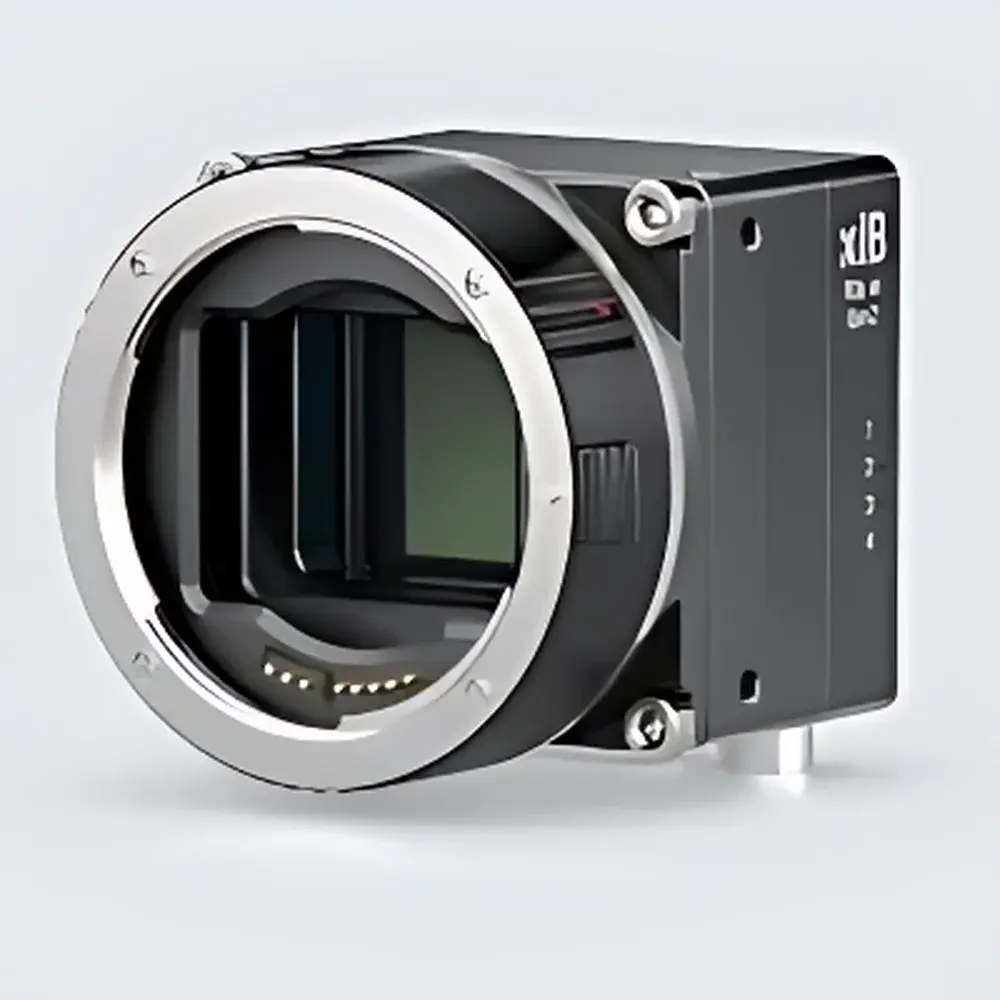
Auniontech CMOS. Scientific-Grade Back-Illuminated sCMOS Camera
| Brand | Auniontech |
|---|---|
| Model | CMOS. |
| Sensor Type | Back-Illuminated sCMOS |
| Resolution | 2048 × 2048 |
| Pixel Size | 6.5 µm × 6.5 µm |
| Active Area | 13.3 mm × 13.3 mm |
| Diagonal | 18.8 mm |
| Full Well Capacity | 54,000 e⁻ |
| Frame Rate | 40 fps |
| Read Noise | 1.2 e⁻ (typ.) |
| Dark Current | <2 e⁻/pixel/s at –25 °C |
| Dynamic Range | 90 dB (HDR) |
| Peak Quantum Efficiency | 93% |
| Cooling | Peltier (TEC), ΔT ≤ 25 °C below ambient |
| Interface | USB 3.0 |
| GPIO | 2 input, 2 output, serial port |
| Bit Depth | 12-bit native (16-bit via API) |
| Mount | C-mount |
| Dimensions | 50 × 50 × 55 mm |
| Weight | 170 g |
Overview
The Auniontech CMOS. is a scientific-grade, back-illuminated sCMOS camera engineered for quantitative low-light imaging in demanding research environments. Based on a high-fill-factor, back-thinned CMOS sensor architecture, it delivers exceptional photon detection efficiency across the visible to near-ultraviolet spectrum (350–1000 nm), with a measured peak quantum efficiency of 93% at 600 nm. Its core measurement principle relies on single-photon counting-capable analog-to-digital conversion with correlated double sampling (CDS), enabling sub-electron read noise (1.2 e⁻ RMS typ.) and high temporal reproducibility—critical for intensity-based quantification in fluorescence lifetime imaging, photon correlation spectroscopy, and time-resolved spectral acquisition. The integrated thermoelectric cooler (TEC) stabilizes sensor temperature to ≤ –25 °C relative to ambient, suppressing dark current to <2 e⁻/pixel/s and ensuring shot-noise-limited performance over extended exposures. Designed for integration into optical benches and OEM systems, the camera complies with industrial mechanical and electrical interface standards—including C-mount optics compatibility, USB 3.0 Gen 1 bandwidth (up to 400 MB/s), and programmable TTL-synchronized GPIO for external trigger coordination.
Key Features
- Back-illuminated sCMOS sensor with 93% peak QE and 90 dB HDR dynamic range—enabling simultaneous capture of weak emission signals and bright reference features without saturation
- Ultra-low read noise (1.2 e⁻ RMS typ.) and deep-cooled operation (–25 °C) for optimal signal-to-noise ratio in low-flux applications such as single-molecule fluorescence or Raman scattering
- Native 12-bit digitization with 16-bit data packaging via SDK—preserving linear response across full well depth (54,000 e⁻) while supporting high-speed streaming at 40 fps
- Compact, lightweight housing (170 g) with C-mount interface and integrated thermal management—ideal for space-constrained setups including inverted microscopes and portable spectrometers
- Programmable hardware triggers, GPIO I/O (2 IN / 2 OUT), and serial communication channel—supporting deterministic synchronization with lasers, shutters, and stage controllers in automated workflows
Sample Compatibility & Compliance
The CMOS. camera is optimized for use with standard optical components and sample geometries common in life science and physical optics laboratories. Its 13.3 mm × 13.3 mm active area accommodates wide-field fluorescence imaging, spectral line profiling, and laser beam characterization without vignetting when paired with f/2.0 or slower optics. The camera meets CE and FCC electromagnetic compatibility requirements and conforms to RoHS Directive 2011/65/EU for hazardous substance restriction. While not certified for medical device use under IEC 62304 or FDA 510(k), its firmware architecture supports audit-ready logging and timestamped metadata embedding—facilitating GLP-compliant experimental documentation in academic and industrial R&D settings. All calibration parameters (gain, offset, flat-field correction) are stored in non-volatile memory and accessible via API for traceable instrument validation per ISO/IEC 17025 guidelines.
Software & Data Management
Auniontech provides a cross-platform SDK (Windows/Linux/macOS) with C/C++, Python, MATLAB, and LabVIEW bindings—enabling full control over exposure, gain, ROI selection, trigger mode, and cooling setpoint. The SDK includes a real-time acquisition library supporting zero-copy memory mapping and ring-buffer streaming, essential for sustained 40 fps operation with minimal CPU overhead. Image data is output in standard TIFF or HDF5 formats with embedded EXIF-style metadata (exposure time, sensor temperature, timestamp, ROI coordinates). For regulated environments, optional SDK extensions support 21 CFR Part 11–compliant electronic signatures, audit trail logging, and role-based access control—ensuring data integrity throughout acquisition, processing, and archival phases. Third-party compatibility includes Hamamatsu HCImage Live, Thorlabs ThorCam, and MicroManager 2.0 via unified device interface (UDI) plugins.
Applications
- Fluorescence Microscopy: High-fidelity capture of GFP/YFP-tagged subcellular structures in TIRF and confocal modalities, leveraging low read noise and high QE for improved contrast-to-noise ratio
- Super-Resolution Imaging: Compatible with STORM, PALM, and SIM reconstruction pipelines requiring precise photon counting statistics and pixel-level linearity
- Spectroscopic Detection: Integration with grating spectrometers for photovoltaic cell EQE mapping, LED spectral analysis, and plasma emission profiling
- Quantitative Phase Imaging: Used in conjunction with digital holographic microscopy (DHM) systems where phase stability and low temporal noise are prerequisites
- Time-Resolved Luminescence: Synchronized acquisition of decay kinetics in phosphor materials and quantum dot suspensions using external pulse triggering
FAQ
What is the maximum sustained frame rate at full resolution?
The camera achieves 40 fps at 2048 × 2048 with full USB 3.0 bandwidth utilization and no binning. Frame rates scale linearly with ROI reduction—for example, 120 fps at 1024 × 1024.
Is hardware binning supported?
No. Binning is implemented digitally in software post-readout to preserve native pixel response uniformity; however, region-of-interest (ROI) cropping is fully hardware-accelerated.
Can the camera be operated in triggered or free-running mode?
Yes. It supports internal timing, external TTL edge-triggered acquisition, and asynchronous reset modes—all configurable via SDK or GUI application.
Does the SDK support multi-camera synchronization?
Yes. Using shared trigger lines and programmable delay offsets, up to four CMOS. units can be synchronized with sub-microsecond jitter for stereo or multi-spectral acquisition.
What cooling performance is guaranteed over ambient temperature variations?
The TEC maintains sensor temperature within ±0.1 °C of the user-defined setpoint (range: –25 °C to +20 °C) provided ambient does not exceed 30 °C and airflow is unobstructed.