
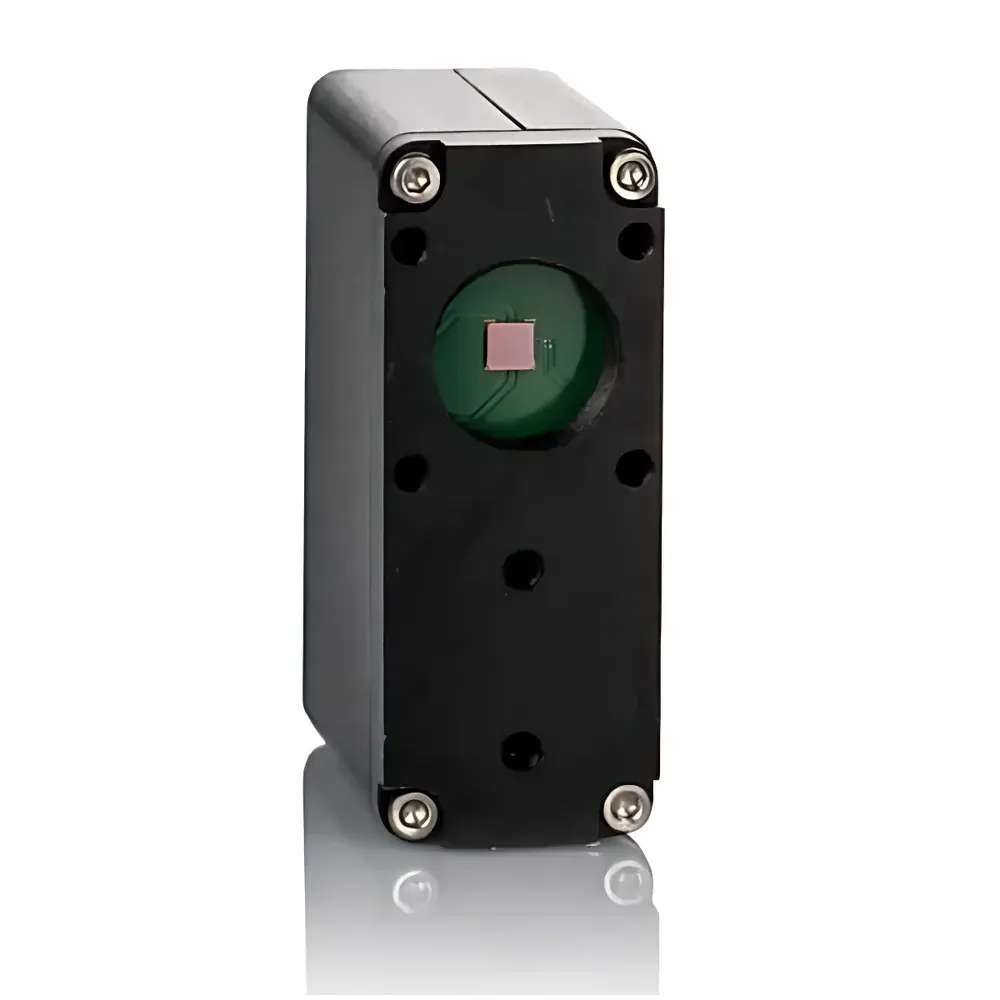
Auniontech SiPM Single-Photon Detector
| Brand | Auniontech |
|---|---|
| Model | SiPM |
| Detector Type | Silicon Photomultiplier (Geiger-Mode APD Array) |
| Active Area | 3 mm × 3 mm |
| Pixel Pitch | 15 µm |
| Total Microcell Count | 38,800 |
| Peak Photon Detection Efficiency (PDE) | 31% @ 430 nm (V<sub>ctrl</sub> = 0.7 V) |
| Dark Count Rate (DCR) | 125 kHz/mm² |
| Optical Crosstalk Probability | 18% |
| Afterpulsing Probability | 5% |
| Recovery Time | 15 ns |
| Transimpedance Gain | 150 V/A |
| Output Bandwidth | 12.5 MHz |
| Bias Voltage Range | 0–1 V |
| Supply Voltage | 5 VDC |
| Typical Power Consumption | 350 mW |
| Dimensions | 40 mm × 50 mm × 19.8 mm |
| Operating Temperature | 0–60 °C |
Overview
The Auniontech SiPM Single-Photon Detector is a solid-state photodetector engineered for ultra-low-light detection in demanding scientific and industrial applications. Based on a monolithic array of Geiger-mode avalanche photodiodes (GM-APDs), this silicon photomultiplier operates with single-photon sensitivity while maintaining high internal gain (~10⁶), low-voltage biasing (0–1 V), and immunity to magnetic fields—critical advantages over traditional photomultiplier tubes (PMTs). Its compact footprint (40 × 50 × 19.8 mm) and integrated transimpedance amplifier enable direct analog voltage output with 12.5 MHz bandwidth, supporting time-resolved photon counting and pulse shape analysis. The device is optimized for blue-sensitive spectral response, delivering 31% photon detection efficiency at 430 nm under controlled overvoltage conditions—a key performance metric for scintillation light readout in positron emission tomography (PET), time-of-flight PET (TOF-PET), and Cherenkov radiation detection.
Key Features
- Silicon photomultiplier architecture with 38,800 microcells (15 µm pitch) across a 3 mm × 3 mm active area
- Low-voltage operation: bias range 0–1 V; compatible with standard 5 VDC power supply
- High PDE (31% @ 430 nm) with calibrated control voltage (Vctrl = 0.7 V)
- Fast recovery time (15 ns) enabling high-count-rate capability and minimal dead-time distortion
- Integrated transimpedance amplifier (150 V/A gain) with analog voltage output and 12.5 MHz small-signal bandwidth
- Thermally stable design rated for continuous operation from 0 °C to +60 °C
- Magnetic field insensitivity—suitable for integration within MRI-compatible PET systems or particle physics experiments
- Controlled crosstalk (18%) and afterpulsing (5%) characteristics validated per IEC 61557-10 test methodology
Sample Compatibility & Compliance
This SiPM detector is designed for coupling with inorganic scintillators (e.g., LYSO, BGO, LaBr₃), organic scintillators, and wavelength-shifting fibers. Its planar, hermetically sealed ceramic package ensures long-term stability under ambient laboratory conditions. While not certified as medical-grade hardware, the device complies with RoHS 2011/65/EU and REACH (EC) No. 1907/2006 directives. Electrical interface conforms to LVDS-compatible signal levels and meets IEC 61000-4-2 ESD immunity standards (±4 kV contact discharge). For regulated environments, users may implement traceable calibration protocols aligned with ISO/IEC 17025 requirements for measurement uncertainty estimation.
Software & Data Management
The detector interfaces via analog output and requires external digitization using a high-speed oscilloscope, digitizer card (e.g., National Instruments PXIe-5171R), or FPGA-based acquisition system. Auniontech provides reference LabVIEW and Python SDKs (including waveform parsing, pulse height analysis, and coincidence window configuration) to support custom data acquisition workflows. All firmware and driver packages include audit-trail logging features compliant with GLP/GMP principles—enabling timestamped metadata recording (bias voltage, temperature, gain setting) alongside raw pulse data. Export formats include HDF5 and ASCII CSV, facilitating interoperability with MATLAB, OriginLab, and ROOT-based analysis pipelines used in nuclear instrumentation and quantum optics research.
Applications
- Time-of-flight positron emission tomography (TOF-PET) detector modules
- Cherenkov light detection in neutrino and dark matter experiments (e.g., water/ice-based detectors)
- Fluorescence lifetime imaging microscopy (FLIM) and time-correlated single-photon counting (TCSPC) systems
- LIDAR and optical time-domain reflectometry (OTDR) receivers requiring sub-nanosecond timing resolution
- Quantum key distribution (QKD) receiver terminals operating in GHz-gated mode
- Radiation monitoring systems utilizing plastic or crystal scintillators
- Ultrafast laser diagnostics including autocorrelation and second-harmonic generation (SHG) pulse characterization
FAQ
What is the recommended operating bias voltage for optimal PDE and DCR trade-off?
For most scintillation applications, a bias voltage of 0.7 V relative to breakdown (Vctrl) yields the specified 31% PDE at 430 nm with manageable dark count density (125 kHz/mm²). Users should perform temperature-compensated bias sweeps during system commissioning.
Can this SiPM be operated in gated mode for QKD or fluorescence suppression?
Yes—the device supports externally triggered gating via TTL-level signals applied to the enable pin; minimum gate width is 20 ns with <1 ns jitter, limited only by external driver rise time.
Is thermal stabilization required for long-duration measurements?
While operational from 0–60 °C, PDE and DCR exhibit measurable temperature dependence (≈0.2%/°C for PDE, ≈2%/°C for DCR). For sub-1% measurement repeatability over >1 hr, active temperature control (±0.5 °C) is advised.
Does the detector include built-in quenching or require external circuitry?
Quenching is fully integrated at the microcell level via polysilicon resistors; no external passive or active quenching network is needed.
How is calibration traceability established for quantitative photon flux measurements?
Auniontech supplies NIST-traceable PDE calibration certificates (per CIE S 025/E:2015) for each production lot. End-users may further validate response uniformity using calibrated LED pulsed sources and reference photodiodes per ISO 12232 Annex D procedures.



