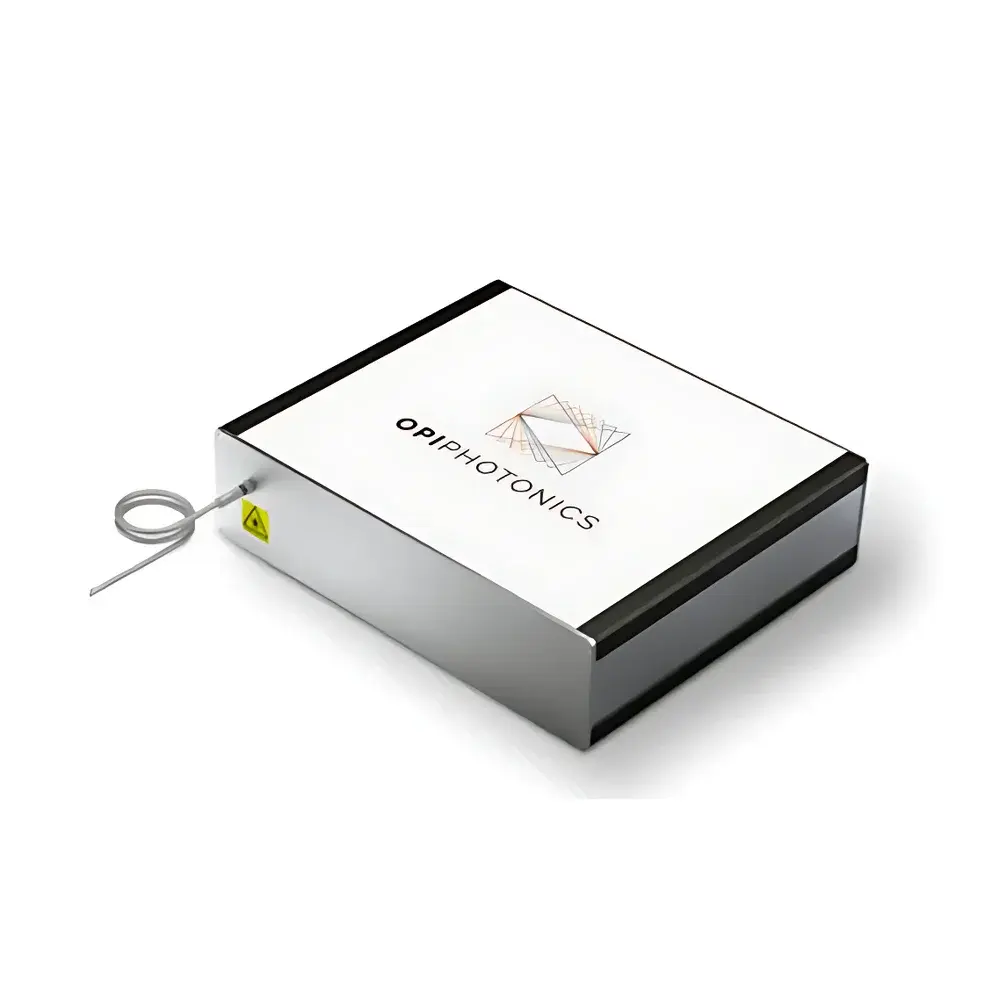
Auniontech BrightboX Bb-E1 Series High-Power Multimode Diode Laser Engines (808 nm, 915 nm, 1064 nm; 300–500 W CW)
| Brand | Auniontech |
|---|---|
| Output Power (CW) | 300 W (Bb-E1-808) / 500 W (Bb-E1-915) |
| Wavelength | 808 nm / 915 nm / 1064 nm |
| Operating Current | 8–13 A |
| Operating Voltage | 36–42 V |
| Fiber Delivery | 200/220 µm multimode fiber with SMA termination |
| Cooling | Conductive (baseplate-mounted) |
| Compliance | RoHS-compliant optical module architecture |
| OEM Integration | Designed for embedded integration in industrial laser systems |
Overview
The Auniontech BrightboX Bb-E1 Series comprises a family of high-brightness, continuous-wave (CW) multimode diode laser engines engineered for industrial photonics integration. These devices operate at three primary near-infrared wavelengths—808 nm, 915 nm, and 1064 nm—each optimized for specific material interaction profiles and system-level efficiency requirements. Unlike single-emitter architectures, the Bb-E1 leverages multi-emitter bar stacking and proprietary beam homogenization optics to deliver stable, spatially uniform output from a single 200/220 µm core fiber. The fundamental operating principle relies on thermally managed edge-emitting semiconductor diode arrays, where electro-optical conversion efficiency is maximized through precision current regulation and conductive heat extraction via a copper-tungsten baseplate. Designed explicitly for OEM deployment, the Bb-E1 series supports direct integration into laser material processing platforms—including direct diode welding, cladding, and heat treatment—as well as as pump sources for DPSS (diode-pumped solid-state) and fiber laser systems.
Key Features
- High-power CW output: 300 W at 808 nm (Bb-E1-808-300W) and 500 W at 915 nm (Bb-E1-915-500W), with 1064 nm variants available upon request
- Stable multimode fiber coupling: 200 µm core / 220 µm cladding, NA ≤ 0.22, SMA-905 connector interface
- Integrated thermal management: Baseplate-mounted conduction cooling compatible with standard cold plate interfaces (flatness tolerance < 5 µm)
- Electrical interface: 36–42 V DC input with programmable current control (0–13 A range); optional analog/digital modulation support (TTL or RS-485)
- Robust mechanical packaging: Hermetically sealed TO-can array modules mounted in aluminum housing with IP52-rated environmental protection
- OEM-ready control architecture: Optional intelligent driver electronics supporting real-time power monitoring, temperature feedback, and fault logging per IEC 61508 functional safety guidelines
Sample Compatibility & Compliance
The Bb-E1 series is qualified for use in environments requiring long-term operational stability under industrial duty cycles (≥ 10,000 h MTBF). Its optical output meets ISO 11146-1 beam parameter measurement standards when coupled into specified fiber delivery systems. The module complies with RoHS Directive 2011/65/EU and CE marking requirements for electromagnetic compatibility (EN 61326-1) and low-voltage safety (EN 61000-6-4). For regulated manufacturing applications—including medical device component processing and aerospace-grade additive manufacturing—the laser engine supports traceable calibration documentation and can be supplied with optional GLP/GMP-aligned test reports (including power stability ±1.5% over 8 h, wavelength drift < ±0.5 nm at constant Tc). It is not classified as a Class IV laser system when integrated with appropriate interlocks and enclosure design per IEC 60825-1:2014.
Software & Data Management
While the Bb-E1 operates as a hardware-integrated subsystem, Auniontech provides optional driver firmware with configurable digital communication protocols (Modbus RTU, CANopen, or custom UART framing). This enables seamless integration into centralized process control systems compliant with ISA-88 and ISA-95 automation hierarchies. Firmware logs include timestamped records of drive current, heatsink temperature, output power (via integrated photodiode feedback), and error codes—all accessible via non-volatile memory with write-cycle endurance > 100,000 entries. Audit trail functionality satisfies FDA 21 CFR Part 11 requirements when deployed with validated host software and user access controls. Remote diagnostics and firmware updates are supported over isolated serial interfaces to maintain electrical separation in high-noise factory environments.
Applications
- Direct diode material processing: Conduction-mode welding of copper, aluminum, and stainless steel; surface hardening of tool steels; selective soldering in electronics assembly
- DPSS laser pumping: High-efficiency excitation of Nd:YAG, Nd:YVO₄, and Yb-doped crystals in Q-switched and CW configurations
- Additive manufacturing: Energy source for directed energy deposition (DED) and binder jetting pre-heating stages
- Automotive laser manufacturing: Beam-switched contour hardening of transmission gears and camshafts using synchronized galvanometric scanning
- Optical pumping of fiber lasers: Seed source for Yb-doped fiber amplifiers in MOPA architectures
- Scientific instrumentation: Pump source for optical parametric oscillators (OPOs) and supercontinuum generation in ultrafast laboratories
FAQ
What is the spectral bandwidth (FWHM) of the Bb-E1 laser outputs?
Typical FWHM values are 3.5 nm @ 808 nm, 4.0 nm @ 915 nm, and 4.5 nm @ 1064 nm, measured under nominal operating conditions.
Is fiber-coupled power stability guaranteed over ambient temperature variations?
Yes—power stability remains within ±2% across an ambient range of 15–35 °C when mounted on a temperature-controlled cold plate (±0.5 °C regulation).
Can the Bb-E1 be operated in pulsed mode?
The module supports quasi-CW operation up to 1 kHz modulation frequency with < 10 µs rise/fall times when driven by compatible external current sources.
What documentation is provided for regulatory validation in GxP environments?
Auniontech supplies Design History File (DHF) excerpts, Factory Acceptance Test (FAT) reports, and traceable calibration certificates upon request—aligned with ISO 13485 and AS9100 quality system frameworks.
Is there a minimum order quantity for custom wavelength or fiber NA configurations?
Standard configurations ship from stock; custom variants (e.g., 0.15 NA fiber, 880 nm center wavelength) require NRE evaluation and MOQ of 10 units for production release.