
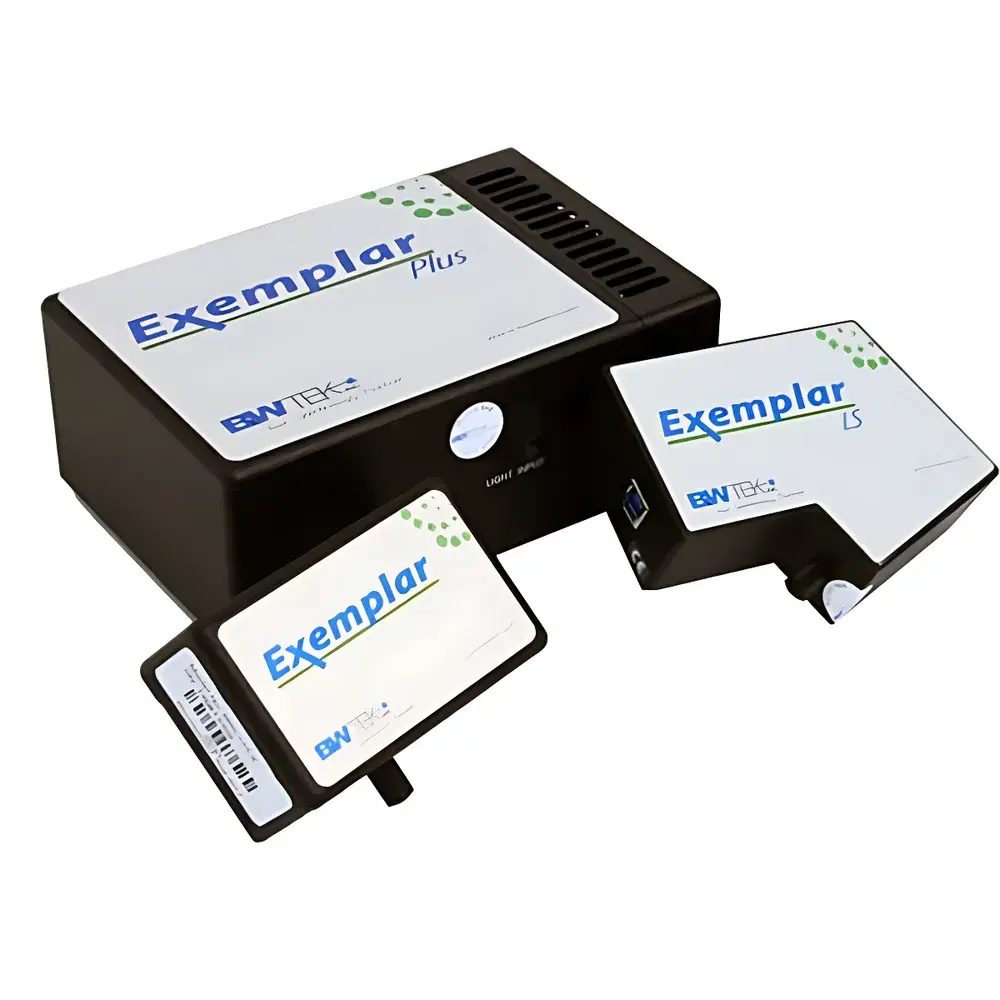
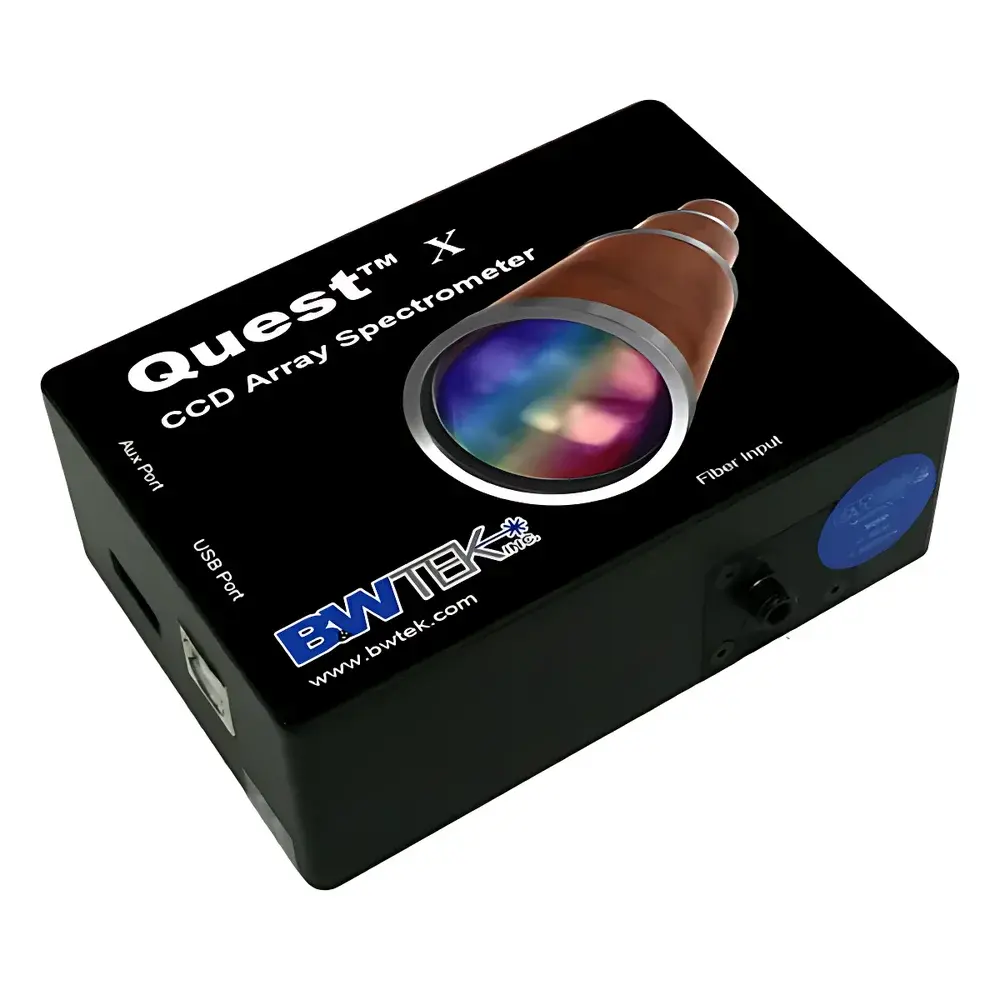
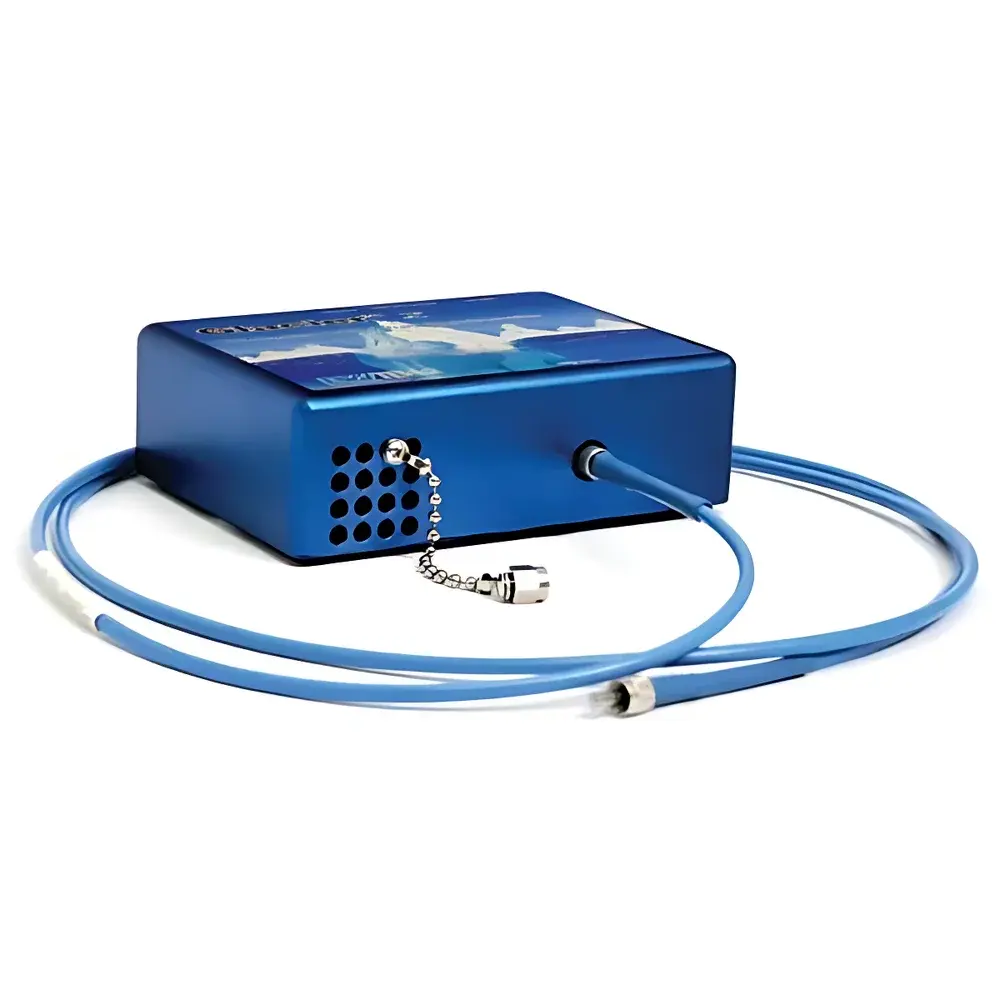
BWTEK B&W Tek Quest X UV-Vis Fiber Optic Spectrometer
| Brand | BWTEK |
|---|---|
| Origin | USA |
| Model | Quest X |
| Spectral Range | 200–1100 nm (typical configuration) |
| Detector | Sony ILX511B linear CCD |
| Cooling | Thermoelectric (TE) temperature stabilization |
| Interface | USB 3.0 |
| Max Acquisition Rate | 140 spectra/sec (6.3 ms integration time) |
| Stray Light | <0.05% @ 600 nm |
| Trigger Latency | 95 ns |
| Gate Jitter | ±20 ns |
| Onboard Processing | Averaging & smoothing algorithms |
| Optical Design | Non-crossed Czerny-Turner |
Overview
The BWTEK Quest X UV-Vis Fiber Optic Spectrometer is a compact, high-stability benchtop spectrometer engineered for precision absorbance, reflectance, fluorescence, and transmission measurements across the ultraviolet–visible–near-infrared spectrum (200–1100 nm). Built upon a non-crossed Czerny-Turner optical architecture, it minimizes stray light (<0.05% at 600 nm), ensuring high photometric fidelity and linearity in quantitative spectral analysis. Its core optical path integrates a fixed grating, optimized collimating/focusing mirrors, and fiber-coupled input (SMA 905), enabling seamless integration into OEM systems or laboratory setups. The spectrometer employs a thermoelectrically stabilized Sony ILX511B linear CCD array, delivering superior thermal drift suppression—critical for long-integration applications such as low-light fluorescence or kinetic monitoring where signal integrity over time is paramount.
Key Features
- Thermoelectric (TE) temperature control of the detector, maintaining stability within ±0.1 °C over ambient fluctuations—enabling reproducible dark current subtraction and reduced baseline drift.
- USB 3.0 interface supporting up to 140 full-spectrum acquisitions per second at 6.3 ms integration time, with hardware-level trigger latency of 95 ns and gate jitter of ±20 ns—ideal for time-resolved spectroscopy and synchronization with pulsed sources (e.g., LEDs, lasers).
- Onboard digital signal processing including real-time averaging (up to 65,535 scans) and Savitzky-Golay smoothing—reducing post-acquisition computational load and accelerating workflow throughput.
- Low-stray-light optical design with optimized coating and baffling, validated per ISO 17025 traceable procedures, supporting compliance with ASTM E308 (colorimetry), USP (spectrophotometric absorbance), and ISO 13485-aligned instrumentation requirements.
- Rugged aluminum housing with passive thermal management; no external cooling required—suitable for deployment in regulated manufacturing environments or portable field instruments.
Sample Compatibility & Compliance
The Quest X interfaces with standard 200 µm or 400 µm core silica optical fibers (NA 0.22), accommodating liquid cuvettes, integrating spheres, flow cells, and remote probe heads. It supports both free-space and fiber-coupled excitation configurations for fluorescence, Raman, and absorption assays. All firmware and calibration data are stored onboard with write-protected EEPROM, supporting audit trails required under FDA 21 CFR Part 11 for electronic records and signatures. Spectral calibrations are NIST-traceable (via certified tungsten-halogen and mercury-argon lamp standards), and system validation documentation—including wavelength accuracy (±0.2 nm), photometric linearity (R² > 0.9999 over OD 0–3), and repeatability (RSD < 0.3% over 8-hour operation)—is provided with each unit.
Software & Data Management
BWTEK’s BWSpec™ software (Windows 10/11 compatible) provides full instrument control, real-time spectral visualization, batch acquisition, and export to CSV, TXT, or HDF5 formats. SDKs for C/C++, Python (PyBW), MATLAB, and LabVIEW enable custom automation and integration into LIMS or MES platforms. Raw spectral data retain full 16-bit depth and timestamp metadata (UTC-sync capable via optional GPS module), satisfying GLP/GMP data integrity requirements. Optional BWSpectraCloud™ enables encrypted cloud-based spectral library management, version-controlled method storage, and role-based access control for multi-user laboratories.
Applications
- LED binning and spectral power distribution (SPD) characterization per IES LM-79 and ENERGY STAR SSL protocols.
- UV-Vis quantitative analysis in pharmaceutical QC (e.g., assay of active ingredients per USP ), water quality monitoring (COD, nitrate, phosphate), and enzymatic kinetics.
- Fluorescence lifetime pre-screening and ratiometric pH sensing using dual-emission probes.
- In-line process monitoring in chemical synthesis, bioreactor control, and semiconductor thin-film thickness measurement via interference fringe analysis.
- OEM integration into medical devices—including pulse oximetry calibration modules and point-of-care blood analyzers—leveraging its compact footprint (120 × 80 × 45 mm) and low power draw (<2.5 W).
FAQ
What spectral resolution can be achieved with the Quest X?
Resolution is slit- and grating-dependent; typical configurations deliver 0.5–2.0 nm FWHM (e.g., 1200 g/mm grating + 25 µm slit = ~0.7 nm). Custom gratings and slits are available for specialized resolution or throughput trade-offs.
Is the Quest X suitable for GMP-regulated environments?
Yes—its firmware supports 21 CFR Part 11-compliant user authentication, electronic signatures, and immutable audit logs. IQ/OQ documentation packages and installation qualification templates are available upon request.
Can the spectrometer operate continuously for extended periods?
Yes—the TE-cooled detector and thermally stable mechanical design ensure <0.01 nm/h wavelength drift and <0.5% intensity drift over 24 hours, verified under ISO/IEC 17025 environmental testing conditions.
Does BWTEK provide NIST-traceable calibration certificates?
Each unit ships with a factory calibration certificate referencing NIST SRM 2035 (tungsten-halogen) and SRM 1930b (Hg-Ar emission lines), including uncertainty budgets per ISO/IEC 17025 Annex A.
How is spectral data synchronized with external triggers?
Hardware TTL-compatible trigger input supports edge-triggered acquisition with sub-100 ns timing precision; external clock synchronization (up to 10 MHz) is supported via optional SMA input for lock-in or gated detection schemes.






