
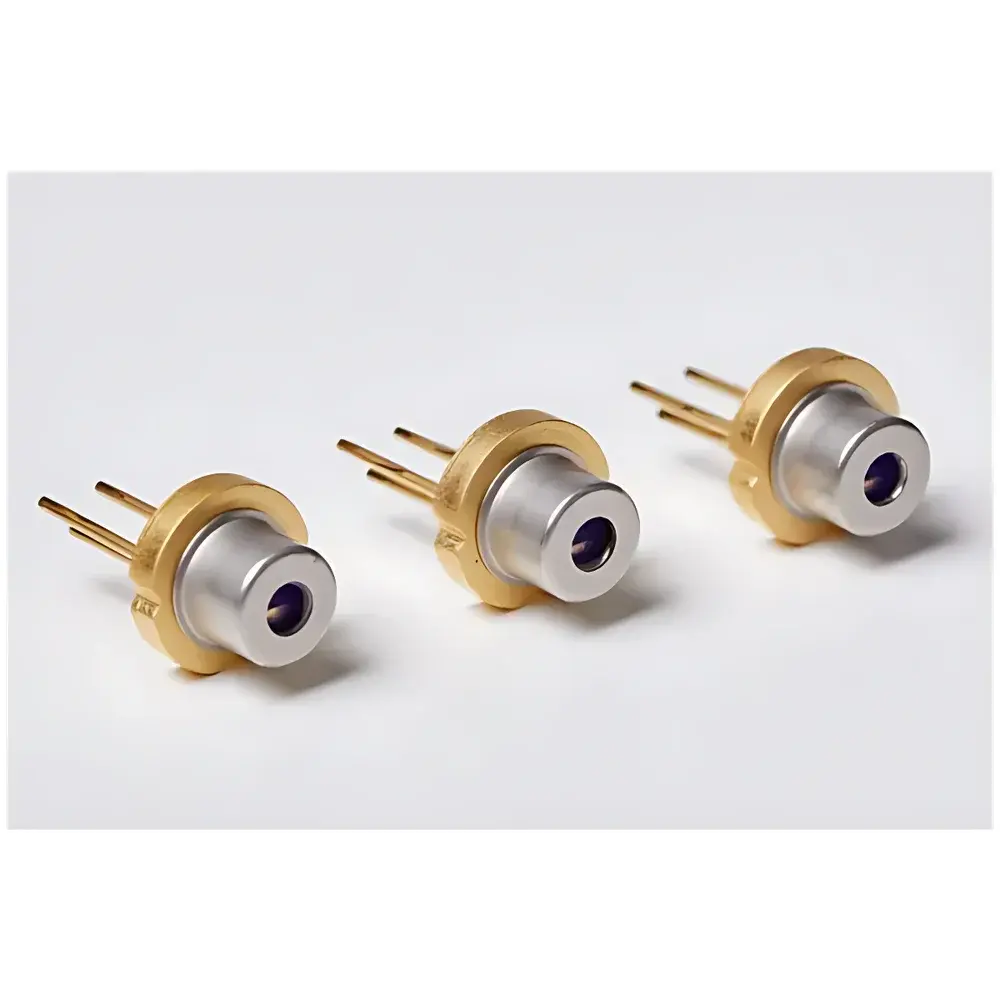
Auniontech QLF063x–QLF093x High-Power Fabry–Pérot Laser Diodes for 640–905 nm Sensor Applications
| Brand | Auniontech |
|---|---|
| Origin | Shanghai, China |
| Manufacturer Type | Authorized Distributor |
| Product Origin | Domestic (PRC) |
| Model Series | QLF063x, QLF073x, QLF083x, QLF093x |
| Wavelength Range | 640–905 nm (discrete options: 640, 650, 660, 685, 785, 830, 905 nm) |
| Output Power | 30–210 mW (CW), 500 mW–1 W (nanosecond pulsed) |
| Package | 5.6 mm TO-56 can with integrated photodiode (PD) monitor |
| Drive Modes | CW and nanosecond-pulsed operation |
| Pin Configuration | Anode-common or cathode-common |
| Beam Profile | Single-lobed, near-Gaussian spatial mode |
| Compliance | RoHS-compliant packaging, JEDEC-standard TO-can reliability testing |
Overview
The Auniontech QLF063x–QLF093x series comprises high-output, wavelength-customizable Fabry–Pérot (FP) laser diodes engineered for precision optical sensing in industrial, scientific, and embedded systems. Operating across the visible to near-infrared spectrum (640–905 nm), these devices leverage FP cavity design to deliver stable longitudinal mode emission with high spectral purity and low relative intensity noise (RIN) under both continuous-wave (CW) and nanosecond-pulsed excitation. The lasers are optimized for applications requiring robust temporal response, high peak power density, and long-term operational stability—particularly where compact form factor, thermal resilience, and integration-ready monitoring capability are critical. Each device integrates a calibrated photodiode within a hermetically sealed 5.6 mm TO-56 package, enabling real-time output power feedback for closed-loop drive control and drift compensation.
Key Features
- Wavelength flexibility: Discrete standard options at 640, 650, 660, 685, 785, 830, and 905 nm; custom wavelengths available within the 640–905 nm range upon request
- Dual-mode operation: Supports both CW (30–210 mW) and nanosecond-pulsed (500 mW–1 W peak) driving schemes with sub-10 ns rise/fall times
- Integrated monitoring: On-board photodiode with linear responsivity enables active power stabilization and lifetime degradation tracking
- Compact, industry-standard packaging: 5.6 mm TO-56 metal-can housing compliant with MIL-STD-750 and JEDEC JESD22-A108 reliability protocols
- Configurable electrical interface: Dual pinout variants—cathode-common and anode-common—to simplify integration into existing driver architectures
- Beam quality: Single-lobed, low-divergence output (typical fast-axis divergence < 35°, slow-axis < 10°) suitable for coupling into multimode fibers or direct collimation
- Thermal management: Designed for operation from −10 °C to +60 °C case temperature, with derating curves provided per IEC 61280-2-9
Sample Compatibility & Compliance
The QLF series is compatible with standard laser driver ICs supporting TTL- or analog-modulated current sources (e.g., ILX Lightwave LDC-37xx, Thorlabs ITC4000, or custom FPGA-based pulsers). All units comply with RoHS Directive 2011/65/EU and meet Class 1M / Class 3R safety classifications per IEC 60825-1:2014 when used with appropriate optics and housing. For medical or aerospace deployments, devices support traceable calibration certificates (NIST-traceable PD responsivity) and undergo burn-in screening per Telcordia GR-468-CORE. While not inherently FDA-cleared or CE-marked as standalone medical devices, the lasers are routinely integrated into systems certified to ISO 13485, IEC 62304, and DO-160G (Section 21) when embedded in validated platforms.
Software & Data Management
No proprietary software is bundled with the QLF diodes; however, Auniontech provides comprehensive technical documentation—including L-I-V characterization curves, spectral width vs. current plots, thermal resistance data, and aging test reports—for integration into third-party system-level validation workflows. Driver firmware examples (C/C++ and Python) for common microcontroller platforms (STM32, Arduino Due, Raspberry Pi Pico) are available upon NDA. All delivered units include serialized traceability logs (lot number, wafer ID, test date) aligned with ISO 9001 manufacturing records. For GxP-regulated environments, audit trails for calibration and functional testing may be supplied under controlled document release procedures.
Applications
- LIDAR and time-of-flight (ToF) sensors: High peak power enables extended detection range (>100 m) in compact automotive, drone, and robotics ranging modules
- Particle counting and aerosol analysis: Stable 640–685 nm output supports Mie scattering detection with high signal-to-noise ratio in portable environmental monitors
- Machine vision illumination: Nanosecond pulsing synchronizes precisely with global-shutter CMOS sensors for motion-free high-speed inspection
- Biomedical instrumentation: 785 nm and 830 nm variants serve as excitation sources in fluorescence lifetime imaging (FLIM) and pulse oximetry reference channels
- Visible light communication (VLC): Modulation bandwidth >150 MHz (small-signal) supports IEEE 802.15.7-compliant data links up to 100 Mbps
- Industrial alignment and leveling: Collimated 635–650 nm beams provide high-visibility reference lines with minimal speckle contrast in construction-grade tools
FAQ
What is the typical spectral linewidth (FWHM) of these FP lasers?
Typical FWHM ranges from 1.5 nm to 3.0 nm depending on wavelength and operating current; values are specified per batch in the test report.
Can these lasers be driven directly by TTL signals without external current limiting?
No—external constant-current drivers with fast turn-on capability and overcurrent protection are mandatory; TTL input must interface via compatible laser driver ICs.
Is optical isolation required when using multiple QLF lasers in proximity?
Yes—back-reflection sensitivity is typical for FP diodes; ≥20 dB optical isolation is recommended for multi-laser systems to prevent mode hopping or instability.
Do you provide fiber-pigtailed versions of the QLF series?
Standard units are free-space TO-56 emitters; fiber-coupled variants (e.g., 105 µm multimode, FC/PC) are available as custom-engineered solutions with lead time and MOQ considerations.
What is the expected lifetime under nominal CW operation at 25 °C?
MTTF exceeds 25,000 hours at rated CW power and junction temperature ≤50 °C, per accelerated life testing per TM-21 methodology.




