
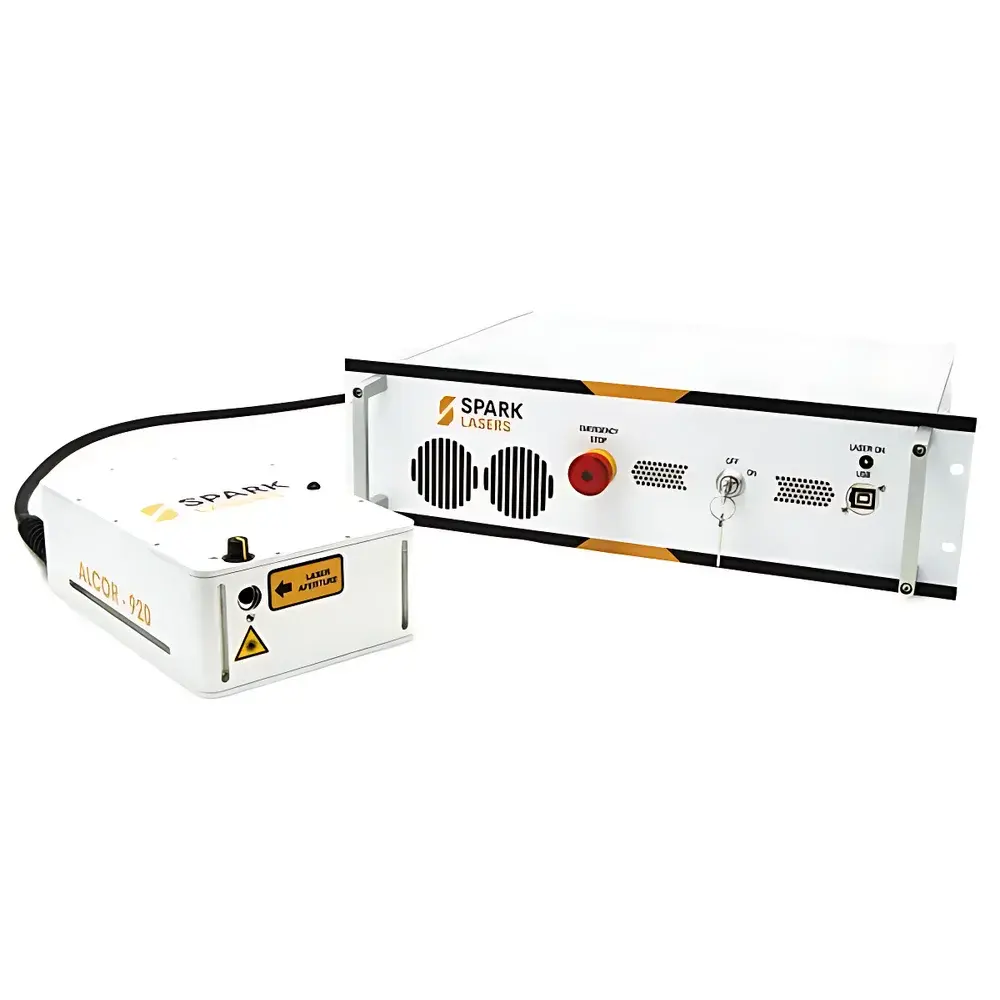
Spark Lasers ALCOR 780 Femtosecond Fiber Laser
| Brand | Spark Lasers |
|---|---|
| Model | ALCOR 780 |
| Central Wavelength | 780 nm |
| Average Power | 0.8 W (up to 4 W optional) |
| Repetition Rate | 80 MHz (40 MHz optional) |
| Pulse Duration | <150 fs |
| Beam Delivery | Free-space collimated output |
| Laser Head Dimensions | 286 × 165 × 79 mm³ |
| Weight | <5 kg |
| Cooling | Air-cooled |
| GDD Pre-compensation Range | 0 to –60,000 fs² (standard), up to –90,000 fs² optional |
| Interfaces | USB, RS232, TCP/IP, TTL sync output |
| Synchronization Jitter | <100 fs RMS |
Overview
The Spark Lasers ALCOR 780 is a turnkey, industrial-grade femtosecond fiber laser engineered for precision ultrafast applications in multiphoton microscopy, optical coherence tomography (OCT), time-resolved spectroscopy, and quantum optics. Operating at a central wavelength of 780 nm—optimized for high two-photon absorption cross-sections in common fluorophores such as GFP, RFP, and synthetic dyes—the ALCOR 780 delivers sub-150 fs pulses at a standard repetition rate of 80 MHz. Its all-fiber, monolithic oscillator-amplifier architecture eliminates alignment-sensitive free-space components, ensuring long-term amplitude and timing stability without active realignment. The laser employs chirped-pulse amplification (CPA) with integrated dispersion management, enabling direct coupling into high-NA microscope objectives without external pulse compressors. Designed for 24/7 operation in laboratory and OEM integration environments, the ALCOR 780 meets IEC 60825-1 Class 4 laser safety requirements and complies with CE, RoHS, and FCC Part 15 Subpart B standards.
Key Features
- Compact, air-cooled laser head (<5 kg, 286 × 165 × 79 mm³) suitable for benchtop mounting or direct integration into inverted/confocal microscope frames
- Factory-aligned, maintenance-free design with no consumables, no water cooling, and zero mechanical vibration—ideal for sensitive interferometric or scanning applications
- Software-controllable group delay dispersion (GDD) compensation from 0 to –60,000 fs² (standard), enabling adaptive pulse shaping for optimal nonlinear excitation depth penetration
- Low timing jitter (<100 fs RMS) synchronization output compatible with external delay generators, Pockels cells, or data acquisition systems via TTL, USB, RS232, or Ethernet (TCP/IP)
- High beam quality (M² < 1.1) with collimated free-space output; optional FleX fiber-coupled module available for 1 W and 2 W variants
- One-button startup with full system self-diagnosis; internal thermal and power monitoring with fault logging accessible via remote API
Sample Compatibility & Compliance
The ALCOR 780 is routinely deployed in GLP-compliant imaging facilities and academic core microscopy labs where regulatory traceability and operational consistency are critical. Its stable pulse energy (<10 nJ at 80 MHz) and minimal pulse-to-pulse energy fluctuation (<0.5% RMS over 8 hours) support quantitative fluorescence lifetime imaging (FLIM) and second-harmonic generation (SHG) intensity calibration per ISO 17025 guidelines. The laser’s spectral bandwidth (~12 nm FWHM) and transform-limited pulse profile meet ASTM E2912–22 criteria for ultrafast source characterization in biomedical instrumentation validation. All firmware and control software adhere to FDA 21 CFR Part 11 requirements for electronic records and signatures when used in regulated preclinical research environments.
Software & Data Management
Control is provided through Spark Lasers’ ALCOR Control Suite—a cross-platform application supporting Windows, Linux, and macOS. The suite includes real-time oscilloscope-style pulse train visualization, GDD sweep automation, and programmable trigger delay sequencing. An open RESTful API and SCPI-compatible command set enable seamless integration into LabVIEW, Python (PyVISA), MATLAB, or custom C++ acquisition frameworks. Audit trails—including timestamped parameter changes, error logs, and runtime statistics—are exportable in CSV or HDF5 format for QA documentation. Firmware updates are delivered via signed OTA packages with SHA-256 verification to ensure integrity and version traceability across multi-instrument deployments.
Applications
- Multiphoton excitation microscopy (MPM) of live tissue, including deep-brain imaging in transgenic mouse models
- Coherent anti-Stokes Raman scattering (CARS) and stimulated Raman scattering (SRS) spectroscopy with simultaneous dual-wavelength pumping
- Optogenetic stimulation using precise temporal gating of neural activity in slice electrophysiology
- Time-of-flight secondary ion mass spectrometry (TOF-SIMS) source for surface molecular mapping
- OEM integration into compact endomicroscopy probes and portable OCT systems requiring low SWaP-C (Size, Weight, Power, and Cost)
- Seed source for optical parametric amplifiers (OPAs) and difference frequency generation (DFG) modules targeting mid-IR spectral regions
FAQ
Is the ALCOR 780 compatible with commercial multiphoton microscopes from Nikon, Zeiss, or Bruker?
Yes—its collimated beam specifications (1.5 mm Ø, divergence <1.0 mrad) and standardized kinematic mount interface align with OEM integration kits from major microscope manufacturers. Custom beam height adapters and dichroic alignment fixtures are available upon request.
Can pulse duration be verified in-house without autocorrelation equipment?
The ALCOR 780 includes an embedded intensity autocorrelator port (FC/APC) for optional third-party verification. Full spectral phase reconstruction is supported via the included SPIDER-compatible measurement mode when paired with a commercial spectral interferometer.
What is the expected lifetime of the pump diodes and gain fiber?
Rated for >30,000 hours MTBF under continuous operation at 25°C ambient. Spark Lasers provides full component-level reliability data per Telcordia GR-468-CORE, including accelerated life testing reports for both 980 nm pump diodes and Yb-doped photonic crystal fiber.
Does the laser support external cavity length locking for interferometric stability?
While not equipped with built-in Pound-Drever-Hall electronics, the ALCOR 780’s low intrinsic frequency noise (<100 Hz/√Hz at 10 kHz offset) and active cavity temperature stabilization (±0.02°C) make it suitable for passive locking schemes when combined with external piezo-driven mirrors or electro-optic modulators.



