
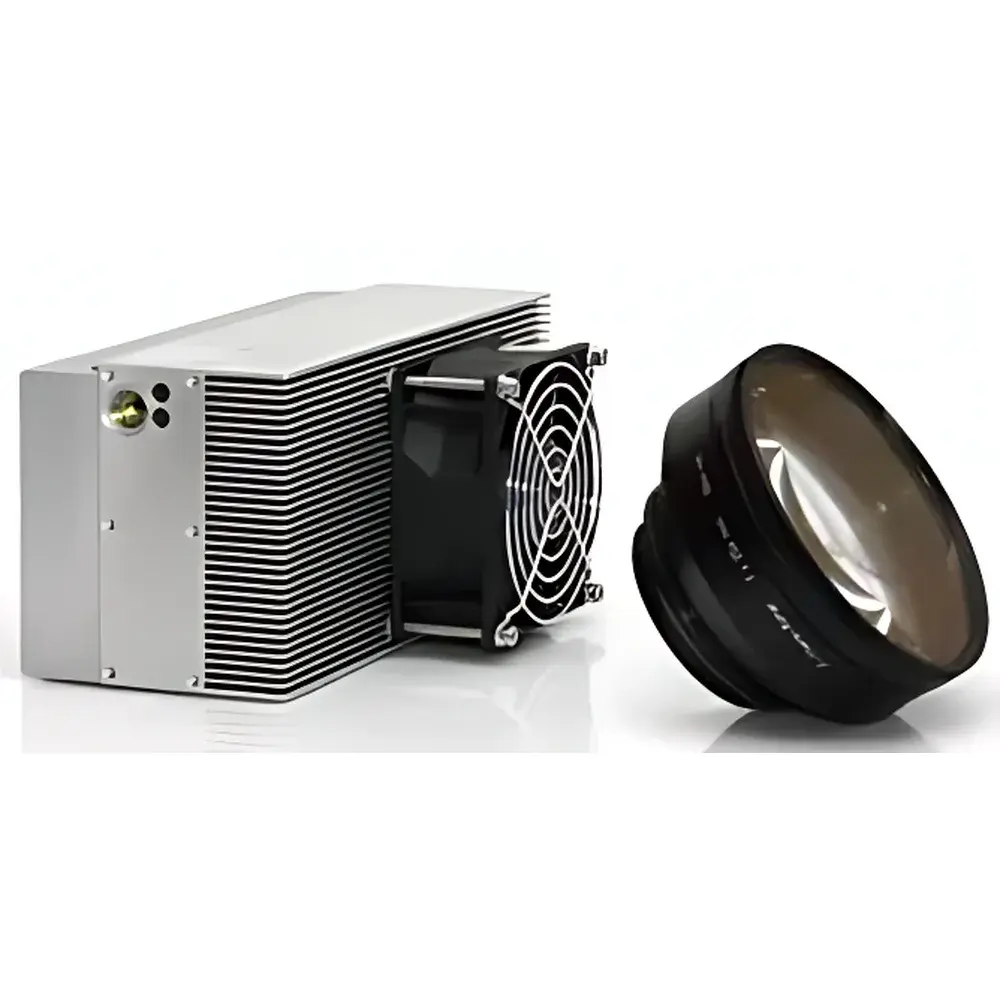
Bright Solutions SOL 1064/532 nm Compact DPSS Q-Switched Laser
| Brand | Bright Solutions |
|---|---|
| Origin | Italy |
| Model | SOL 1064/532 nm |
| Wavelength | 1064 nm / 532 nm |
| Average Output Power | 3–40 W (model-dependent) |
| Pulse Repetition Rate | Single Shot to 200 kHz |
| Pulse Width | 6–90 ns (depending on model & wavelength) |
| Beam Quality (M²) | <1.3–<2.5 |
| Polarization | Linear (100:1), optional circular |
| Beam Diameter | <8 mm (with integrated beam expander) |
| Cooling | Air-cooled (thermostatic fan), optional water or contact cooling |
| Power Supply | 24 V DC (6–20 A) |
| Dimensions | 23 × 10 × 9 cm |
| Weight | ≤4.5 kg |
| Peak Power | Up to 300 kW |
| Diode Replaceable | Yes |
Overview
The Bright Solutions SOL 1064/532 nm is a fully integrated, ultra-compact diode-pumped solid-state (DPSS) Q-switched laser system engineered for high-reliability industrial and scientific integration. Operating on the fundamental Nd:YAG transition at 1064 nm and its frequency-doubled output at 532 nm, the SOL leverages advanced end-pumping architecture and monolithic cavity design to deliver exceptional pulse-to-pulse stability and spatial beam fidelity. Its Q-switching mechanism—based on acousto-optic (AO) or electro-optic (EO) modulation—enables precise temporal control of nanosecond-scale pulses with minimal timing jitter (<100 ps RMS). Unlike conventional DPSS lasers requiring external power supplies and complex thermal management, the SOL integrates the laser head, driver electronics, and intelligent thermal regulation into a single 23 × 10 × 9 cm chassis weighing no more than 4.5 kg. This architecture eliminates alignment drift, reduces EMI susceptibility, and supports rapid OEM integration in space-constrained environments such as portable LIDAR platforms, benchtop micromachining stations, or embedded marking systems.
Key Features
- Monolithic DPSS design with integrated driver and thermostatically regulated air cooling—no external chiller or rack-mount PSU required
- Peak optical power up to 300 kW with pulse widths tunable from 6 ns (532 nm) to 90 ns (1064 nm), enabling optimized material interaction across metals, ceramics, polymers, and transparent substrates
- Repetition rate flexibility: standard operation from 10 kHz to 100 kHz; extended range options support single-shot triggering and up to 200 kHz for high-throughput applications
- Adjustable single-pulse energy via internal digital control—critical for grayscale laser marking, controlled ablation depth profiling, and nonlinear frequency conversion efficiency tuning
- Beam quality maintained at M² < 1.3 (532 nm) and < 2.5 (1064 nm, 40 W model), ensuring diffraction-limited focusing for sub-20 µm spot sizes with standard F-theta lenses
- Field-serviceable architecture: pump diodes are user-replaceable without realignment, minimizing downtime and supporting long-term operational continuity under GLP-compliant maintenance logs
Sample Compatibility & Compliance
The SOL series is compatible with a broad spectrum of optically active and non-transparent materials, including anodized aluminum, stainless steel, polyimide, fused silica, sapphire, and lithium niobate. Its stable TEM₀₀ output and low pointing instability (<5 µrad/°C) ensure repeatable feature placement in precision microfabrication. The laser conforms to IEC 60825-1:2014 Class 4 safety requirements when operated with appropriate interlocks and enclosure integration. All models meet CE electromagnetic compatibility (EMC) Directive 2014/30/EU and RoHS 2011/65/EU material restrictions. For regulated manufacturing environments, the SOL’s deterministic pulse timing, onboard temperature and current monitoring, and RS-232/USB command interface support audit-ready data traceability aligned with ISO 13485 and FDA 21 CFR Part 11 requirements when paired with validated host software.
Software & Data Management
Control is implemented via ASCII-based serial protocol over RS-232 or USB virtual COM port, enabling seamless integration with LabVIEW, Python (PySerial), MATLAB, or custom PLC-driven motion controllers. The firmware supports real-time parameter adjustment—including repetition rate, pulse energy setpoint, and burst mode sequencing—without interrupting lasing. Optional OEM SDK provides API-level access to internal diagnostics: diode junction temperature, cavity alignment status (via photodiode feedback), and cumulative pulse count with timestamp resolution of 1 µs. All operational parameters are logged internally (non-volatile memory) and exportable as CSV for statistical process control (SPC) analysis per ISO 22514-7. No proprietary runtime or dongle licensing is required; configuration files are human-readable and version-controllable.
Applications
- Laser marking and engraving of medical devices, aerospace components, and semiconductor packaging—leveraging grayscale pulse-energy modulation for variable contrast without mechanical shuttering
- Thin-film removal (e.g., ITO, SiNₓ, DLC) with minimal substrate heating, enabled by short pulse width and high peak intensity
- Internal glass engraving (3D subsurface marking) using tightly focused 1064 nm pulses to induce controlled micro-void formation within borosilicate and fused quartz
- Time-of-flight LIDAR transmitter modules where compactness, low mass, and pulse-to-pulse timing stability are critical for UAV- and drone-mounted topographic mapping
- Pump source for optical parametric oscillators (OPOs) and difference-frequency generation (DFG) stages targeting mid-IR spectral regions (3–12 µm)
- Time-resolved fluorescence lifetime imaging (FLIM) and pump-probe spectroscopy setups requiring synchronized, low-jitter excitation pulses
FAQ
Is the SOL laser compliant with FDA 21 CFR Part 11 for use in pharmaceutical manufacturing environments?
Yes—when operated with validated host software that implements electronic signatures, audit trails, and role-based access control, the SOL’s deterministic command interface and internal event logging satisfy core Part 11 requirements for electronic records and signatures.
Can the 1064 nm and 532 nm versions be operated simultaneously?
No—the SOL is a single-wavelength platform; dual-wavelength operation requires separate 1064 nm and 532 nm units or an external harmonic separation setup.
What is the expected lifetime of the pump diode under continuous operation at rated power?
Rated for >10,000 hours at 25°C case temperature; lifetime scales inversely with junction temperature—integrated thermal management maintains diode Tj < 45°C under full-load air-cooled conditions.
Does the laser support external TTL triggering with adjustable delay relative to the internal clock?
Yes—TTL input accepts 3.3–5 V logic; trigger delay is digitally adjustable from 0 to 100 µs in 10 ns steps, with jitter < 50 ps RMS.
Is beam pointing stability specified, and how is it measured?
Beam pointing stability is characterized at < ±5 µrad over 8 hours at constant ambient temperature (23 ±0.5°C); measurement performed per ISO 11146-1 using quadrant photodiode and centroid tracking algorithm.




