
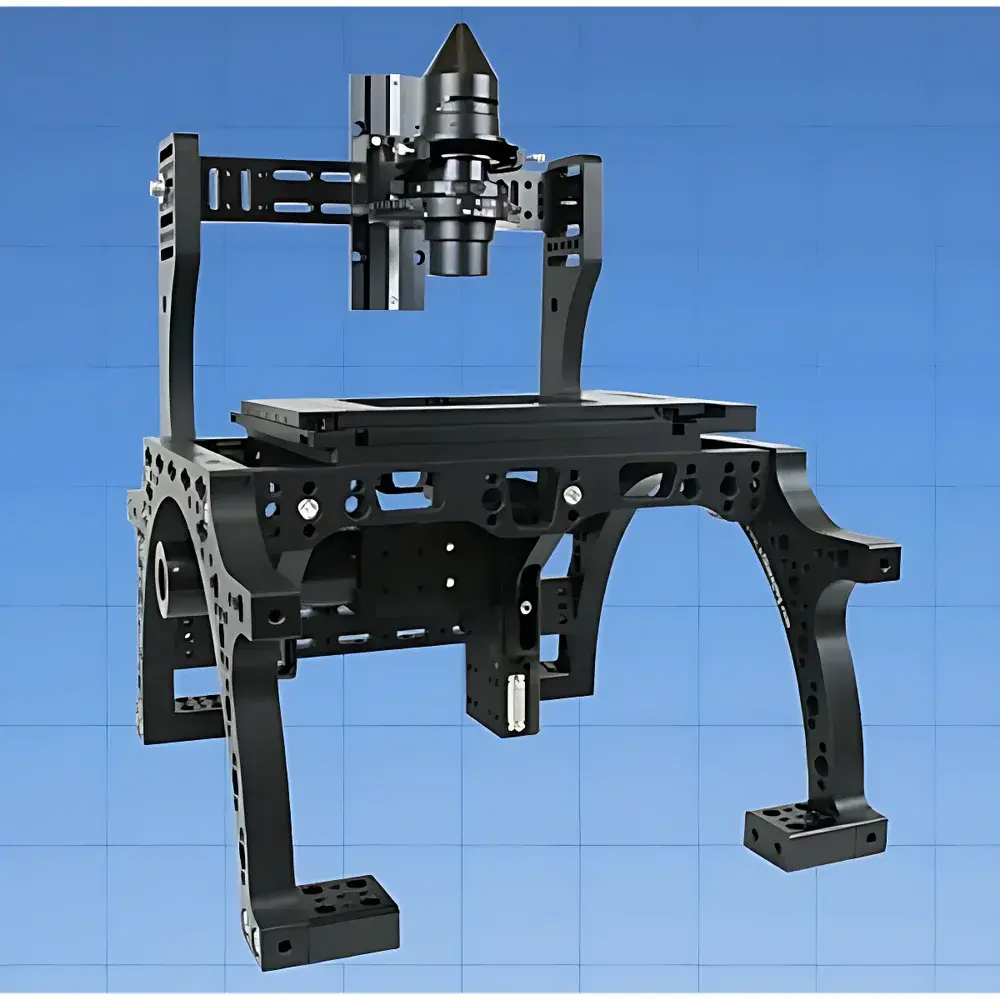
Auniontech MIM Modular Infinity-Corrected Microscopy Platform
| Brand | Auniontech |
|---|---|
| Origin | Shanghai, China |
| Manufacturer Type | Authorized Distributor |
| Product Category | Domestic |
| Model | Biological Micro-Imaging System |
| Pricing | Upon Request |
Overview
The Auniontech MIM (Modular Infinity-Corrected Microscopy) Platform is an engineered optical infrastructure designed for research-grade prototyping and validation of advanced microscopy architectures. Unlike fixed-function commercial microscopes, the MIM platform implements a true infinity-corrected optical design—ensuring collimated light propagation between objective and tube lens—which enables precise insertion, repositioning, and interchanging of optical components without compromising wavefront fidelity or magnification linearity. This architecture supports quantitative imaging modalities including epifluorescence, transmitted-light DIC, confocal scanning, TIRF, and structured illumination—all within a single mechanical framework. The system’s core mechanical stability derives from its LS-50 linear stage-based backbone, which provides sub-micron positional repeatability and thermal drift compensation via rigid aluminum alloy construction and kinematic mounting interfaces. It is not a “microscope” in the conventional sense but rather a standardized, ISO-traceable optical bench optimized for iterative optical engineering in academic labs, core imaging facilities, and OEM development environments.
Key Features
- Modular infinity-corrected optical path with standardized C-mount and 60 mm cube interfaces for seamless integration of objectives, tube lenses, dichroics, and filters
- LS-50 precision linear stage foundation enabling XYZ alignment with ≤0.5 µm resolution and <100 nm long-term positional drift over 8 hours
- Interchangeable optical cubes (CUBE-I, CUBE-II, CUBE-III) supporting 25 mm filters, 25 × 36 mm dichroic mirrors, and motorized mirror tilt adjustment (CUBE-III)
- Four-position manual or motorized optical path selector with C60-CUBE footprint compatibility and full software control via Micro-Manager and MetaMorph
- CRISP autofocus system utilizing infrared reference-beam detection at refractive index discontinuities (e.g., glass–water interface), delivering continuous focus stabilization with ±5 nm axial repeatability
- Dual-controller ecosystem: MS2000 (4-axis) for basic XYZ + focus actuation; TG-8/TG-16 (8-/16-channel) for synchronized control of piezo stages, filter wheels, MEMS scanners, PMTs, tunable lenses, and multi-wavelength LED drivers
Sample Compatibility & Compliance
The MIM platform accommodates standard microscope slide formats (76 × 26 mm), petri dishes (35–100 mm), and custom sample holders via configurable dovetail and tapped-hole mounting surfaces. All optical modules conform to ANSI/ISO 10110 surface quality standards (scratch-dig 20–10), and mechanical components meet ISO 2768-mK general tolerances. The system supports GLP-compliant workflows through audit-trail-capable controller firmware and time-stamped metadata logging in Micro-Manager. While not FDA-cleared as a diagnostic device, the platform complies with IEC 61000-6-3 (EMC emissions) and IEC 61000-6-2 (immunity) for laboratory instrumentation. Optical safety follows ANSI Z136.1 Class 1/1M requirements when integrated with approved laser sources.
Software & Data Management
Native support for open-source Micro-Manager v2.0+ and commercial MetaMorph 7.12+ ensures full hardware abstraction, multi-dimensional acquisition scripting (Z-stack, time-lapse, channel multiplexing), and real-time ROI-based triggering. Controller firmware logs all actuator commands, sensor readings, and timestamped configuration changes—enabling reproducible experiment reconstruction. TG-series controllers export JSON-formatted device state files compatible with Python-based analysis pipelines (e.g., napari, scikit-image). No proprietary binary formats are used; raw image data is saved in TIFF or OME-TIFF with embedded EXIF and OMEXML metadata per Open Microscopy Environment specifications.
Applications
- Rapid prototyping of custom light-sheet fluorescence microscopes (LSFM) using interchangeable illumination arms and detection paths
- Development and validation of adaptive optics modules, including deformable mirror integration and wavefront sensor coupling
- Quantitative phase imaging system assembly (e.g., DHM, QPI) requiring stable common-path interferometric configurations
- Multi-modal correlative platforms combining widefield fluorescence, Raman spectroscopy, and AFM synchronization via shared coordinate referencing
- Teaching laboratories requiring modular disassembly/reassembly for optics pedagogy and aberration analysis exercises
FAQ
Can the MIM platform be used with high-NA oil immersion objectives?
Yes—the platform’s mechanical rigidity and Z-stage repeatability support objectives up to 100×/1.49 NA; objective adapters include parfocal spacing compensation and lateral centering adjustment.
Is third-party camera integration supported?
All standard C-mount, F-mount, and M42-mount cameras are mechanically and electrically compatible; trigger signals, exposure control, and ROI readout are fully scriptable via Micro-Manager DeviceAdapters.
Does the system support automated multi-position tile scanning?
Yes—MS2000 and TG-series controllers provide hardware-accelerated stage sequencing with sub-pixel overlap correction and mosaic stitching metadata export.
Are optical alignment tools included?
A calibrated HeNe alignment laser, crosshair reticle eyepiece, and collimation verification target set are available as optional accessories (Part No. MIM-ALN-KIT).
What documentation is provided for regulatory submissions?
A complete Design History File (DHF) package—including mechanical drawings, optical layout diagrams, firmware revision logs, and calibration certificates—is supplied upon request for GxP-aligned development projects.



