
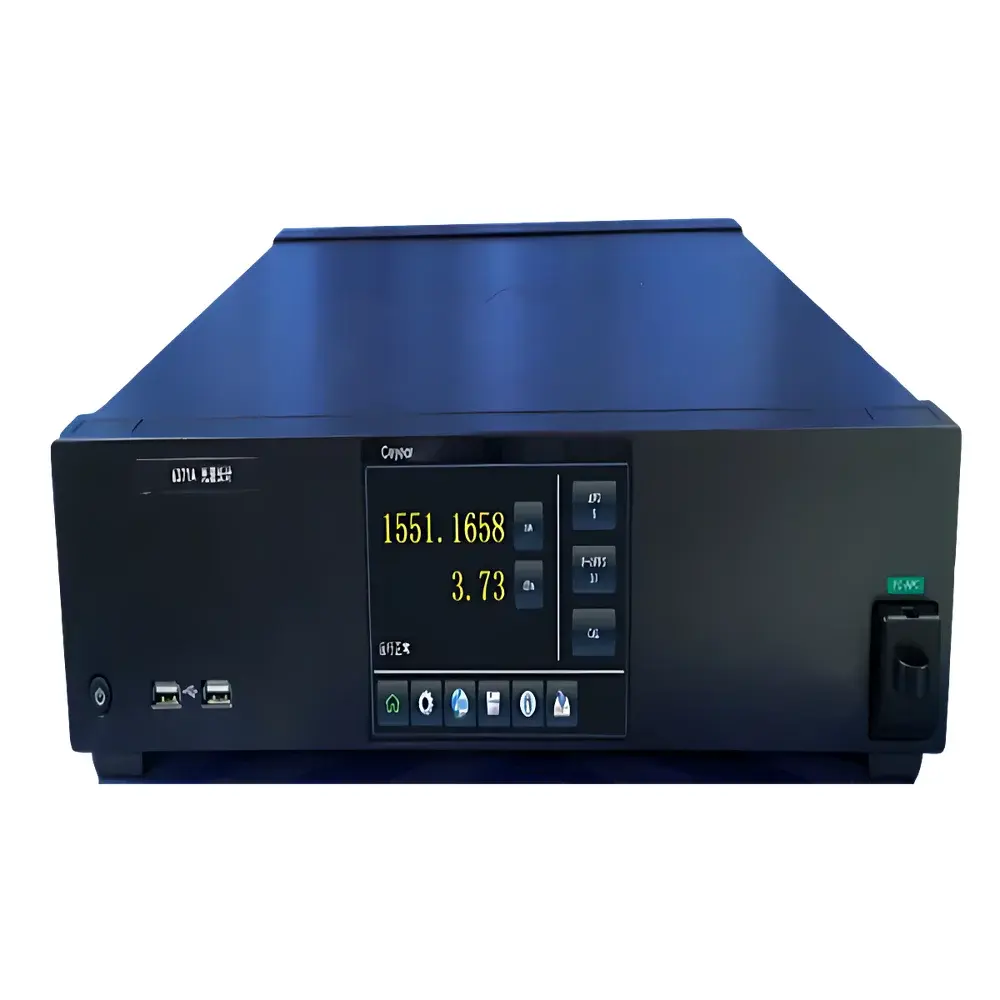
Auniontech 6371A High-Resolution Optical Wavelength Meter for Telecom Bands
| Brand | Auniontech |
|---|---|
| Origin | Shanghai, China |
| Model | 6371A |
| Wavelength Range | 1250–1650 nm |
| Wavelength Accuracy | ±0.65 ppm (±0.1 pm @ 1550 nm) |
| Wavelength Resolution | 0.1 pm |
| Power Accuracy | ±0.5 dB (@ 1310 nm & 1550 nm, ±30 nm bandwidth) |
| Power Linearity | ±0.5 dB |
| Power Resolution | 0.01 dB |
| Sensitivity | −25 dBm @ 1 kHz (3 µW), −30 dBm @ 500 Hz (1 µW), −35 dBm @ 250 Hz (0.3 µW), −40 dBm @ 100 Hz (0.1 µW) |
| Max Input Power | < 18 dBm |
| Return Loss | > 35 dB |
| Measurement Speed | < 1 kHz |
| Input Connector | FC/APC |
| Operating Temperature | 15–30 °C, ≤75% RH |
| Dimensions | 426 × 98.5 × 426.5 mm |
Overview
The Auniontech 6371A High-Resolution Optical Wavelength Meter is a precision metrology instrument engineered for demanding wavelength characterization tasks in optical telecommunications and photonics R&D environments. It implements a Fizeau interferometric architecture coupled with a high-speed, low-noise area-scan detector array to deliver sub-picometer wavelength resolution and exceptional measurement repeatability. Unlike grating-based or scanning Fabry–Pérot approaches, the Fizeau design enables single-shot, absolute wavelength determination without mechanical tuning—making it intrinsically suited for both continuous-wave (CW) and pulsed laser sources. Its calibrated spectral response spans the full telecom C- and L-bands (1250–1650 nm), covering key wavelengths used in DWDM systems, tunable lasers, DFB/DBR emitters, and coherent transceivers. With a specified accuracy of ±0.65 ppm (equivalent to ±0.1 pm at 1550 nm) and real-time measurement rates up to 1 kHz, the 6371A supports dynamic applications including wavelength drift monitoring, laser stabilization feedback, and production-line calibration of tunable light sources.
Key Features
- Fizeau interferometer core with monolithic thermal-stable optical path for long-term wavelength stability and minimal environmental drift
- Single-shot acquisition mode enabling deterministic latency and synchronization via external TTL trigger input
- High sensitivity down to −40 dBm at 100 Hz measurement rate, supporting low-power test configurations and integrated photonic device characterization
- Compact benchtop form factor (426 × 98.5 × 426.5 mm) optimized for integration into automated test equipment (ATE) racks and lab-scale optical benches
- FC/APC input interface with >35 dB return loss specification to minimize back-reflection-induced measurement artifacts
- Power measurement capability with ±0.5 dB accuracy and 0.01 dB display resolution, traceable to NIST-traceable reference detectors
Sample Compatibility & Compliance
The 6371A is designed for direct fiber-coupled input from standard single-mode telecom fibers (SMF-28, G.652.D). It accepts both polarized and unpolarized light without performance degradation and maintains accuracy across typical telecom source linewidths—from narrow-linewidth DFB lasers (<100 kHz) to broader multimode pump diodes. The instrument complies with IEC 61326-1:2013 for electromagnetic compatibility (EMC) and meets safety requirements per IEC 61010-1:2010 for laboratory electrical equipment. While not certified to ISO/IEC 17025 as a standalone calibration laboratory, its wavelength scale is traceable to primary standards maintained by national metrology institutes (e.g., NIM China, PTB Germany) via documented intercomparison protocols. For regulated environments—including those governed by FDA 21 CFR Part 11 or ISO 13485—the optional audit trail logging module records all measurement parameters, operator ID, timestamp, and system configuration changes with cryptographic integrity.
Software & Data Management
Control and analysis are performed via the native Windows-based AunionTech WLM Control Suite, which provides API support for LabVIEW, Python (PyVISA), MATLAB, and .NET frameworks. The software implements full data logging with user-defined metadata tagging, CSV/TXT export, and real-time plotting of wavelength vs. time, power vs. time, and drift histograms. All raw interferogram data can be exported for offline reprocessing using custom algorithms. Firmware updates are delivered through signed binary packages with SHA-256 verification. For enterprise deployment, the system supports domain authentication, role-based access control (RBAC), and integration with centralized LIMS platforms via OPC UA or RESTful HTTP endpoints. Measurement reports include full uncertainty budgets calculated per GUM (JCGM 100:2008) methodology, incorporating contributions from thermal drift, detector nonlinearity, and interferometer phase noise.
Applications
- Calibration and verification of tunable lasers (iTLA, SG-DBR, MEMS-VCSEL) in DWDM component manufacturing
- Wavelength drift and thermal tuning coefficient (nm/°C) quantification for laser packaging qualification
- Reference-grade validation of optical spectrum analyzers (OSAs) and wavelength selective switches (WSS)
- Characterization of gain spectra and channel flatness in EDFAs and Raman amplifiers
- Pass/fail testing of filter insertion loss vs. wavelength in AWG, TFF, and cascaded MUX/DEMUX modules
- Stabilization feedback loop integration for external cavity diode lasers (ECDLs) and frequency combs
- Optical sensing applications requiring sub-picometer resolution, such as fiber Bragg grating (FBG) interrogation and cavity ring-down spectroscopy
FAQ
What is the traceability basis for the wavelength scale calibration?
The factory calibration is performed against stabilized HeNe and iodine-stabilized lasers whose frequencies are directly referenced to the SI second via cesium fountain clocks. Certificate of calibration includes deviation curves and expanded uncertainties (k=2).
Can the 6371A measure modulated or chirped laser sources?
It measures instantaneous optical frequency at the moment of acquisition. For rapidly chirped sources (e.g., swept lasers), measurement validity requires that the chirp rate remains below 1 MHz/ms within the integration window to avoid spectral smearing.
Is averaging supported, and how does it affect measurement uncertainty?
Yes—software-supported ensemble averaging of up to 1024 consecutive acquisitions reduces random phase noise, improving wavelength repeatability by up to √N. Uncertainty propagation accounts for both statistical and systematic components per GUM Annex H.1.
Does the instrument support GPIB or only USB/Ethernet interfaces?
Standard configuration includes USB 3.0 and 10/100/1000BASE-T Ethernet. GPIB is not natively supported but can be enabled via optional IEEE-488.2-to-Ethernet bridge modules compliant with SCPI 1999.
How is linearity verified across the 1250–1650 nm range?
Using a set of 12 NIST-traceable laser lines spanning the band, measured sequentially under identical thermal and alignment conditions. Residual nonlinearity is corrected in firmware using a 5th-order polynomial fit with residuals < ±0.02 pm RMS.






