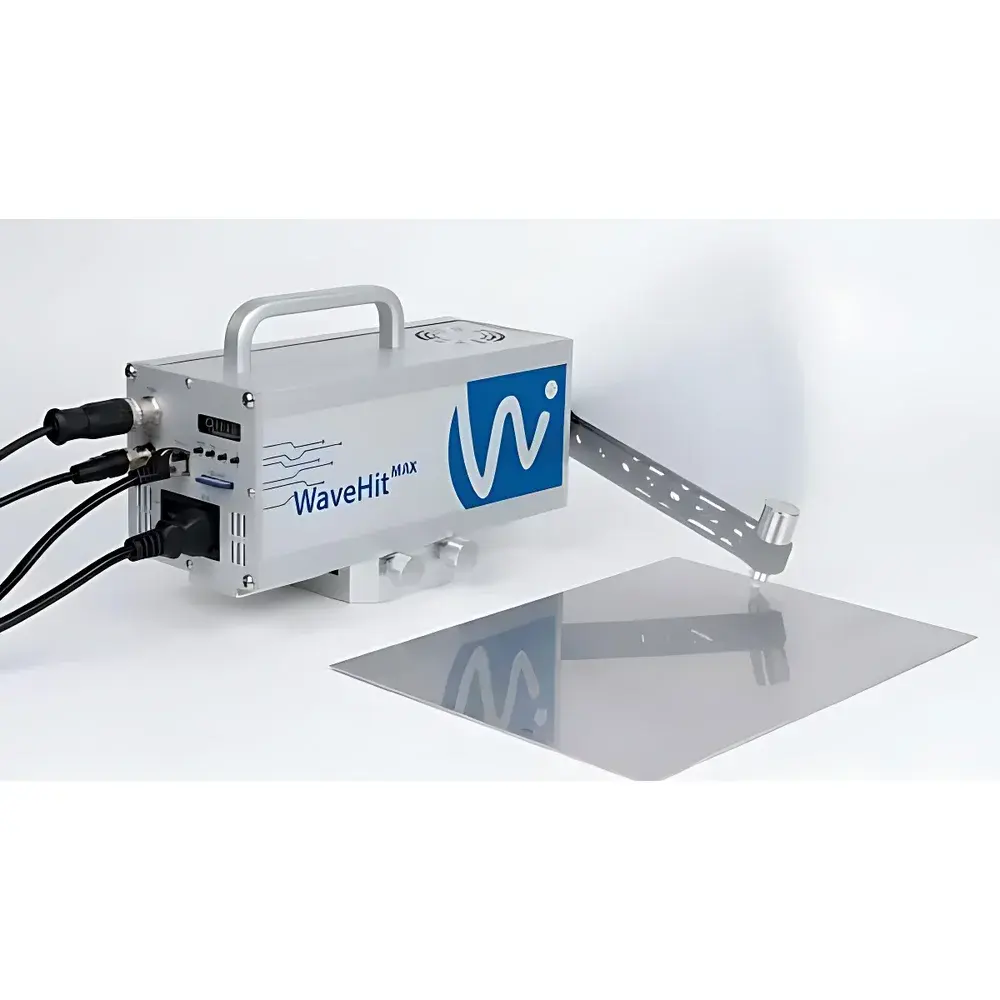
Auto-Modal Impulse Hammer WaveHitMAX by Auniontech
| Brand | Auniontech |
|---|---|
| Model | WaveHitMAX |
| Type | Fully Automated Modal Excitation Impulse Hammer |
| Force Sensing | Single-Axis Piezoelectric Load Cell (2.224 N & 444 N Full-Scale Options) |
| Hammer Tip Materials | Metal (Hard), Plastic (Medium), Rubber (Soft), Ultra-Soft Rubber |
| Tip Mass Add-ons | 12 g & 60 g |
| Trigger Interface | M12 Digital Input |
| Signal Output | BNC (IEPE-compatible) |
| Connectivity | Ethernet, SD Card Slot |
| Compliance | Designed for ISO 18431-1, ASTM E2534, and modal testing workflows compliant with ISO 7626-2 and ISO 10816 series |
Overview
The Auto-Modal Impulse Hammer WaveHitMAX by Auniontech is a precision-engineered, fully automated instrument for structural modal excitation in experimental modal analysis (EMA). Unlike conventional manual impulse hammers, the WaveHitMAX integrates real-time force feedback, adaptive impact positioning, and closed-loop control to deliver repeatable, single-hit excitations without bounce or double-impact artifacts. It operates on the principle of controlled transient mechanical excitation—applying a short-duration, broadband force pulse to a structure, enabling high-fidelity acquisition of frequency response functions (FRFs) via synchronized data acquisition systems. The system is optimized for laboratory, production-line, and field-based vibration testing where repeatability, operator independence, and environmental robustness are critical. Its architecture supports both fixed-base and dynamically shifting test setups—compensating autonomously for minor positional drifts or platform motion during operation.
Key Features
- Fully automated impact sequence: self-locates optimal strike point and angle via integrated scanning algorithm, eliminating manual alignment dependency.
- Bounce-free excitation: proprietary contact-detection and release logic ensures single, clean impact per trigger cycle—verified in time-domain waveform inspection.
- Adaptive force calibration: real-time adjustment of hammer mass (12 g / 60 g add-on weights) and tip stiffness (metal, plastic, soft/rubber variants) to match target frequency bandwidth and structural impedance.
- Integrated controller with touchscreen interface, Ethernet remote control, and SD-card logging for standalone operation.
- IEPE-compatible BNC output (±5 V, 100 mV/g typical sensitivity) with built-in charge amplifier; dual-range piezoelectric force sensors (2.224 N and 444 N full scale) ensure accurate dynamic range coverage across light and heavy structures.
- M12 digital trigger input for synchronization with external DAQ systems; supports TTL-level start/stop commands and hardware gating.
Sample Compatibility & Compliance
The WaveHitMAX is compatible with rigid and semi-rigid mechanical components—including castings, machined housings, PCB assemblies, turbine blades, automotive subframes, and aerospace structural panels. It accommodates surface curvatures and limited-access geometries through its compact head design and angular auto-scan function. The system adheres to core standards governing modal testing practice: ISO 7626-2 (measurement of mechanical admittance), ISO 18431-1 (signal processing for vibration and shock), and ASTM E2534 (guidelines for impact testing of rotating machinery). Data integrity meets GLP-aligned traceability requirements when used with compliant DAQ software supporting audit trails and electronic signatures (e.g., NI VeriStand, Siemens Testlab, or HEAD Acoustics Artemis).
Software & Data Management
The WaveHitMAX operates natively with Auniontech’s WaveControl Suite—a Windows-based application providing real-time impact preview, FRF preview, force-time history overlay, and automatic rejection of double-impacts based on time-domain thresholding and spectral null detection. All raw force waveforms and metadata (tip type, mass, impact location, timestamp, sensor ID) are stored in IEEE-compliant UFF58 format on internal SD card or streamed over Ethernet to host PC. Export options include MATLAB (.mat), CSV, and HDF5 for post-processing in ME’scope, LMS Test.Lab, or Python-based SciPy workflows. The system supports FDA 21 CFR Part 11–compliant configurations when deployed with validated third-party DAQ platforms offering electronic signature and change-control features.
Applications
- Production-line modal screening of assembled components for resonance shift detection (e.g., weld integrity verification, bolt preload assessment).
- Lab-based experimental modal analysis of prototypes under varying boundary conditions (free-free, suspended, or fixture-mounted).
- Vibration qualification of electronics enclosures and PCB stacks against MIL-STD-810H Method 514.8.
- Acoustic resonance mapping of architectural panels, composite laminates, and MEMS packaging substrates.
- Educational use in mechanical engineering labs for teaching FRF measurement, mode shape extraction, and damping estimation techniques.
FAQ
What parameters determine appropriate excitation bandwidth?
Excitation bandwidth is governed primarily by hammer tip stiffness and effective mass. Harder tips (e.g., metal) produce shorter-duration impulses ( 1 ms), limiting upper frequency to ~500 Hz. Mass reduction further increases high-frequency energy transfer but must be balanced against sufficient force amplitude to overcome sensor noise floor.
How does the WaveHitMAX detect and reject double impacts?
It applies dual-domain validation: time-domain peak separation analysis (minimum 2 ms inter-peak interval) and frequency-domain interference pattern recognition—specifically, comb-filter-like notches spaced at intervals corresponding to reciprocal impact timing errors.
Can the WaveHitMAX operate in unattended, long-duration test sequences?
Yes—when configured with scheduled trigger logic and SD-card logging, it supports autonomous multi-point modal surveys across predefined grid locations, with automatic pass/fail flagging based on user-defined force amplitude and waveform symmetry thresholds.
Is calibration traceable to national standards?
Force sensors ship with NIST-traceable calibration certificates (per ISO 17025-accredited lab); periodic recalibration is recommended every 12 months or after 10,000 impacts, whichever occurs first.