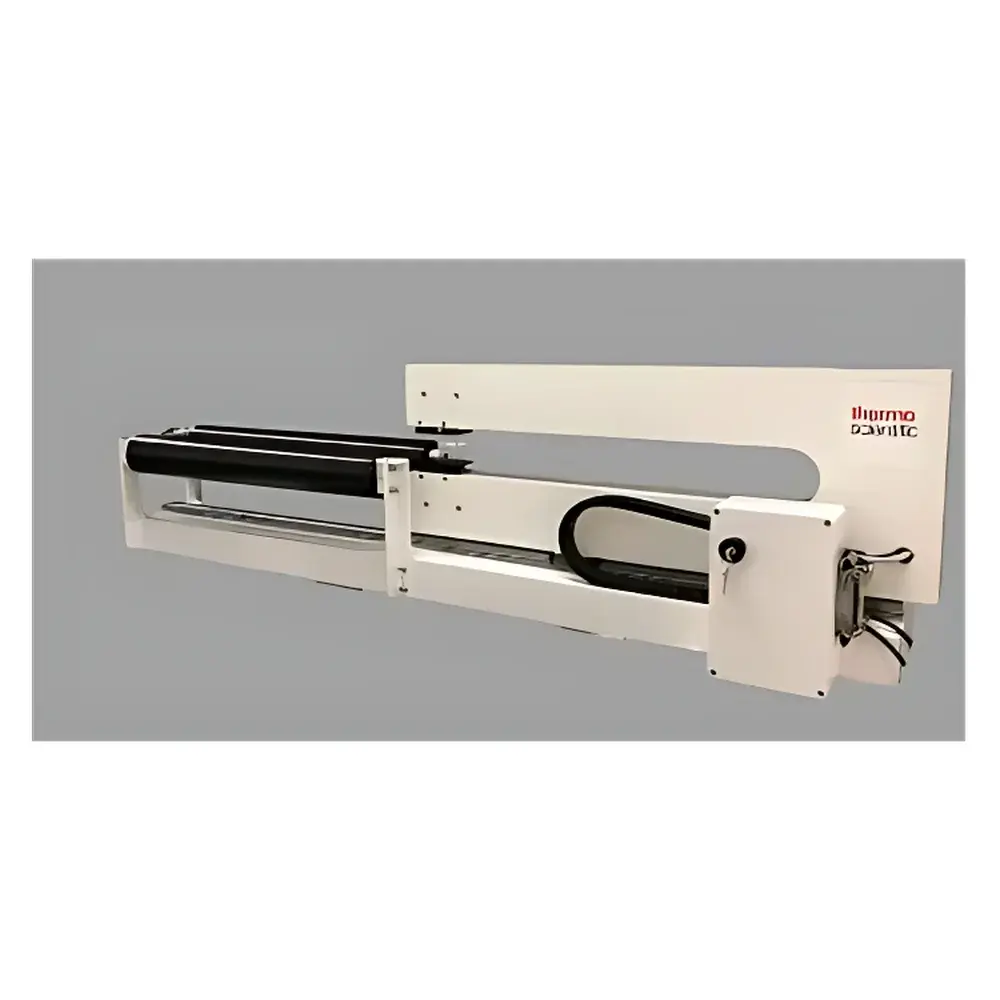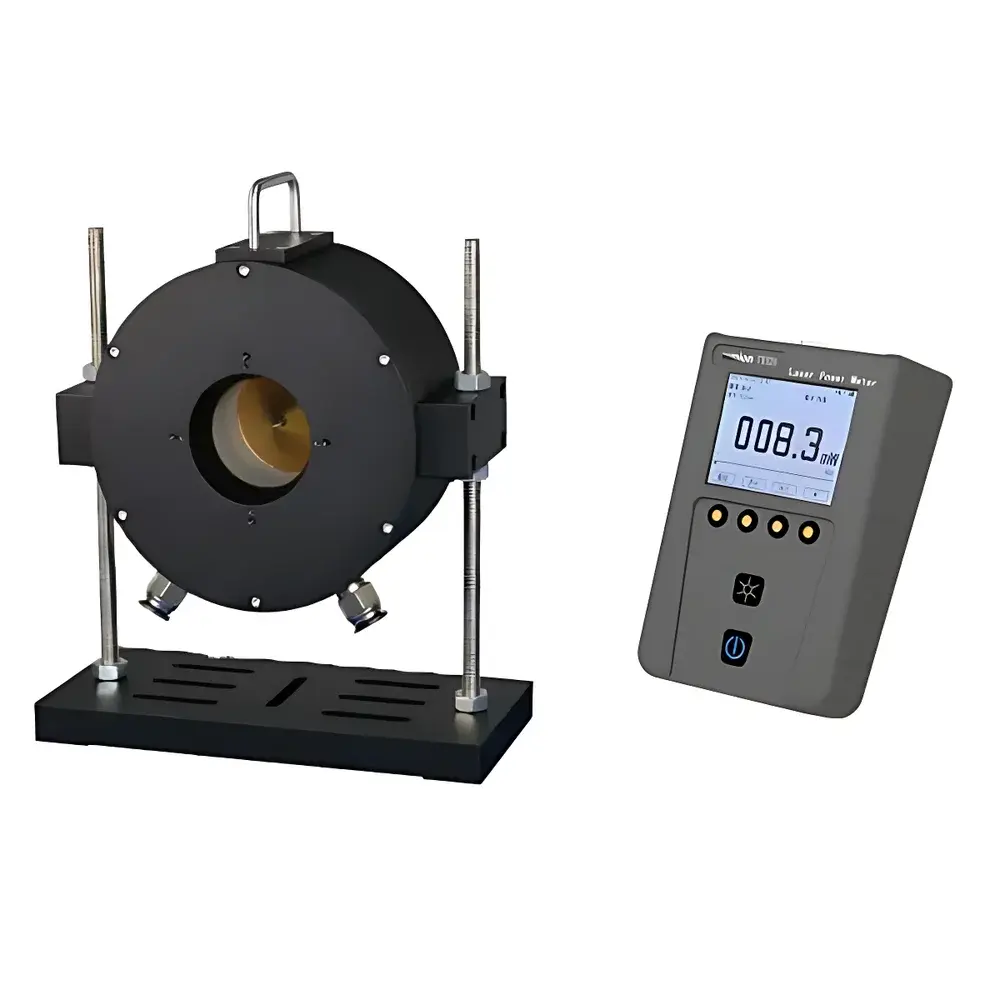
Auniontech AUT-5KW-W / AUT-15KW-W / AUT-30KW-W High-Power Laser Power Meter (≥1 kW)
| Brand | Auniontech |
|---|---|
| Origin | Shanghai, China |
| Model Series | AUT-5KW-W, AUT-15KW-W, AUT-30KW-W |
| Spectral Range | 0.19–25 µm (AUT-5KW-W) |
| Power Range | 20 W–5 kW / 100 W–15 kW / 100 W–30 kW |
| Resolution | 1000 mW |
| Nonlinearity | <1% / <2% / <2% |
| Accuracy | <3% / <5% / <5% |
| Response Time | <3.5 s / <3 s / <5 s |
| Aperture Diameter | 55 mm / 55 mm / 80 mm |
| Max Avg. Power Density | 20 kW/cm² (CW), 3 kW/cm², 10 kW/cm² |
| Max Energy Density | 0.3 J/cm² @ 1064 nm, 1 ns (AUT-5KW-W) |
| Cooling | Water-cooled (5–10 / 8–15 / 10–30 L/min) |
| Interface | DB-9M |
| Cable Length | 1.5 / 5 / 10 m |
Overview
The Auniontech AUT-Series High-Power Laser Power Meters are engineered for precise, stable, and safe measurement of continuous-wave (CW) and pulsed laser radiation at power levels exceeding 1 kW—up to 30 kW in the AUT-30KW-W variant. Unlike conventional thermopile or pyroelectric sensors limited by thermal saturation and damage risk, these instruments utilize a robust, water-cooled absorber architecture optimized for high average power density handling. The core measurement principle is based on calorimetric energy conversion: incident laser radiation is absorbed by a calibrated, spectrally broadband coating; the resulting temperature rise is measured via high-stability thermistor networks and converted into optical power using traceable calibration coefficients. Designed specifically for industrial and research environments where beam stability, long-term drift resistance, and operational safety are critical, the AUT-Series complies with fundamental requirements for radiometric traceability under ISO/IEC 17025-accredited calibration practices.
Key Features
- Three scalable models supporting 5 kW, 15 kW, and 30 kW maximum CW power measurement—enabling selection aligned with specific system output and safety margins
- Broad spectral coverage: 0.19–25 µm for AUT-5KW-W (encompassing UV excimer, visible, NIR, and far-IR CO₂ lasers); dual-band optimization (0.8–2 µm and 10.6 µm) for AUT-15KW-W and AUT-30KW-W to maximize absorptivity at common fiber laser and CO₂ wavelengths
- Large aperture geometry: 55 mm (AUT-5KW-W/AUT-15KW-W) and 80 mm (AUT-30KW-W) clear apertures accommodate highly divergent or expanded beams without clipping or edge effects
- Water-cooling integration with specified flow-rate ranges (5–10 L/min up to 10–30 L/min) ensures thermal equilibrium during extended operation—critical for maintaining measurement repeatability in production-grade laser processing
- Integrated USB interface (via optional external meter head or direct DB-9M-to-PC connectivity) enables real-time data streaming, remote monitoring, and synchronization with process control systems
- Single-shot pulse energy capability (for nanosecond pulses) supports qualification of high-energy Q-switched or MOPA sources alongside CW characterization
Sample Compatibility & Compliance
The AUT-Series accommodates collimated, focused, and multimode laser beams across material processing, defense, and scientific applications. Its absorber surface is qualified for maximum average power densities up to 20 kW/cm² (AUT-5KW-W, CW), with validated performance under ISO 11554-defined beam uniformity conditions. All models meet mechanical and electrical safety requirements per IEC 61010-1 for measurement equipment operating in industrial environments. Calibration certificates include NIST-traceable reference standards and uncertainty budgets compliant with ISO/IEC 17025. While not inherently FDA 21 CFR Part 11-compliant as a standalone hardware device, the system supports audit-ready data logging when paired with validated third-party software meeting GLP/GMP documentation protocols.
Software & Data Management
Auniontech provides a Windows-compatible PC application enabling real-time power display, statistical analysis (min/max/avg/std dev), time-stamped logging (CSV export), and configurable alarm thresholds. Raw analog output (via DB-9M) permits integration into PLC-based control loops or SCADA platforms. For regulated environments, users may implement supplementary software validation packages to satisfy 21 CFR Part 11 requirements—including electronic signatures, audit trails, and user access controls. Data integrity is preserved through lossless timestamping synchronized to host system clocks and buffered acquisition during transient network interruptions.
Applications
- Industrial laser manufacturing: Real-time power feedback control in multi-kilowatt fiber laser cutting, welding, and cladding systems
- High-power laser source qualification: Factory acceptance testing (FAT) of kW-class diode, disk, and fiber lasers per ISO 11146 and ISO 13694
- Laser weapon system development: Radiometric verification of directed energy output under variable atmospheric and thermal loading conditions
- Scientific laser physics: Characterization of ultrafast amplifier chains, OPCPA systems, and high-repetition-rate thin-disk lasers
- Optical component damage threshold testing: Quantitative irradiance mapping for coatings, windows, and focusing optics exposed to multi-kW beams
FAQ
What is the recommended minimum water flow rate for the AUT-15KW-W model?
The specified operational range is 8–15 L/min; sustained operation below 8 L/min may exceed thermal design limits and compromise accuracy or sensor longevity.
Can this instrument measure both CW and pulsed lasers?
Yes—continuous-wave measurement is its primary function, but it also supports single-pulse energy determination for pulses ≥1 ns duration, provided peak power remains within the sensor’s damage threshold envelope.
Is calibration traceable to national metrology institutes?
Each unit ships with a certificate referencing calibrations performed against standards maintained by CNAS-accredited laboratories, with full traceability to NIM (National Institute of Metrology, China) and cross-referenced to BIPM CIPM key comparisons.
Does the DB-9M interface support analog voltage output?
Yes—the interface provides isolated 0–10 V analog output proportional to measured power, configurable via software scaling factors for seamless OEM integration.
How often should recalibration be performed?
Annual recalibration is recommended for routine industrial use; more frequent intervals (e.g., quarterly) are advised for mission-critical defense or pharmaceutical laser applications governed by internal QA policies.