
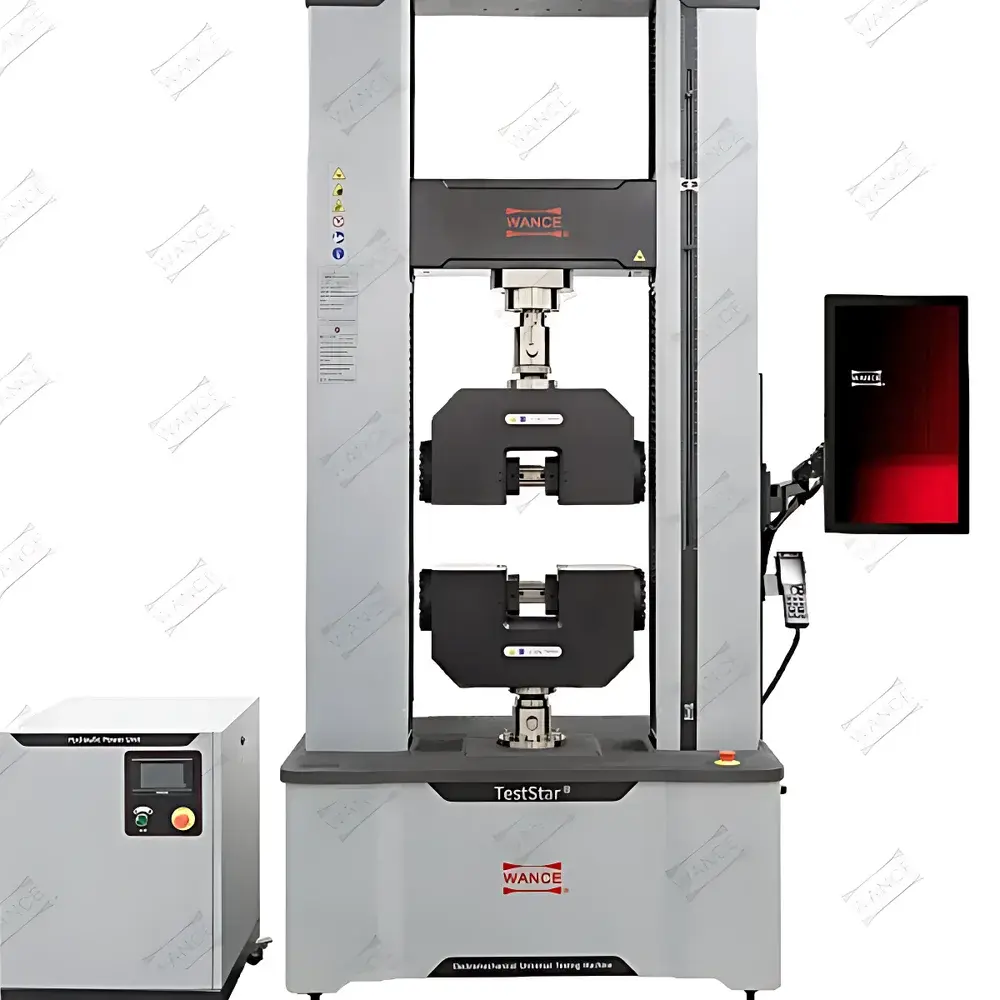
WANCE ETM305D Microcomputer-Controlled Electronic Universal Testing Machine
| Brand | WANCE |
|---|---|
| Model | ETM305D |
| Type | Electronic Universal Testing Machine |
| Load Capacity | 300 kN |
| Load Accuracy | ±0.5% |
| Frame Type | Floor-standing |
| Test Space | Single- or Dual-Space Configuration |
| Maximum Test Speed | 600 mm/min |
| Minimum Test Speed | 5 × 10⁻⁵ mm/min |
| Maximum Return Speed | 1200 mm/min |
| Crosshead Travel | 1200 mm |
| Crosshead Position Resolution | 0.0067 µm |
| Axial Frame Stiffness | 380 kN/mm (measured with spoke-type load cell) |
| Vertical Test Space | 1520 mm |
| Horizontal Test Space | 600 mm |
| Dimensions (H×W×D) | 2550/2650 × 1175 × 710 mm |
| Weight | 1225 kg (single-space) / 1500 kg (dual-space) |
| Power Supply | AC 380 V ±10%, 50 Hz, 4.6 kW |
Overview
The WANCE ETM305D is a floor-standing, microcomputer-controlled electronic universal testing machine engineered for high-precision static mechanical property evaluation of metallic and non-metallic materials under tension, compression, bending, shear, and peel loading conditions. It operates on the principle of closed-loop servo control, utilizing a high-rigidity dual-column frame and precision ball-screw-driven crosshead actuation to ensure stable force application and displacement tracking across wide dynamic ranges. Designed to meet the structural and metrological requirements of international standards—including ISO 6892-1, ASTM E8/E9/E21, GB/T 228.1–228.3, and GB/T 16491—the ETM305D delivers traceable, repeatable, and auditable mechanical test data suitable for R&D laboratories, quality control departments, and third-party certification facilities operating under GLP or GMP frameworks.
Key Features
- High-stiffness floor-standing frame with axial rigidity of 380 kN/mm—optimized to minimize compliance errors during high-load testing and ensure accurate stress-strain curve generation.
- Ultra-wide speed range: from 5 × 10⁻⁵ mm/min (for creep and relaxation studies) up to 600 mm/min (for high-speed tensile or impact-simulated loading), programmable in real time via digital control interface.
- Crosshead position resolution of 0.0067 µm supports sub-micron displacement monitoring—critical for low-strain modulus determination and fine-grained deformation analysis.
- Modular accessory integration architecture: compatible with high-temperature furnaces (up to 1200 °C), environmental chambers (−70 °C to +350 °C), automatic video extensometers, clip-on axial and transverse extensometers, strain gauges, and digital force transducers with NIST-traceable calibration certificates.
- Compliance with electromagnetic compatibility (EMC) and electrical safety standards per IEC 61000-6-3 and IEC 61010-1, ensuring safe operation in shared laboratory environments.
Sample Compatibility & Compliance
The ETM305D accommodates specimens ranging from miniature coupons (e.g., ASTM E8 sub-size bars) to full-section structural components (e.g., welded joints, composite laminates, or reinforced concrete prisms). Its 1520 mm vertical test space and 600 mm horizontal clearance enable testing of elongated or bulky samples without reconfiguration. The system conforms to mechanical testing standard requirements for force verification (ISO 7500-1 Class 0.5), displacement measurement accuracy (ISO 9513 Class 0.5), and machine classification per GB/T 16491-2022 (Class 0.5) and ASTM E4. All hardware and firmware configurations support audit-ready documentation per FDA 21 CFR Part 11 when paired with compliant software—enabling electronic signatures, user access controls, and immutable audit trails for regulated industries.
Software & Data Management
Control and analysis are performed using WANCE’s proprietary TESTSuite™ v5.x software, a Windows-based platform compliant with ISO/IEC 17025 documentation requirements. The software provides real-time synchronized acquisition of load, displacement, extensometer strain, temperature, and video-derived deformation fields. It supports automated test sequences per ISO 6892-1 Annex A (strain-controlled ramp-hold protocols), ASTM E21 thermal ramp profiles, and custom multi-step loading programs. Raw data export is available in CSV, XML, and universal .tdms formats; all reports include metadata such as operator ID, calibration dates, environmental conditions, and instrument configuration logs. Optional modules include statistical process control (SPC) dashboards and LIMS integration via HL7 or RESTful API.
Applications
- Mechanical characterization of aerospace alloys (Ti-6Al-4V, Inconel 718) under ambient and elevated temperatures per ASTM E21.
- Compression testing of civil engineering materials including concrete, mortar, and geosynthetic reinforcements per GB/T 7314 and ASTM C39.
- Bending performance evaluation of thermoplastic composites and fiber-reinforced polymers per ISO 7438 and GB/T 232.
- Peel and shear strength validation of adhesive bonds in automotive and electronics assembly lines.
- Calibration and verification of secondary force standards in national metrology institutes and accredited calibration labs.
FAQ
What standards does the ETM305D comply with for force calibration and verification?
The system meets ISO 7500-1 Class 0.5 for static force verification and is supplied with factory calibration certificates traceable to NIM (China National Institute of Metrology) or optional UKAS-accredited equivalents.
Can the ETM305D be integrated into an existing LIMS or MES environment?
Yes—via TESTSuite™’s configurable OPC UA server or HTTP-based API, enabling bidirectional data exchange with enterprise systems while preserving audit trail integrity.
Is high-temperature testing supported out-of-the-box?
The base system includes mounting interfaces and thermal shielding provisions for third-party high-temperature furnaces; furnace selection, installation, and thermal gradient validation must be performed per ASTM E220 and ISO 204.
What is the recommended maintenance schedule for long-term accuracy retention?
Biannual verification of load cell linearity, crosshead alignment, and screw preload is advised; annual recalibration by an ISO/IEC 17025-accredited provider is required for GLP/GMP compliance.
Does the system support simultaneous multi-channel data acquisition?
Yes—up to eight synchronized analog inputs (±10 V, 24-bit resolution) are available for concurrent acquisition of strain, temperature, acoustic emission, or LVDT signals alongside primary load/displacement channels.



