
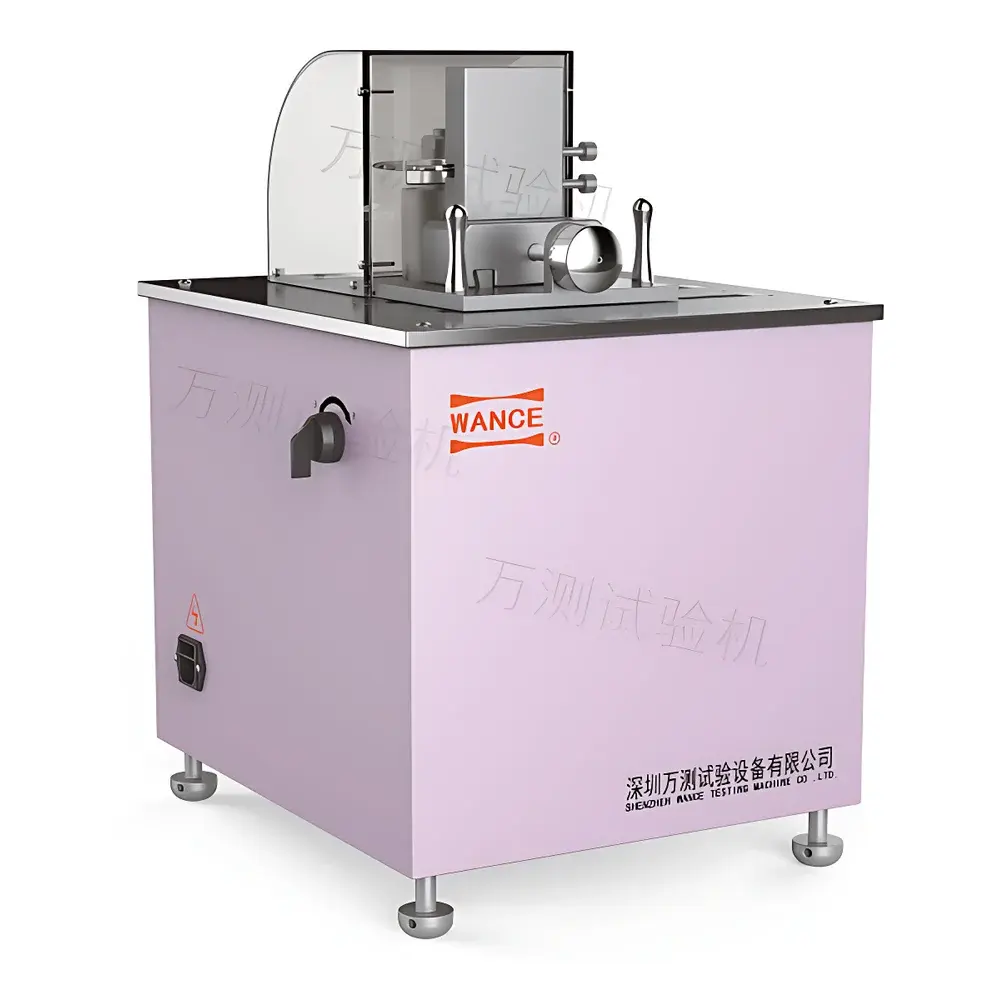
NSM Series A-Type Notching Machine for Plastic Specimens
| Origin | Guangdong, China |
|---|---|
| Manufacturer Type | Distributor |
| Origin Category | Domestic |
| Model | NSM Series A-Type |
| Price | Upon Request |
| Specimen Types | Type 1, 2, 3, 4 |
| Notch Types | A, B, C1, C2 |
| A-Type Cutter Geometry | 45° ± 30′, r = 0.25 mm (standard) |
| B-Type | 45° ± 30′, r = 1 mm |
| C1-Type Thickness | 2.0 ± 0.2 mm |
| C2-Type Thickness | 0.8 ± 0.1 mm |
| Max. Specimen Thickness | 25 mm |
| Motor Speed | 1440 rpm |
| Dimensions (L×W×H) | 316 × 366 × 450 mm |
| Power Supply | 220 V ± 10%, 5 A, 50 Hz |
| Net Weight | ~30 kg |
Overview
The NSM Series A-Type Notching Machine for Plastic Specimens is a precision mechanical instrument engineered to produce standardized notches in polymeric test bars prior to Charpy or Izod impact testing per ASTM D6110, ISO 179-1, ISO 180, and GB/T 1043.1. It operates on a fixed-cutter, linear-feed principle: the specimen is clamped onto a horizontally translating stage, which advances the material into a stationary high-hardness alloy cutting tool under controlled feed geometry. This deterministic kinematic arrangement ensures repeatable notch depth, consistent root radius, and minimal thermal or mechanical distortion—critical prerequisites for valid fracture toughness evaluation. Unlike manual filing or milling methods, the NSM Series eliminates operator-dependent variability and delivers edge integrity compliant with ISO 2818 requirements for machined polymer specimens.
Key Features
- Interchangeable hardened alloy cutter system supporting A-, B-, C1-, and C2-type notch geometries per ISO 2818 Annex A and ASTM D6110 Figure 1; A-type cutter (45° ± 30′, root radius 0.25 mm) supplied as standard.
- Linearly actuated specimen stage with micrometer-adjustable stop for precise notch depth control—enabling reproducible positioning within ±0.05 mm tolerance across repeated cycles.
- Integrated polycarbonate safety guard with interlocked power cutoff, meeting IEC 60204-1 requirements for mechanical safeguarding of industrial equipment.
- Stable cast-iron base and rigid column structure dampen vibration during cutting, minimizing chatter marks and preserving surface finish (Ra < 1.6 µm typical at notch root).
- Single-phase induction motor (1440 rpm, 220 V ± 10%, 50 Hz) coupled via direct-drive transmission—optimized for low-speed, high-torque operation essential for clean polymer chip removal without melting or smearing.
Sample Compatibility & Compliance
The NSM Series accommodates rectangular plastic bars conforming to ISO 179-1 (Charpy) and ISO 180 (Izod) dimensional specifications: widths from 4–15 mm, lengths ≥ 80 mm, and thicknesses up to 25 mm. Compatible materials include thermoplastics (e.g., ABS, PC, PP, PA6), thermosets (e.g., phenolic, epoxy composites), and filled polymers—provided hardness does not exceed 120 Shore D. All notch configurations comply with the geometric tolerances defined in ISO 2818:2019 Table 1 and ASTM D6110–22 Section 7. The machine itself bears no CE marking but conforms structurally to EN 61000-6-2 (immunity) and EN 61000-6-4 (emissions) when operated in laboratory environments. Documentation supports GLP-compliant validation protocols including installation qualification (IQ), operational qualification (OQ), and performance qualification (PQ) templates.
Software & Data Management
This is a fully mechanical, non-programmable device with no embedded firmware or digital interface. All operational parameters—including stage position, cutter type, and specimen dimensions—are set manually using calibrated vernier scales and physical stops. As such, it requires no software installation, network connectivity, or cybersecurity controls. Maintenance logs, calibration records, and usage history are maintained externally in paper-based or LIMS-integrated formats. For laboratories operating under FDA 21 CFR Part 11 or EU Annex 11, the absence of electronic records simplifies audit trails: each notch is traceable to operator ID, date/time stamp, and specimen lot number recorded in hard-copy lab notebooks or validated ELN systems.
Applications
- Preparation of notched specimens for standardized impact testing of engineering plastics in QC labs and R&D facilities.
- Supporting failure analysis workflows where notch sensitivity (e.g., environmental stress cracking resistance) must be evaluated under controlled geometry.
- Calibration verification of impact testers—using identically notched reference bars to assess machine energy repeatability per ISO 13802.
- Teaching laboratories in universities and technical colleges for hands-on instruction in polymer mechanical testing standards and specimen preparation best practices.
- Compliance testing for automotive interior components (e.g., dashboards, trim), electrical enclosures, and medical device housings requiring impact certification per UL 94 or ISO 3167.
FAQ
What standards does this notching machine support?
It produces specimens compliant with ISO 179-1 (Charpy), ISO 180 (Izod), ASTM D6110, ASTM D256, and GB/T 1043.1—specifically for Type 1–4 bars and A/B/C1/C2 notch profiles.
Can it process fiber-reinforced composites?
Yes, provided the composite’s nominal thickness ≤25 mm and the reinforcing phase does not contain abrasive particles exceeding 15% by volume (e.g., >30 wt% glass fiber may accelerate cutter wear).
Is calibration required before first use?
Yes—initial verification of stage travel linearity, cutter angle accuracy (±30′), and root radius conformity (via SEM or optical profilometry) must be performed using NIST-traceable gages and documented per ISO/IEC 17025.
How often should the A-type cutter be replaced?
Under typical lab usage (≤200 specimens/month), replace every 6–12 months or after visible edge rounding (>0.02 mm deviation in measured r-value) confirmed by metrology.
Does the machine require compressed air or coolant?
No—it operates dry, relying on optimized cutting speed and rake angle to prevent polymer adhesion or thermal degradation during machining.



