
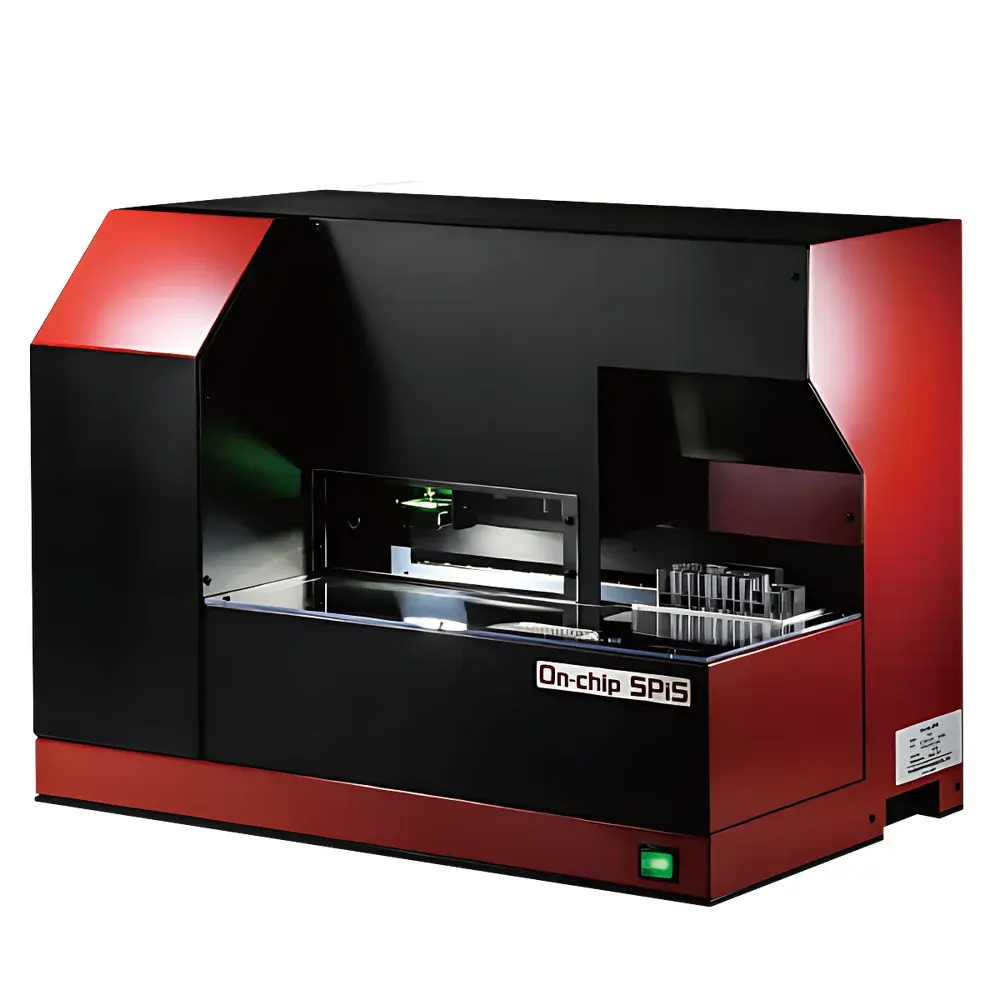
On-chip SPiS Automated Single-Cell Dispensing System
| Brand | On-chip |
|---|---|
| Origin | Japan |
| Model | On-chip SPiS |
| Separation Method | Fully Automated |
| Maximum Sample Diameter | 200 µm |
| Dispensing Accuracy | >90% |
| Consumable | Disposable Tips |
| Imaging System | Integrated CCD Camera |
| Dilution Capability | On-board Automatic Dilution |
Overview
The On-chip SPiS Automated Single-Cell Dispensing System is an integrated microfluidic platform engineered for high-fidelity, deterministic single-cell isolation and precise dispensing into multiwell plates or custom substrates. Unlike stochastic methods such as limiting dilution or FACS-based sorting—where clonality cannot be visually verified at the point of deposition—the SPiS system employs real-time optical confirmation via an embedded high-resolution CCD camera coupled with programmable microfluidic actuation. This enables deterministic selection and transfer of individual cells based on morphological criteria, size, and positional validation prior to dispensing. The system operates on the principle of pressure-driven microfluidic control within disposable, sterilized tip cartridges, ensuring minimal carryover, no cross-contamination between samples, and full traceability per dispense event. Designed specifically for applications demanding rigorous clonal assurance—including therapeutic cell line development, CRISPR-edited clone validation, and single-cell omics library preparation—the SPiS delivers reproducible, audit-ready single-cell workflows compliant with GLP-aligned laboratory practices.
Key Features
- Fully automated single-cell dispensing with real-time visual verification using integrated CCD imaging
- Deterministic cell selection: each dispensed event is confirmed optically before ejection, eliminating statistical uncertainty
- On-board automatic serial dilution module enabling precise concentration adjustment without manual pipetting
- Disposable, pre-sterilized microfluidic tips (no shared channels or fluidic pathways) ensure zero carryover and eliminate cleaning validation requirements
- Compatible with cells and micro-aggregates up to 200 µm in diameter—including spheroids, organoids, and primary tumor clusters
- Software-controlled dispensing into standard 96-well, 384-well, or custom-patterned plates with positional logging
- Minimal hands-on time: setup, loading, and run initiation completed in under 5 minutes
Sample Compatibility & Compliance
The SPiS platform supports a broad range of suspension-based biological samples, including adherent cells after gentle dissociation, PBMCs, stem cells, circulating tumor cells (CTCs), and multicellular structures such as tumor spheroids and embryoid bodies. Its non-contact, low-shear dispensing mechanism preserves cell viability and surface marker integrity—critical for downstream functional assays and sequencing. From a regulatory perspective, the system’s deterministic operation, electronic log generation (including timestamped images of each selected cell), and lack of reusable fluid paths align with expectations for data integrity under FDA 21 CFR Part 11 when deployed in GMP-adjacent environments. While not certified as medical device hardware, its architecture meets foundational requirements for use in ISO 13485-informed QC labs and academic core facilities conducting ICH-GCP–aligned translational research.
Software & Data Management
The SPiS Control Software provides intuitive workflow configuration through a graphical interface, supporting protocol templates for common applications (e.g., monoclonal antibody development, PDX-derived spheroid screening). Each run generates a structured metadata file containing acquisition timestamps, coordinate maps of dispensed wells, annotated CCD frames of selected objects, and dilution history logs. Export formats include CSV for LIMS integration and TIFF stacks for archival. Audit trails are immutable and password-protected; user access levels can be assigned to comply with role-based permissions frameworks. Raw image data retention follows institutional data governance policies, and optional encryption modules support HIPAA- and GDPR-compliant deployments.
Applications
- Monoclonal cell line derivation for biologics manufacturing, with documented clonality per ICH Q5D
- Single-cell RNA-seq and ATAC-seq library preparation requiring verified singlet input
- High-content drug screening using size-standardized spheroids—paired with On-chip Sort for pre-selection and SPiS for arrayed dispensing
- Functional validation of CRISPR-Cas9 knockouts or base-edited clones via phenotypic segregation
- Microbiome single-cell isolation from complex consortia using morphology-guided selection
- Development of patient-derived organoid biobanks with traceable lineage assignment
FAQ
Does the SPiS system require specialized training to operate?
No formal certification is required; operators with basic cell culture and microplate handling experience can achieve proficiency within one supervised session.
Can the system be integrated with existing LIMS or ELN platforms?
Yes—via standardized CSV export and optional API extension for direct ingestion into common laboratory informatics systems.
Is the CCD imaging resolution sufficient to distinguish viable from apoptotic cells?
The system resolves features ≥2 µm; while it does not perform live/dead staining autonomously, phase contrast morphology (e.g., membrane blebbing, nuclear condensation) can be assessed manually during review mode.
What maintenance is required beyond tip replacement?
None—there are no pumps, valves, or fluidic manifolds requiring calibration or cleaning; the system is designed for walk-away reliability.
Are consumables supplied exclusively by On-chip Biotech?
Yes—disposable tips and dilution cartridges are proprietary and manufactured under ISO 13485 quality management systems to ensure lot-to-lot consistency and sterility assurance.
Related Products




