
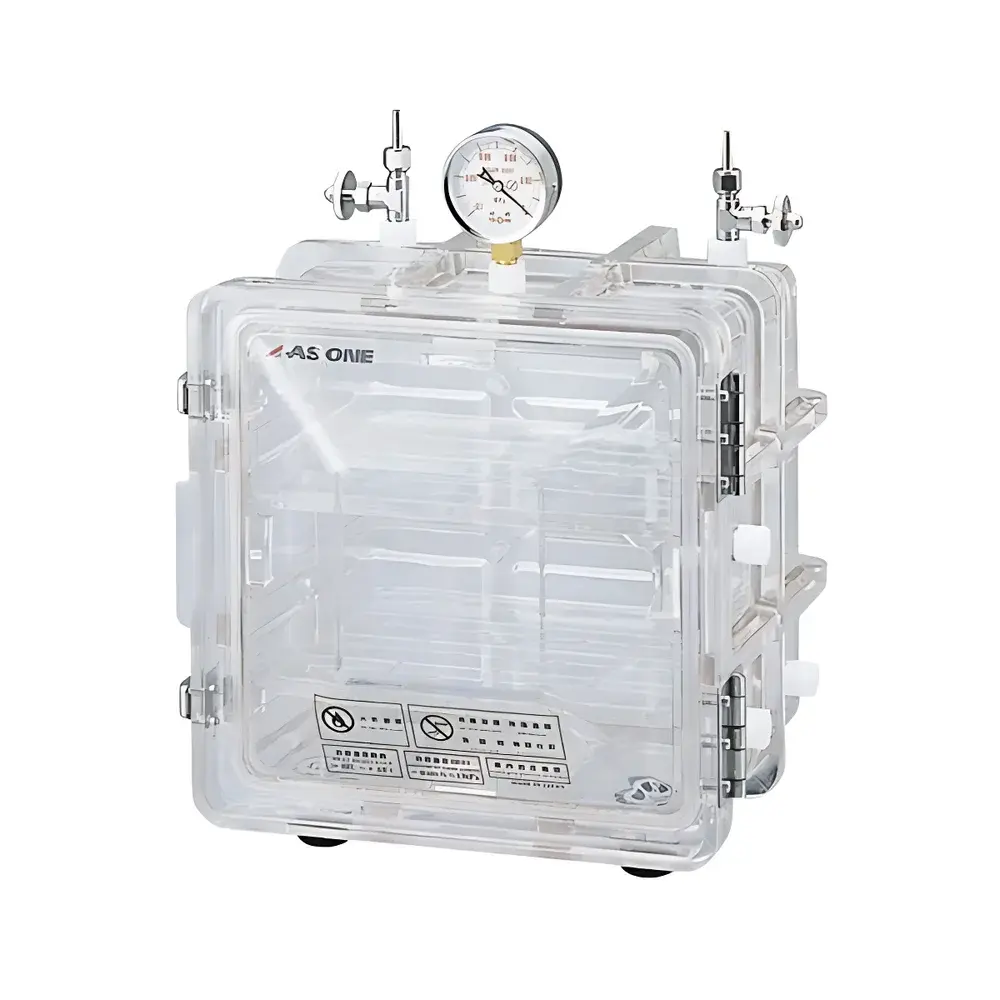
AS ONE MVD-100 Vacuum Desiccator Cabinet
| Brand | AS ONE |
|---|---|
| Origin | Japan |
| Manufacturer Type | Direct Manufacturer |
| Origin Category | Imported |
| Model No. | 1-6158-01 |
| Instrument Type | Vacuum Oven |
| Material | Polycarbonate (PC) |
| Chamber Capacity | 13 L |
| Internal Dimensions (W×D×H) | 250 × 210 × 250 mm |
| Shelf Dimensions | 250 × 200 mm |
| Number of Shelves | 4 |
| Max. Permissible Vacuum | 1 Torr (≈133 Pa) |
| Vacuum Gauge | 1 unit |
| Vacuum Valves | 2 × φ8 mm |
| Included Shelves | 2 |
| Weight | 7 kg |
| Load Capacity | Cabinet Body ≤50 kg, Shelf ≤5 kg |
| Mounting Options | Top or Right-Side Installation for Gauge/Valves |
Overview
The AS ONE MVD-100 Vacuum Desiccator Cabinet is an engineered solution for moisture-sensitive sample storage, conditioning, and low-temperature drying under controlled vacuum environments. Unlike conventional hot-air ovens, this unit operates without internal heating elements—its primary function is to maintain a stable, low-humidity atmosphere by evacuating ambient air and residual moisture from sealed enclosures. The cabinet leverages fundamental principles of vapor pressure depression: at reduced pressure, the boiling point and equilibrium relative humidity of water decrease significantly, enabling effective desiccation of hygroscopic materials—including reference standards, calibration weights, optical components, semiconductor wafers, and analytical reagents—without thermal degradation. Constructed entirely from high-impact polycarbonate (PC), the MVD-100 offers exceptional chemical resistance, optical clarity, and mechanical durability while eliminating metal corrosion risks common in stainless-steel alternatives. Its design prioritizes operational safety, long-term dimensional stability, and compatibility with GLP-compliant laboratory workflows.
Key Features
- Monolithic polycarbonate housing formed via precision thermoforming—no seams, welds, or gasket-dependent joints that compromise vacuum integrity.
- High-performance silicone sealing system between door and frame; requires no grease or lubricants for maintenance, ensuring contamination-free operation and consistent leak-tight performance over thousands of cycles.
- Modular vacuum interface: vacuum gauge and dual φ8 mm isolation valves can be mounted on either the top panel or right-side wall, supporting flexible benchtop integration and ergonomic access.
- Four-tier internal shelf support structure (2 shelves supplied standard); all shelves are removable, autoclavable, and rated for up to 5 kg distributed load per level.
- Stackable configuration certified for vertical pairing with the MVD-300N model (using optional interlocking brackets), optimizing floor space in high-density lab environments.
- No internal heaters or electrical components inside the chamber—eliminates fire hazard, electromagnetic interference, and thermal drift during sensitive gravimetric or spectroscopic procedures.
Sample Compatibility & Compliance
The MVD-100 is suitable for storage and stabilization of ISO/IEC 17025-certified reference materials, USP-grade pharmaceutical excipients, NIST-traceable calibration artifacts, and humidity-sensitive electronics. Its 13 L internal volume (250 × 210 × 250 mm) accommodates standard desiccator trays, Petri dishes, vial racks, and small instrumentation modules. All materials comply with RoHS Directive 2011/65/EU and meet UL 94 V-0 flammability rating for polycarbonate enclosures. While not classified as a medical device or FDA-regulated instrument, the unit supports GMP-aligned environmental control protocols when used in conjunction with validated vacuum pumps and documented logbooks. It conforms to JIS Z 8806:2017 (Humidity Control Equipment for Laboratories) and is routinely deployed in metrology labs adhering to ISO/IEC 17025 clause 6.4.3 (environmental monitoring).
Software & Data Management
The MVD-100 operates as a standalone passive vacuum enclosure and does not include embedded electronics or digital controllers. Vacuum monitoring relies on a mechanical analog Bourdon-tube vacuum gauge (included), calibrated to read from atmospheric pressure down to 1 Torr (133 Pa). For traceable data recording, users integrate external vacuum logging systems—such as capacitance manometers paired with USB data acquisition modules compliant with IEEE 1451.2 standards. When deployed in regulated environments, manual entries into electronic lab notebooks (ELNs) must include timestamped vacuum readings, pump-down duration, and ambient temperature/humidity—supporting audit readiness under FDA 21 CFR Part 11 where handwritten records are supplemented by secure, attributable digital backups.
Applications
- Precision weighing preparation: equilibrating analytical balances, calibration weights, and microgram-level samples prior to measurement to minimize hygroscopic mass drift.
- Long-term storage of lithium battery cathode materials, MOFs (metal–organic frameworks), and P2O5-based desiccants requiring <5% RH retention.
- Pre-conditioning of FTIR ATR crystals, UV-Vis cuvettes, and laser optics to prevent condensation-induced scattering or coating delamination.
- Stabilization of enzyme powders, lyophilized proteins, and oligonucleotides prior to reconstitution or QC testing.
- Supporting ASTM E104-20 (Standard Practice for Maintaining Constant Relative Humidity by Means of Aqueous Solutions) via integration with saturated salt solutions placed inside the chamber.
FAQ
Is the MVD-100 compatible with oil-free vacuum pumps?
Yes—the unit’s φ8 mm vacuum ports accept standard KF-10 or NW10 fittings; compatibility with diaphragm, scroll, and dry piston pumps is confirmed per manufacturer specifications.
Can I install a temperature sensor inside the chamber?
No internal power supply or feedthroughs are provided; however, wireless Bluetooth temperature/humidity loggers (e.g., Onset HOBO UX100 series) may be placed inside for post-cycle analysis.
What is the typical ultimate vacuum achievable with a standard two-stage rotary vane pump?
When paired with a properly maintained pump and leak-free connections, users routinely achieve ≤50 mTorr (6.7 Pa) within 15 minutes—well below the 1 Torr (133 Pa) maximum permissible limit.
Does AS ONE provide validation documentation for IQ/OQ protocols?
Factory test reports confirming vacuum hold-time (≥30 min at 1 Torr), dimensional conformity, and material certifications are available upon request; full qualification support requires third-party vendor engagement.
How often should the silicone seal be replaced?
Under normal use (≤5 cycles/day), the seal maintains functional integrity for ≥5 years; visual inspection for compression set or cracking is recommended annually as part of preventive maintenance.



