
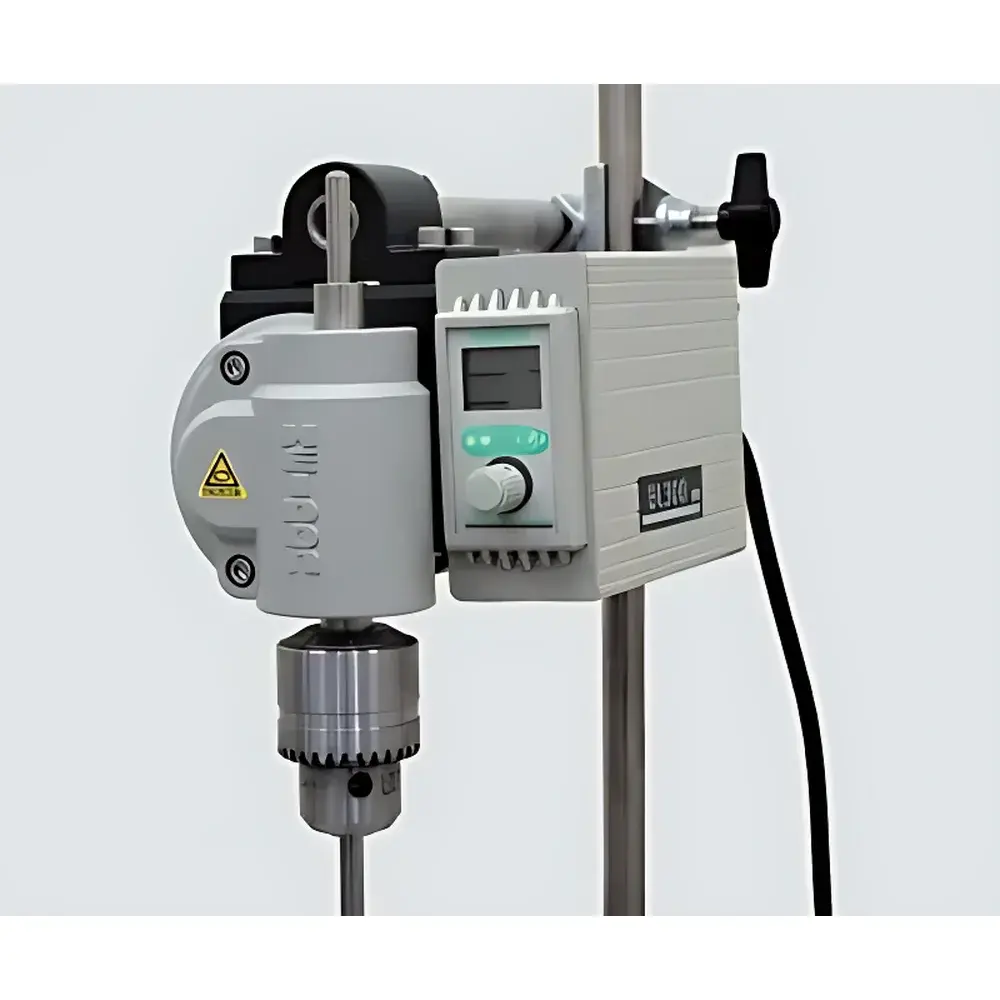
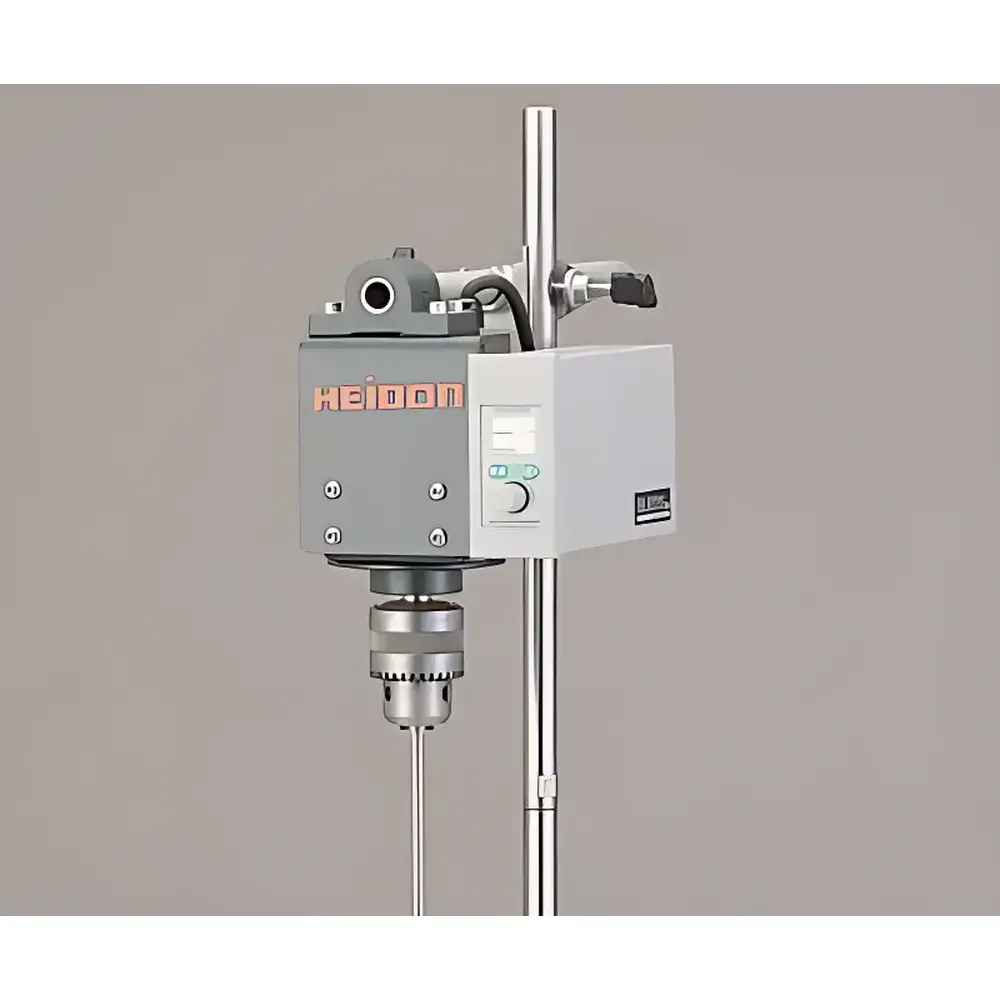
AS ONE BLW300 High-Viscosity Laboratory Stirrer (100 V AC, Brushless DC Motor)
| Brand | AS ONE |
|---|---|
| Origin | Japan |
| Manufacturer Type | Original Equipment Manufacturer (OEM) |
| Product Category | Imported Laboratory Equipment |
| Model No. | 1-4956-01 |
| Motor | 120 W Brushless DC Motor, Class B Insulation (130 °C) |
| Torque Range | 4.5 N·m / 45.0 kgf·cm |
| Speed Control | Feedback-Controlled Forward/Reverse Switching with Timer (5/10/20/30/45/60 sec) |
| Display | 4-Digit RPM Digital Readout + Overload Torque Indicator (1 scale = 20% of max torque) |
| Chuck | φ13 mm Keyless Drill Chuck |
| Thermal Protection | Winding Temperature Cutoff at 90 °C |
| Power Supply | Single-Phase 100 V ±10%, 50/60 Hz, 400 VA |
| Power Cord | 2 m, 2-Pin Grounded Plug |
| Mounting Bracket Included | 21 × 16 mm Base Interface |
| Remote I/O Capability | Yes (External Input/Output Control Enabled) |
| Accessories Not Included | Stand, Shaft, or Impeller |
Overview
The AS ONE BLW300 is a high-torque, brushless DC laboratory stirrer engineered for reproducible mixing and dispersion of highly viscous media—ranging from polymer melts and pastes to ceramic slurries and pharmaceutical gels. Unlike conventional AC induction or brushed DC stirrers, the BLW300 employs a 120 W brushless motor with Class B insulation (rated to 130 °C), delivering sustained rotational force without commutator wear or thermal derating under load. Its core operational principle relies on closed-loop feedback control: real-time current monitoring enables dynamic torque compensation, ensuring stable RPM across viscosity fluctuations. Designed for integration into controlled lab environments, the unit operates on standardized Japanese 100 V AC mains (50/60 Hz), making it compatible with regulated power supplies in R&D labs, QC facilities, and pilot-scale formulation units. The absence of carbon brushes eliminates particulate shedding—a critical advantage in cleanroom-adjacent applications where contamination control is mandated by ISO 14644 or USP .
Key Features
- High-torque capability (up to 4.5 N·m / 45.0 kgf·cm) optimized for viscosities exceeding 50,000 mPa·s—validated with standard Newtonian and shear-thinning reference fluids per ASTM D2196.
- Intelligent stall protection: automatic motor shutdown upon shaft immobilization, triggered by instantaneous current surge detection—compliant with IEC 61800-5-1 functional safety guidelines for drive systems.
- Precise bidirectional timing: six preset forward/reverse intervals (5–60 sec) enable controlled thixotropic recovery studies and particle de-agglomeration protocols.
- Digital RPM readout with four-digit resolution and integrated torque overload indicator (calibrated in 20% increments), supporting traceable process documentation under GLP/GMP frameworks.
- Modular mechanical interface: includes a 21 × 16 mm mounting bracket compatible with standard lab clamping systems (e.g., Thorlabs, LabServo), facilitating vertical/horizontal alignment per ISO 8573-1 mounting tolerances.
- Remote I/O port supports TTL-level external triggering—enabling synchronization with data loggers, PLCs, or automated reactor control systems adhering to IEEE 1394 or Modbus RTU standards.
Sample Compatibility & Compliance
The BLW300 accommodates a broad spectrum of sample containers—including jacketed glass reactors (50–2000 mL), stainless-steel mixing vessels, and disposable bioreactor bags—when paired with appropriate shafts and impellers (e.g., anchor, helical ribbon, or dissolver blades). Its torque profile meets the mechanical requirements for ASTM D1893 (viscosity measurement of asphalt binders) and ISO 2555 (aqueous polymer solutions). As an imported OEM device manufactured in Japan, it conforms to JIS C 61000-3-2 (harmonic current emissions) and carries PSE certification for electrical safety. While the unit itself does not include a stand or impeller, its design permits seamless integration with ISO/IEC 17025-accredited calibration workflows when used with NIST-traceable torque sensors.
Software & Data Management
The BLW300 operates as a standalone hardware controller with no embedded firmware or proprietary software dependency. All operational parameters—including timer settings, direction sequence, and overload status—are managed via front-panel inputs and reflected in real time on the LED display. For laboratories requiring electronic recordkeeping, the optional remote I/O interface allows connection to third-party SCADA platforms (e.g., LabVIEW, Ignition SCADA) for timestamped RPM logging, event-triggered data capture, and audit trail generation compliant with FDA 21 CFR Part 11 Annex 11 requirements. No driver installation or cloud connectivity is required; data integrity is preserved through deterministic signal timing and galvanically isolated I/O circuitry.
Applications
- Rheological pre-conditioning of thermoset resins prior to DSC or DMA analysis.
- Homogenization of battery electrode slurries (e.g., NMC cathode dispersions in NMP solvent) under inert atmosphere gloveboxes.
- Stabilization of nanoemulsions and liposomal suspensions during hot-melt extrusion development.
- QC testing of ointment consistency per USP using standardized paddle geometries.
- Process simulation of industrial kneading operations in polymer compounding R&D.
FAQ
Does the BLW300 include a support stand or stirring shaft?
No. The unit ships with only the motor head, chuck, mounting bracket, and power cord. Stands, shafts, and impellers must be selected separately based on vessel geometry and rheological requirements.
Can the BLW300 operate continuously at maximum torque?
Yes—within thermal limits. The built-in winding temperature cutoff (90 °C) and Class B insulation allow extended operation at rated torque when ambient temperature remains ≤30 °C and airflow is unobstructed.
Is the timer function programmable beyond the six preset intervals?
No. Timer selection is fixed to 5, 10, 20, 30, 45, or 60 seconds per direction. Custom timing requires external relay control via the I/O port.
What safety certifications apply to this model?
The BLW300 carries Japan’s PSE mark (J61000-1-2:2015) and complies with JIS C 61000-4-2 (ESD immunity) and JIS C 61000-4-3 (radiated RF immunity). It is not CE-marked for EU use without voltage conversion.
How is torque calibrated and verified?
Torque output is factory-calibrated using dead-weight loading per JIS B 7510. End users may verify performance using traceable dynamometer systems aligned to ISO/IEC 17025 accredited laboratories.



