
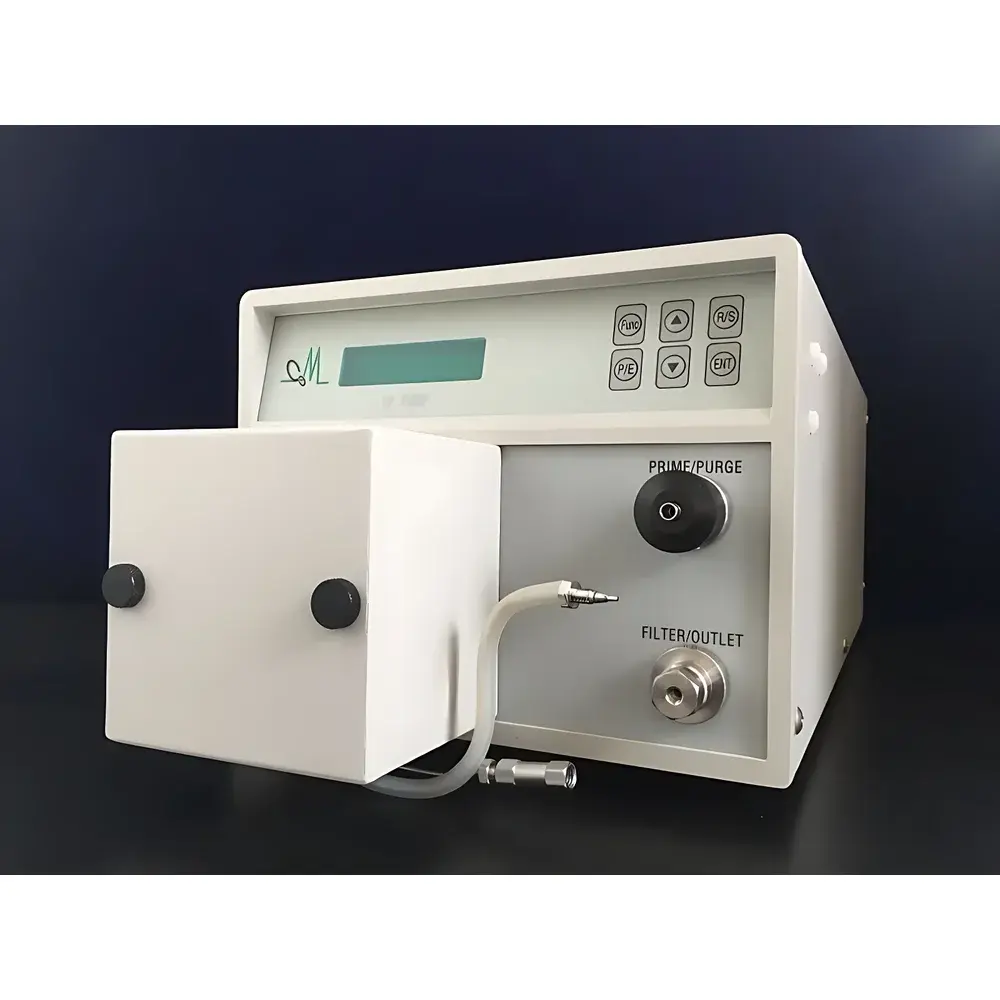
CoMetro CP Series High-Pressure Constant-Flow Temperature-Controlled Pump
| Brand | CoMetro |
|---|---|
| Origin | Imported |
| Model | CP Temperature-Controlled |
| Flow Rate | 0.001–50 mL/min |
| Maximum Pressure | 6000 psi (42 MPa) |
| Temperature Range | Room Temp +10°C to 120°C |
| Temperature Accuracy | ±0.5°C (PID Control) |
| Flow Accuracy | ±2% |
| Flow Precision | 0.2% RSD |
| Display | Digital Panel (Flow & Temp Setpoints) |
| Communication | RS232, Analog Voltage/Frequency Input |
| Wetted Materials | 316L Stainless Steel |
| Power Supply | 220 V, 50 Hz |
Overview
The CoMetro CP Series High-Pressure Constant-Flow Temperature-Controlled Pump is an engineered solution for precision liquid delivery under elevated pressure and tightly regulated thermal conditions. Built upon a dual-critical architecture—combining high-fidelity positive displacement pumping with active, closed-loop temperature control—the CP Series operates on the principle of micro-stepped stepper motor-driven plunger displacement, synchronized with real-time pressure feedback and PID-regulated resistive heating. This integration enables stable, pulse-dampened flow across demanding applications where both hydraulic integrity and thermal homogeneity are non-negotiable: including catalytic reaction monitoring, supercritical fluid delivery, high-temperature HPLC mobile phase supply, and kinetic studies requiring isothermal solvent introduction. Unlike conventional constant-flow pumps, the CP Series maintains thermal equilibrium not only in the reservoir but throughout the entire wetted path—including inlet manifold, pump head cavity, and outlet tubing—ensuring minimal viscosity drift and eliminating thermally induced flow deviation.
Key Features
- High-pressure capability up to 6000 psi (42 MPa), validated per ASME B31.3 process piping standards for laboratory-scale chemical systems
- Wide programmable flow range: 0.001–50 mL/min, selectable via front-panel keypad or remote digital/analog interface
- Integrated PID temperature controller with ±0.5°C stability across 10–120°C operating range; sensor-embedded 316L stainless steel heating block ensures uniform thermal transfer
- Modular pump head design with suspended plunger assembly, low-compliance fluidic path, and passive pulse dampening—reducing flow ripple to <0.5% RSD
- Self-cleaning cycle function and integrated bypass valve for automatic system priming and residue mitigation between runs
- Dual-mode operation: local control via intuitive LCD interface or external command via RS232 serial protocol compliant with SCPI command syntax
- Full wetted-path construction in electropolished 316L stainless steel—resistant to organic solvents (e.g., THF, DMF, chlorinated hydrocarbons) and compatible with ISO 10993-5 cytotoxicity screening protocols
Sample Compatibility & Compliance
The CP Series accommodates aqueous, organic, and mixed-phase fluids without degradation of flow performance or thermal fidelity. Its chemically inert fluid path supports long-term use with aggressive media including concentrated acids (up to 30% HCl), basic solutions (1 M NaOH), and high-boiling-point solvents (e.g., NMP, DMSO). The pump meets mechanical safety requirements outlined in IEC 61010-1 for laboratory equipment and incorporates overpressure protection aligned with EN 858-1 for high-pressure fluid handling systems. Temperature control firmware includes audit-trail logging (timestamped setpoint changes, actual readings, error events), supporting GLP and GMP environments requiring traceability per FDA 21 CFR Part 11 when paired with compliant data acquisition software.
Software & Data Management
The CP Series supports bidirectional communication via RS232 using standard ASCII-based SCPI commands, enabling seamless integration into LabVIEW, MATLAB, or custom Python-based control frameworks. Optional OEM firmware permits synchronization with external triggers (TTL input) for time-resolved delivery sequences. All temperature and flow parameters are logged internally with 1 Hz sampling resolution and stored in non-volatile memory for post-run retrieval. Remote configuration includes ramp rate definition for temperature gradients, flow profile scripting (step, ramp, hold), and alarm threshold setting (e.g., overtemp, pressure fault, motor stall). Data export is supported in CSV format with ISO 8601 timestamping for interoperability with LIMS and ELN platforms.
Applications
- High-temperature/pressure catalysis research: precise co-injection of reagents into fixed-bed or microreactor systems
- HPLC and UHPLC solvent delivery at elevated column temperatures (>80°C) without pre-heater-induced band broadening
- Calibration and validation of flow sensors and mass flow meters under controlled thermal boundary conditions
- Controlled feeding in polymerization reactors where monomer viscosity is highly temperature-sensitive
- Pharmaceutical formulation development requiring sterile-compatible, bioinert solvent delivery at physiological or supra-physiological temperatures
- Academic teaching labs for demonstrating fluid mechanics principles—including Poiseuille flow dependence on temperature and pressure gradient
FAQ
What is the maximum allowable backpressure for continuous operation at 120°C?
The pump is rated for full 6000 psi capacity across its entire temperature range; however, sustained operation above 4000 psi at >100°C requires verification of downstream component ratings (e.g., tubing, fittings, valves) per ASTM F2217.
Can the CP Series be integrated into a PLC-controlled pilot plant?
Yes—via analog voltage (0–10 V) or frequency input (0–10 kHz) for flow setpoint modulation, and discrete dry-contact signals for start/stop and fault reporting.
Is the temperature control system validated for ISO/IEC 17025 calibration workflows?
The embedded PT100 sensor and PID controller are factory-calibrated; users may perform in-house verification using NIST-traceable thermocouple probes and documented SOPs—full IQ/OQ documentation packages are available upon request.
Does the pump support gradient elution when used in chromatography?
While not a binary or quaternary gradient mixer, the CP Series enables precise single-solvent temperature- and flow-programmed elution; for multi-solvent gradients, it is typically deployed as a dedicated modifier or post-column delivery module.
What maintenance intervals are recommended for the plunger seals under continuous 6000 psi operation?
With proper filtration (≤0.2 µm inline filter) and solvent compatibility, plunger seal service life exceeds 3000 hours; preventive replacement is advised every 18 months in GMP settings or after 2000 operational hours in R&D use.



