
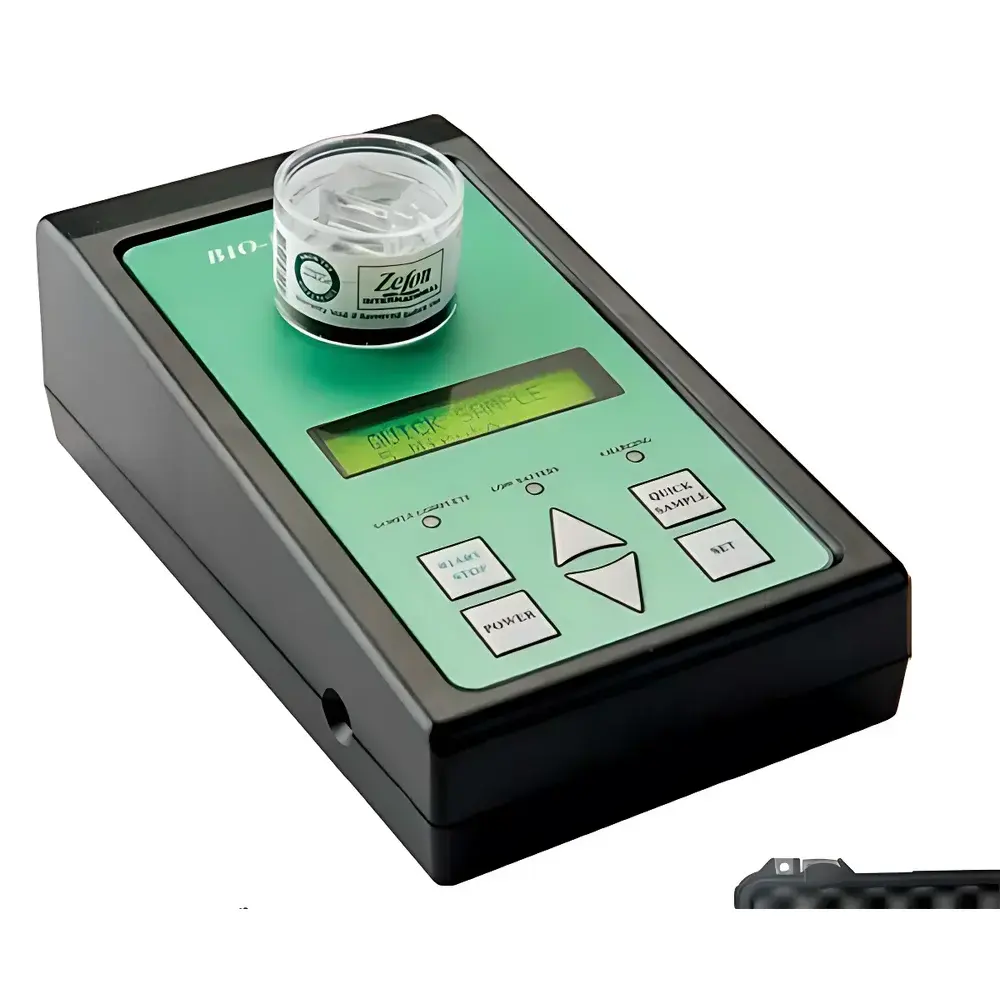
Zefon Bio-PumP® Plus Portable Air Sampling Pump
| Brand | Zefon |
|---|---|
| Origin | USA |
| Model | Bio-PumP® Plus |
| Instrument Type | 24-Hour Constant-Temperature & Constant-Flow Air Sampler |
| Configuration | Multi-Channel Gas Sampler |
| Flow Rate | 15 LPM |
| Pressure Capability | Application-Dependent |
| Flow Stability | <5% over 1 h |
| Flowmeter Accuracy | >1% of reading |
| Service Life at Max Flow & Backpressure | >5000 h |
| Continuous Operation at Max Flow & Backpressure | 8 h |
| Battery Type | NiMH |
| Battery Runtime | Up to 8 h continuous or ~100 × 5-min samples |
| Charging Time | 3 h |
| Dimensions (W×H×D) | 11.43 × 6.99 × 20.3 cm |
| Weight | 0.68 kg |
Overview
The Zefon Bio-PumP® Plus is a compact, battery-powered portable air sampling pump engineered for precision and reliability in occupational health, indoor air quality (IAQ), and environmental monitoring applications. It operates on the principle of constant-flow volumetric sampling—maintaining a stable 15 LPM airflow across variable filter or impactor backpressures typical of standard bioaerosol collection media such as Air-O-Cell® and Via-Cell® cassettes. Designed to meet the operational requirements of NIOSH Method 0500 (total dust), 0600 (respirable dust), and ISO 16000-17 (bioaerosol sampling), the Bio-PumP® Plus delivers consistent performance under field conditions where AC power is unavailable. Its lightweight aluminum chassis, sealed electronics, and low-noise motor assembly ensure robustness during extended deployments in laboratories, construction sites, cleanrooms, and outdoor ambient monitoring stations.
Key Features
- Compact footprint (11.43 × 6.99 × 20.3 cm) and ultra-lightweight design (0.68 kg) optimized for handheld or tripod-mounted operation
- NiMH rechargeable battery supporting up to 8 hours of continuous 15 LPM sampling or approximately 100 discrete 5-minute sampling events
- Integrated real-time runtime counter with LED display for traceable exposure duration logging
- Onboard flow indicator port enabling secondary field calibration without external instrumentation
- Acoustically damped motor delivering <45 dB(A) noise emission—suitable for quiet environments including offices and healthcare facilities
- Front-panel tactile controls and intuitive mode switching between sampling, calibration, and standby states
- 3-hour rapid-charge capability via included smart charger with overcharge protection and thermal cutoff
Sample Compatibility & Compliance
The Bio-PumP® Plus is validated for use with Zefon’s proprietary single-use bioaerosol sampling cassettes—including Air-O-Cell® (for spore trap analysis) and Via-Cell® (for viable mold and bacterial enumeration)—as well as standard 37-mm and 25-mm filter cassettes compatible with gravimetric, ICP-MS, and GC-MS downstream analysis. It conforms to key regulatory frameworks governing occupational hygiene sampling: NIOSH Manual of Analytical Methods (NMAM) Chapter 2, OSHA ID-130, and ASTM D7382 (standard practice for airborne particulate sampling). While not intrinsically rated for hazardous locations, its non-sparking motor and UL-listed power management system support safe deployment in Class I, Division 2 environments when used with appropriate sampling trains. All firmware and mechanical calibrations are documented per GLP-compliant recordkeeping standards.
Software & Data Management
The Bio-PumP® Plus operates as a standalone hardware platform without embedded microprocessor-based data logging. However, it supports full auditability through manual logbook integration and external time-stamped calibration records. The included flow indicator functions as a primary verification tool aligned with ISO/IEC 17025 traceability requirements; when paired with optional TSI Series 4040 or 4000 electronic calibrators (sold separately), users can generate NIST-traceable calibration certificates compliant with FDA 21 CFR Part 11 Annex 11 expectations for electronic records. For high-volume programs, Zefon provides standardized SOP templates covering pump setup, pre-sampling verification, post-run inspection, and preventive maintenance scheduling—all editable to align with internal QA/QC protocols.
Applications
- Occupational exposure assessment for respirable crystalline silica, asbestos fibers, and metal fumes in industrial hygiene surveys
- Indoor air quality investigations targeting fungal spores, pollen, endotoxins, and allergenic particulates in schools, hospitals, and residential buildings
- Environmental baseline studies measuring ambient PM10 and PM2.5 concentrations using cyclone or impactor pre-separators
- Pharmaceutical facility environmental monitoring (EM) programs requiring ISO 14644-1 classified area air sampling
- Field validation of HVAC filtration efficiency and ductwork integrity testing
- Epidemiological research involving longitudinal personal exposure monitoring across diverse geographic settings
FAQ
What sampling media are compatible with the Bio-PumP® Plus?
Air-O-Cell®, Via-Cell®, 37-mm mixed-cellulose ester (MCE) filters, polyvinyl chloride (PVC) filters, and gelatin membrane filters—provided backpressure remains within the pump’s specified operating envelope.
Is the Bio-PumP® Plus suitable for use in explosive atmospheres?
No. It is not ATEX-, IECEx-, or UL-classified for hazardous locations. Use only in non-classified areas unless integrated into an explosion-proof sampling train certified by a qualified safety engineer.
How often should the pump be calibrated?
Per NIOSH and ISO 17025 recommendations, verify flow rate before each sampling day using the included flow indicator; perform full primary calibration with a NIST-traceable calibrator at least once every 3 months or after any maintenance event.
Can the battery be replaced in the field?
Yes—the NiMH battery pack is user-replaceable using standard Torx tools; replacement kits (P/N 65211-40) include pre-configured cells and mounting hardware.
Does the pump support multi-point sequential sampling?
Not natively. As a single-channel constant-flow device, it requires external manifold systems or timed manual reconfiguration to achieve multi-location sampling protocols.
Related Products







