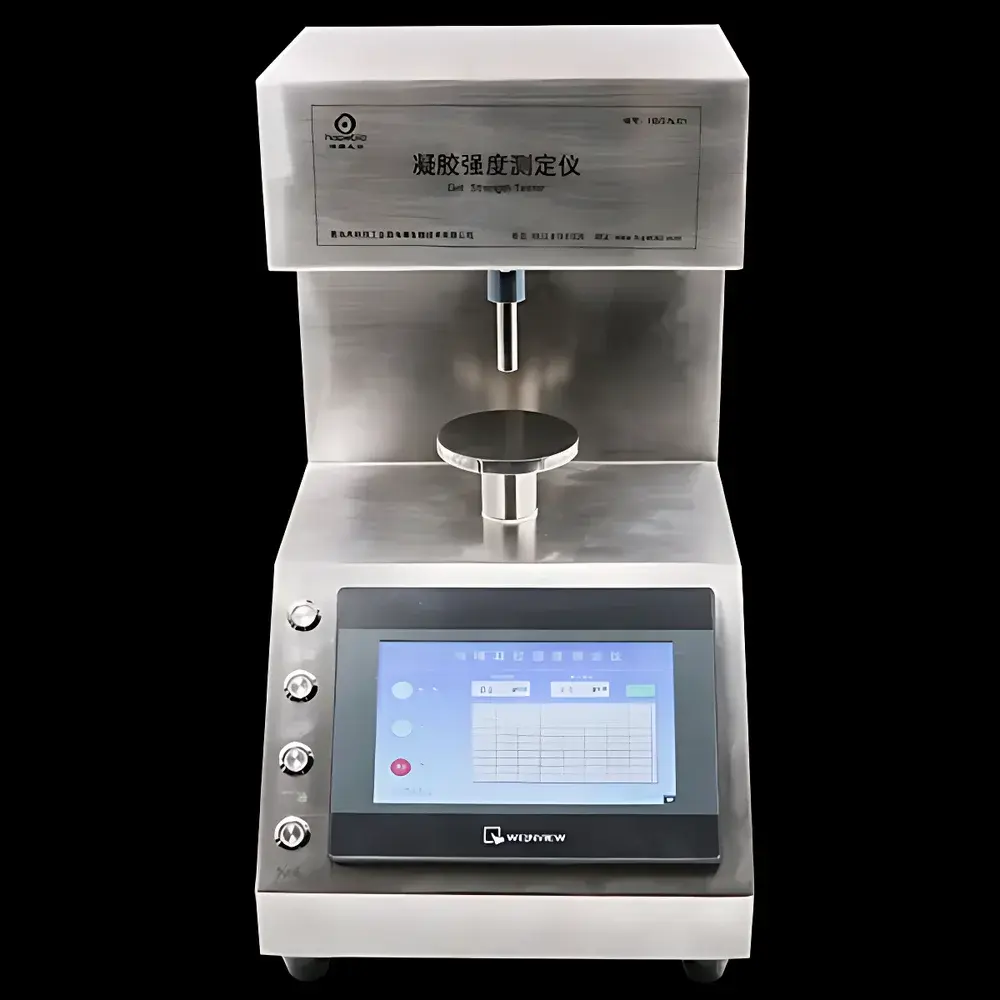
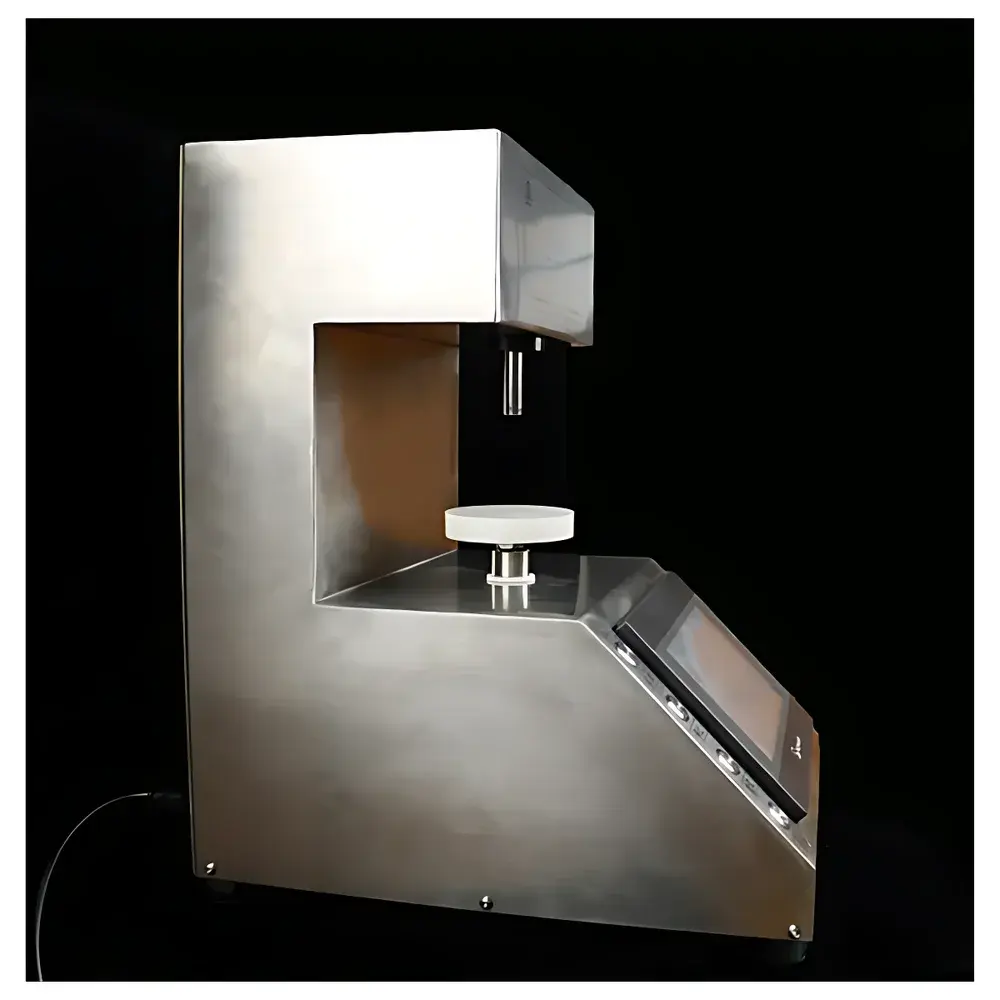
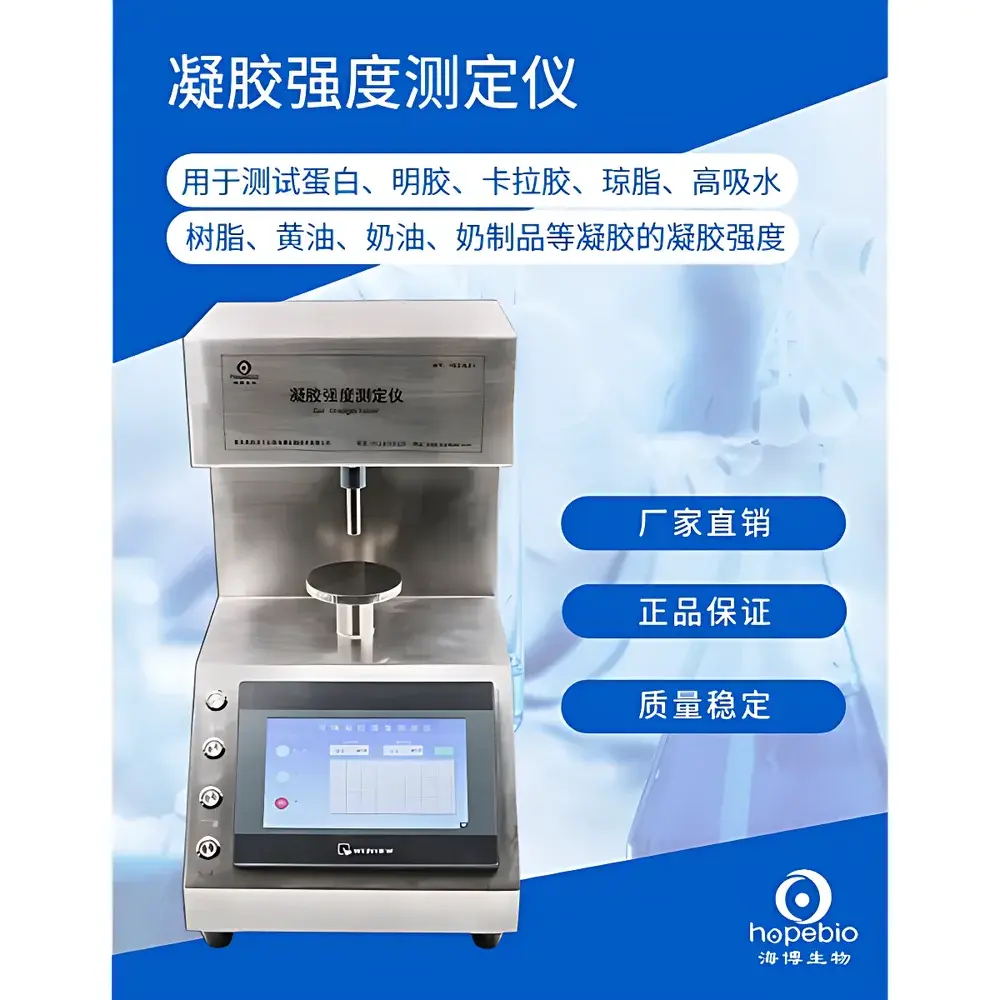
Hopebio HBS-NJ01 Gel Strength Tester
| Brand | Hopebio |
|---|---|
| Origin | Shandong, China |
| Manufacturer Type | Authorized Distributor |
| Country of Origin | China |
| Model | HBS-NJ01 |
| Voltage | 220 V AC, 1 A |
| Dimensions | 350 × 250 × 435 mm |
| Weight | 10 kg |
| Operating Temperature | 10–40 °C |
| Relative Humidity | <90% RH |
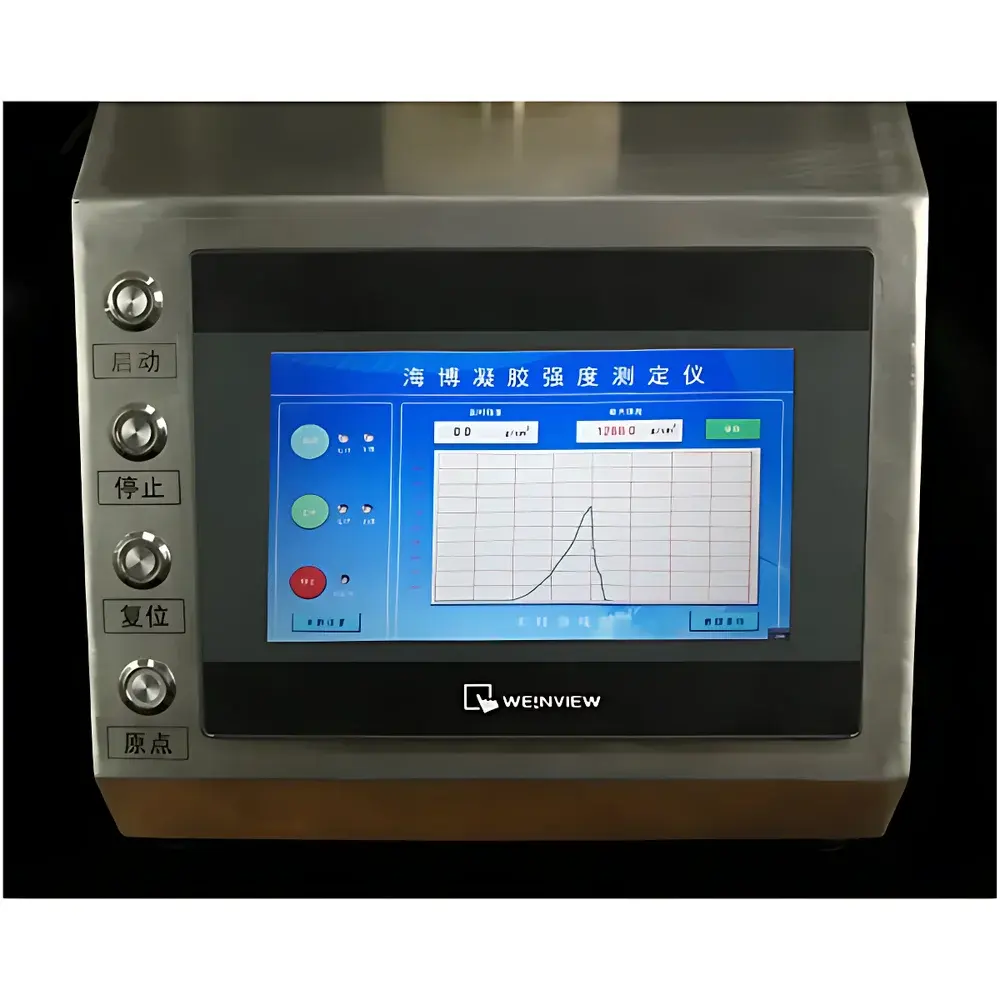
| Touchscreen | 7-inch capacitive LCD |
| Load Cell Range | 0–3000 g/cm² |
| Resolution | 0.1 g |
| Probe Diameter | 11.28 mm (cross-sectional area: 1 cm²) |
| Penetration Speed | Adjustable, default 1.0 mm/s |
| Retraction Speed & Distance | Adjustable |
| Penetration Depth Range | 0.01–40 mm |
| Data Storage | Internal buffer for up to 36 test records |
| Data Export | USB flash drive, CSV format |
| Compliance | ISO 9665, GB 28304-2012, GB 6783-2013 |
Overview
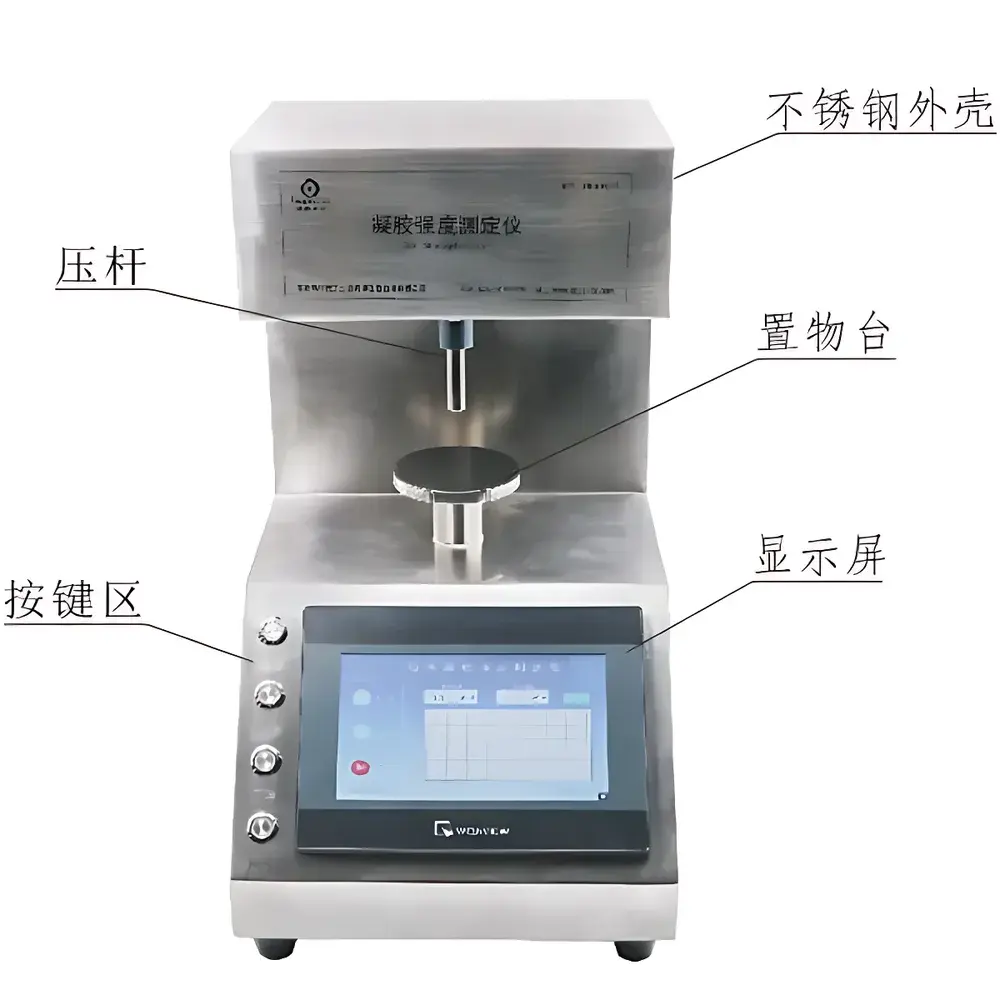
The Hopebio HBS-NJ01 Gel Strength Tester is a precision-controlled, benchtop mechanical compression instrument engineered for quantitative measurement of gel firmness and breaking force in hydrocolloid systems. It operates on the principle of standardized axial compression using a calibrated stainless-steel cylindrical probe (11.28 mm diameter, 1 cm² cross-section) driven at programmable linear velocity against a pre-conditioned gel sample. The system captures real-time force–displacement profiles via a high-resolution load cell (0.1 g resolution, 0–3000 g/cm² range), enabling determination of maximum rupture force—the primary metric reported as “gel strength” in food science, quality control, and regulatory documentation. Designed in accordance with ISO 9665 (adhesives—animal glues), GB 28304-2012 (curdlan gel strength), and GB 6783-2013 (gelatin bloom strength), the HBS-NJ01 delivers reproducible, method-compliant results essential for raw material qualification, process validation, and product shelf-life assessment.
Key Features
- High-stability PLC-based control architecture ensuring consistent actuation timing and force sampling integrity
- 7-inch capacitive touchscreen interface with intuitive icon-driven navigation and dual-input support (touch + physical buttons)
- Adjustable penetration speed (0.01–10 mm/s), retraction speed, and post-peak retraction distance—enabling method optimization per matrix viscosity and thermal history
- Full stainless-steel housing and probe assembly for corrosion resistance and cleanability under GMP-aligned environments
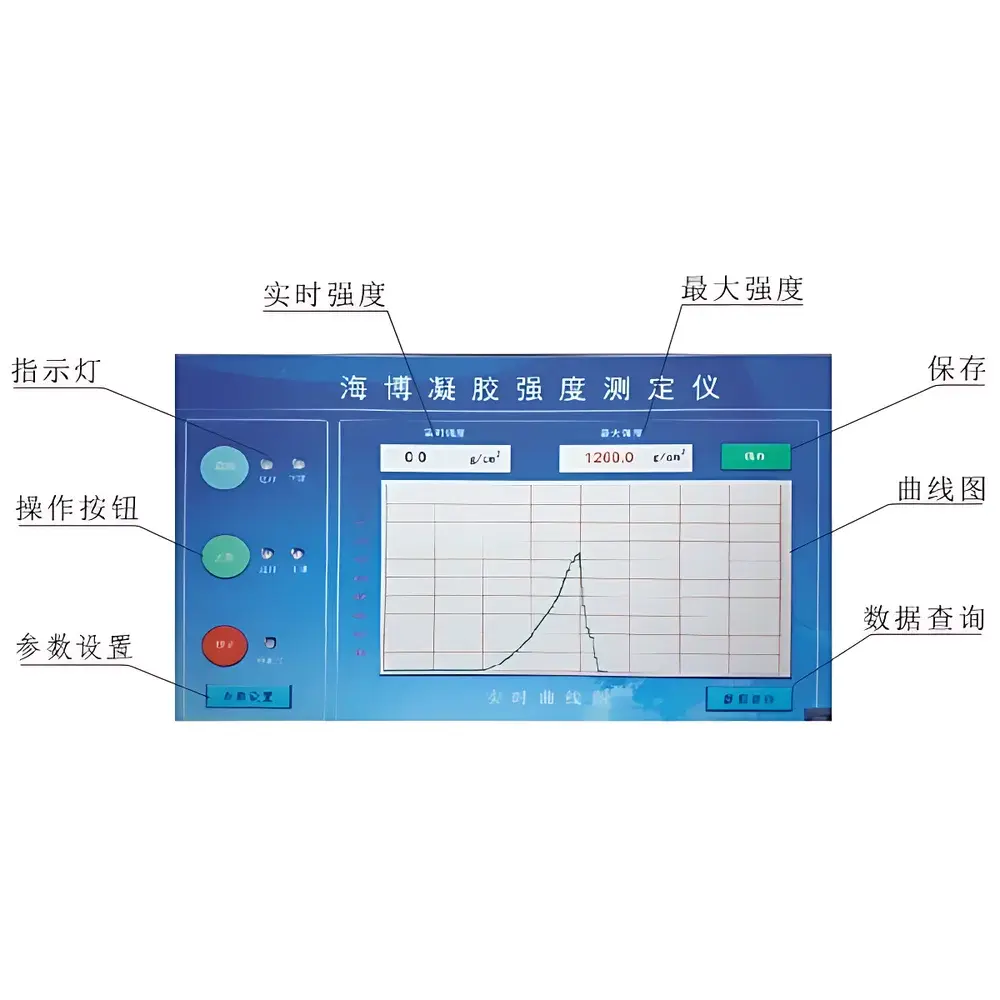
- Real-time graphical display of force–distance curves with automatic peak detection and numeric readout of maximum force (g/cm²)
- Onboard data buffer storing up to 36 complete test records; exportable via USB to CSV for traceable post-processing in Excel or LIMS
- Self-zeroing function: automatically nulls baseline when ≤60 g load detected on platform at power-on, minimizing operator-induced offset error
Sample Compatibility & Compliance
The HBS-NJ01 is validated for use across a broad spectrum of thermoreversible and thermoirreversible hydrocolloids, including agar, carrageenan, pectin, alginates, locust bean gum, guar gum, xanthan gum, gelatin, konjac glucomannan, curdlan, and synthetic superabsorbent polymers. Sample preparation follows defined thermal equilibration protocols: gels must be set ≥1.5 h at 10–25 °C; refrigerated plates (2–8 °C) require ambient acclimation prior to testing. Minimum specimen dimensions are 40 mm diameter × 3 mm thickness to ensure representative bulk response and avoid edge effects or bottom-contact artifacts. The instrument’s mechanical design excludes vibration coupling through rigid base mounting and isolated load path architecture—critical for maintaining measurement fidelity in shared laboratory spaces. Regulatory alignment includes full support for GLP-compliant documentation workflows, with CSV exports retaining timestamp, operator ID (if entered), test parameters, and raw curve metadata.
Software & Data Management
No proprietary software installation is required. All configuration, execution, and data handling occur natively on the embedded touchscreen OS. Test parameters—including penetration speed, retraction settings, and pass/fail thresholds—are saved per user-defined method profile. Each test record contains: date/time stamp, probe displacement trajectory (100 Hz sampling), maximum force value, and visual curve overlay. Data export generates UTF-8 encoded CSV files compliant with FDA 21 CFR Part 11 requirements when paired with institutional audit trail policies (e.g., controlled USB access, operator log-in). Files open directly in Microsoft Excel; users may convert to .xlsx or integrate into statistical process control (SPC) platforms via standard import filters. Internal memory clears upon shutdown—emphasizing procedural discipline in timely USB backup, consistent with ISO/IEC 17025 clause 7.5.2 on data integrity.
Applications
- Raw material acceptance testing for hydrocolloid suppliers and food ingredient manufacturers
- In-process monitoring of gelation kinetics during thermal processing (e.g., retort, pasteurization)
- Formulation development: quantifying synergistic or antagonistic interactions in multi-gum blends
- Stability studies tracking texture degradation under accelerated aging (temperature/humidity cycling)
- Regulatory submission support: generating data packages aligned with Codex Alimentarius, EFSA, and USDA-FSIS specifications
- Academic research in soft matter physics, polymer rheology, and food structure–function relationships
FAQ
What is the recommended sample conditioning protocol before testing?
Gels must be formed and equilibrated for ≥90 minutes at 10–25 °C. Refrigerated samples (2–8 °C) must reach ambient temperature (±1 °C) for ≥30 minutes prior to placement on the platform.
Why does the instrument require a minimum sample thickness of 3 mm?
Thinner specimens risk premature contact between the probe and support plate, introducing non-gel mechanical resistance and invalidating the measured rupture force.
Can the HBS-NJ01 be integrated into a networked QA/QC lab environment?
Yes—via manual USB transfer of CSV files to centralized servers or LIMS. While it lacks Ethernet/Wi-Fi, its structured output format enables automated parsing and database ingestion using standard ETL pipelines.
Is calibration traceable to national standards?
The load cell is factory-calibrated against NIST-traceable deadweight standards. Users should perform routine verification using certified test weights (not included) per internal SOPs aligned with ISO/IEC 17025 Section 6.5.
Does the instrument meet electromagnetic compatibility (EMC) requirements for CE marking?
It complies with IEC 61326-1:2013 for laboratory equipment, including immunity to electrostatic discharge (ESD), radiated RF fields, and fast transient bursts—validated during type testing in accredited EMC laboratories.