
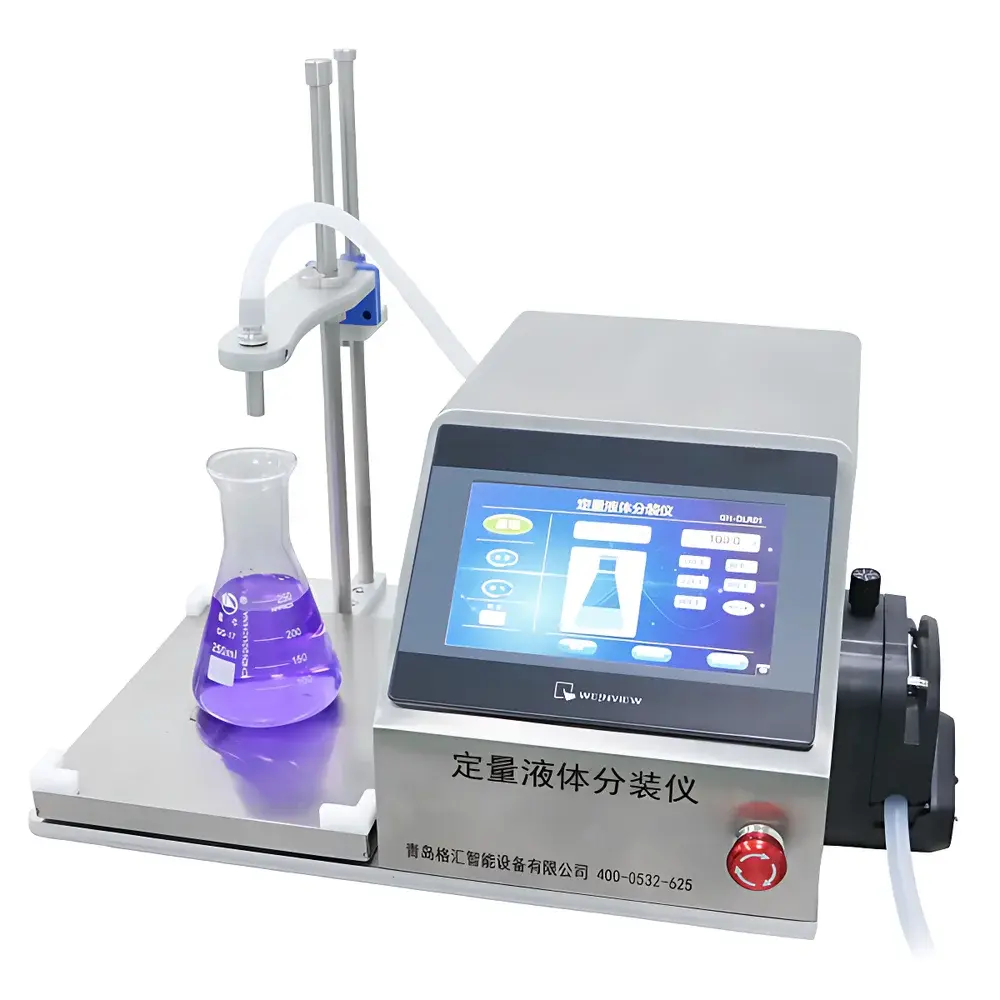
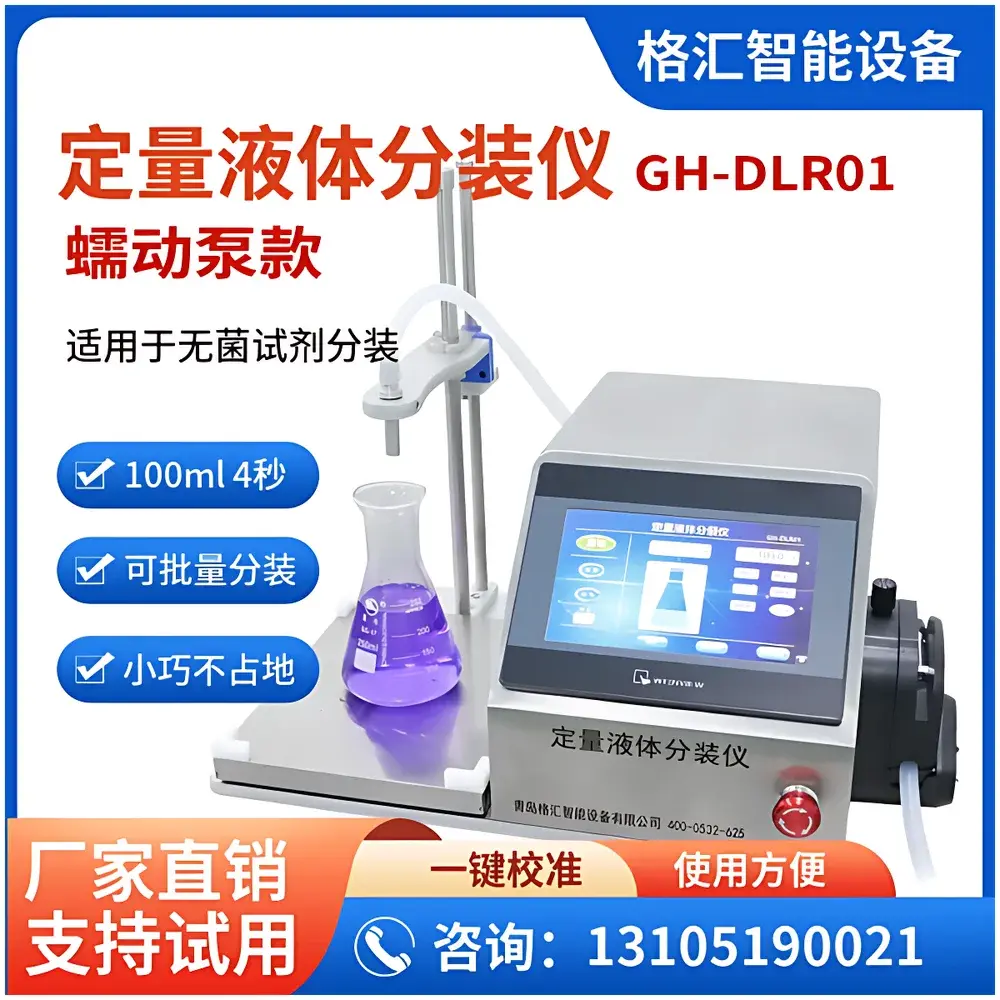
Hopebio GH-DLR01 Quantitative Liquid Dispenser (Peristaltic Pump Model)
| Brand | Hopebio |
|---|---|
| Origin | Shandong, China |
| Manufacturer Type | Authorized Distributor |
| Country of Manufacture | China |
| Model | GH-DLR01 |
| Dimensions | 480 × 310 × 410 mm |
| Dispensing Speed | 2000 mL/min |
| Volume Range | 20–4000 mL |
| Power Supply | 220 V AC, 100 W |
| Net Weight | 10 kg |
| Control Interface | Touchscreen |
| Operating Temperature | 5–40 °C |
| Relative Humidity | <90% RH |
| Dispensing Accuracy | ±1% |
| Dispensing Principle | Peristaltic Pumping |
| Sensor Type | High-Precision Load Cell |
| Calibration | Automatic Flow Calibration |
| Accessories | Homogenization Bag Holder Stand |
| Sterility Support | Aseptic Dispensing Capable |
Overview
The Hopebio GH-DLR01 Quantitative Liquid Dispenser (Peristaltic Pump Model) is an engineered solution for high-throughput, precision liquid dispensing in microbiological, clinical, and quality control laboratories. Designed around a robust peristaltic pumping mechanism, the system delivers repeatable volumetric transfer without fluid contact with internal mechanical components—ensuring contamination-free operation and simplifying cleaning and validation protocols. Unlike piston- or syringe-based dispensers, the GH-DLR01 leverages positive displacement via roller compression of flexible tubing, making it ideal for viscous, particulate-laden, or shear-sensitive reagents commonly used in microbial media preparation, dilution series generation, and sample homogenate distribution. Its core operational logic integrates real-time mass monitoring: a high-resolution load cell continuously measures container weight gain during dispensing, triggering pump activation upon target vessel placement and terminating flow precisely at the preset volume—eliminating reliance on timers, foot switches, or manual intervention. This gravimetric feedback loop underpins its ±1% volumetric accuracy across the full 20–4000 mL range.
Key Features
- Gravimetric dispensing control with integrated high-precision load cell for real-time mass-based endpoint detection
- Automatic peristaltic pump calibration routine to compensate for tubing wear, pressure variation, and flow drift over time
- Dedicated homogenization bag holder stand for hands-free, ergonomic filling of Stomacher®-compatible and ISO-standardized bags
- High-capacity peristaltic pump head rated for continuous operation at up to 2000 mL/min—optimized for rapid bulk media or buffer dispensing
- Intuitive 7-inch capacitive touchscreen interface supporting multi-language UI, user-defined presets, and audit-ready operation logs
- CE-compliant electrical architecture with reinforced insulation and thermal overload protection; designed for stable performance in ambient lab environments (5–40 °C, <90% RH non-condensing)
Sample Compatibility & Compliance
The GH-DLR01 accommodates a wide range of liquid types—including nutrient broths, enzymatic solutions, buffered saline, ethanol-based disinfectants, and suspensions containing microbeads or low-concentration particulates—provided they are compatible with standard silicone or PharMed® BPT tubing (tubing selection must be validated per application). Its aseptic dispensing capability aligns with ISO 13408-1 (Aseptic Processing of Health Care Products) principles when deployed with sterile tubing sets and laminar flow hood integration. While not certified to FDA 21 CFR Part 11 out-of-the-box, the system supports ALCOA+ data integrity principles: all dispense events—including timestamp, operator ID, target volume, actual dispensed mass, pump RPM, and calibration status—are stored locally with tamper-evident logging. Optional USB export enables traceable data transfer for GLP/GMP documentation workflows.
Software & Data Management
Firmware v2.3 includes embedded dispensing protocol management with up to 99 programmable methods, each configurable for volume, ramp rate, pause intervals, and post-dispense tube purge. All parameters are saved with version-stamped metadata. The touchscreen interface provides immediate access to calibration history, pump runtime hours, and tubing usage counters—critical for preventive maintenance scheduling. Raw dispensing logs (CSV format) include ISO 8601 timestamps, deviation metrics (±mL vs. target), and sensor stability indicators. For networked labs, optional Ethernet module enables remote firmware updates and centralized log aggregation via secure SFTP—facilitating compliance with internal SOPs requiring instrument data archival and review.
Applications
- Preparation of standardized microbial dilution series (e.g., ISO 6887-1, AOAC 977.27) with minimal operator variability
- Automated filling of pre-sterilized homogenization bags for food, environmental, or pharmaceutical sample processing
- Bulk dispensing of culture media into Petri dishes, tubes, or bioreactor feed vessels under laminar airflow
- QC batch release testing where volumetric consistency directly impacts assay sensitivity (e.g., ELISA buffer dispensing)
- Research labs requiring reproducible liquid handling for high-content screening workflows with non-corrosive aqueous formulations
FAQ
Does the GH-DLR01 support regulatory-compliant electronic records?
Yes—when configured with optional audit trail enablement, it generates time-stamped, operator-identified, and immutable dispensing logs meeting ALCOA+ criteria for GLP environments.
Can I use third-party tubing with this dispenser?
Yes, provided the tubing meets dimensional specifications (ID/OD tolerance ±0.05 mm) and chemical compatibility requirements; however, accuracy validation is required per ISO/IEC 17025 clause 5.4.2.
Is the load cell factory-calibrated and traceable to NIST standards?
Calibration certificates are supplied with each unit, referencing traceable mass standards; users may perform in-house verification using Class M2 weights per ISO 9001 Annex A.4.
What maintenance is required for long-term accuracy?
Routine inspection of tubing compression geometry, quarterly load cell zero-check, and annual recalibration using certified reference masses are recommended per manufacturer’s maintenance schedule.
How does the system handle foaming or low-surface-tension liquids?
The gravimetric endpoint algorithm incorporates dynamic noise filtering and settling-time thresholds to mitigate false termination from foam-induced transient weight fluctuations.



