
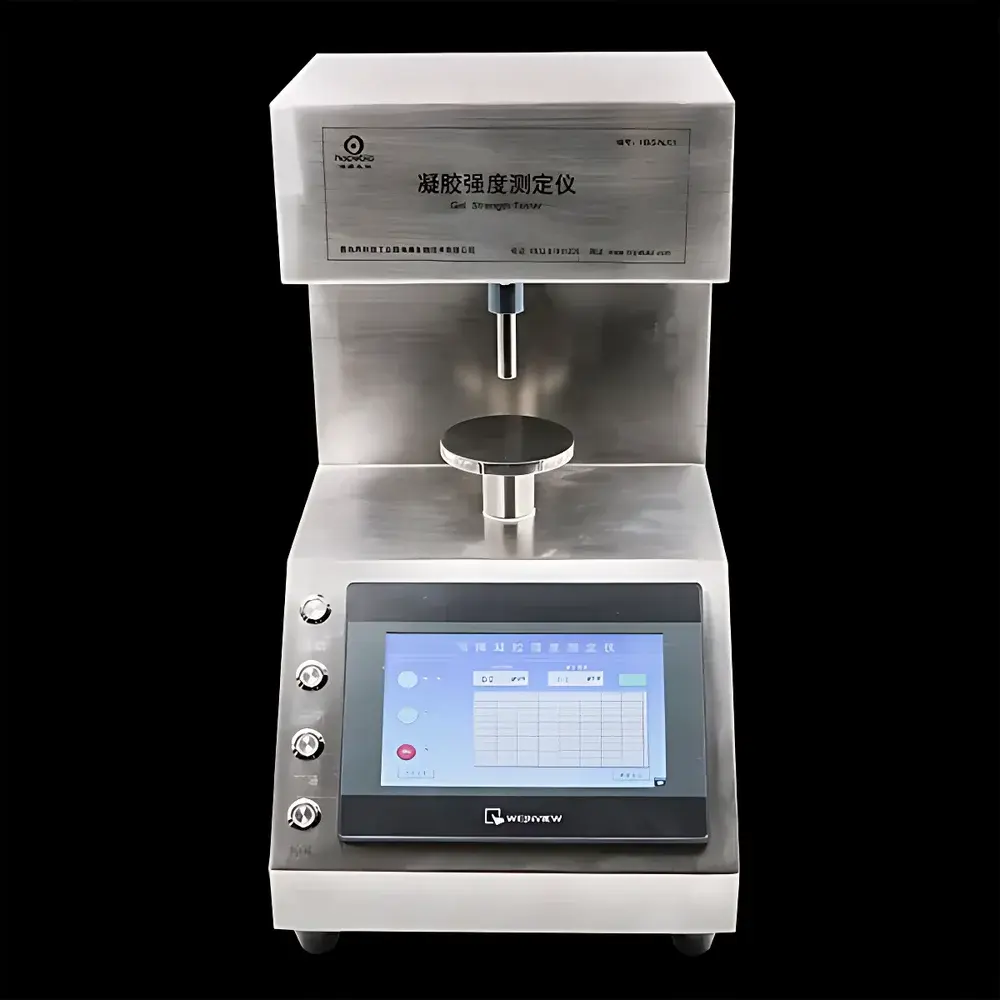
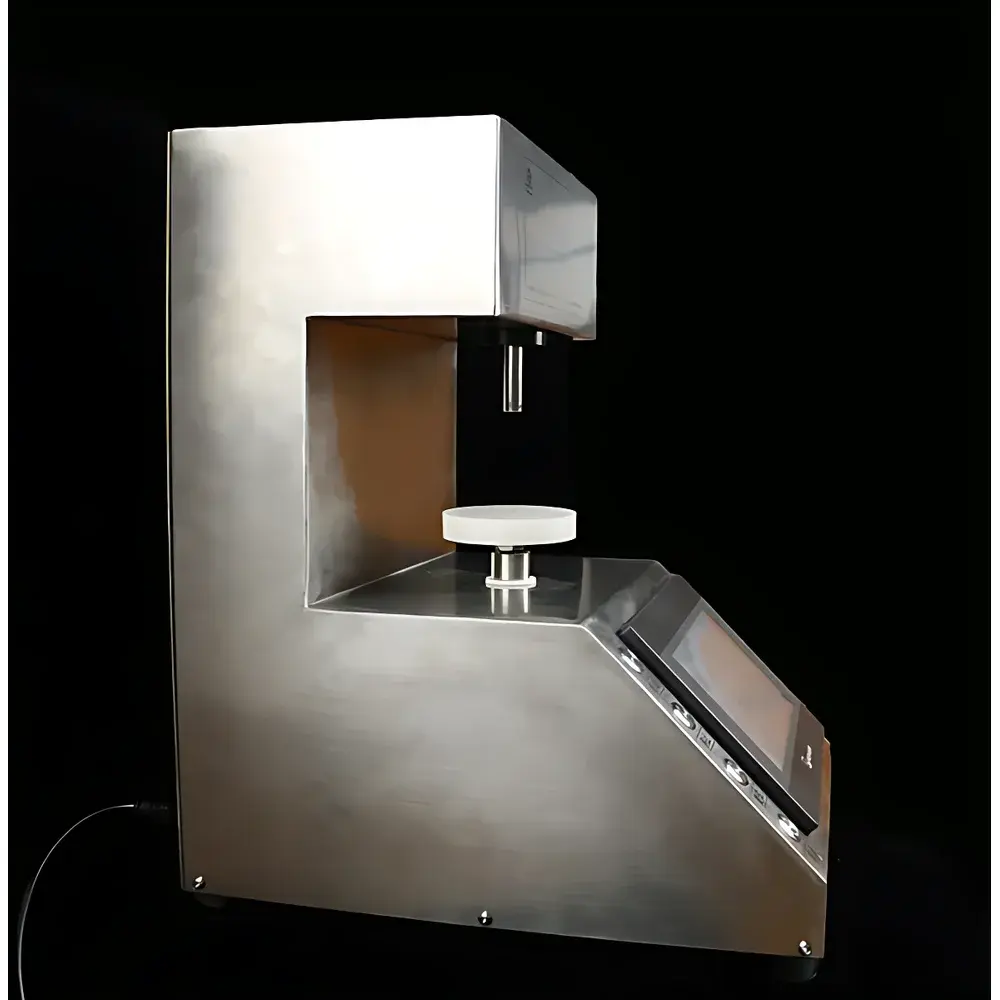
Hopebio HBS-NJ01 Gel Strength Tester
| Brand | Hopebio |
|---|---|
| Model | HBS-NJ01 |
| Measurement Range | 0–3000 g/cm² |
| Resolution | 0.1 g |
| Probe Diameter | 11.28 mm (Cross-sectional Area: 1 cm²) |
| Test Speed | Adjustable (Default: 1.0 mm/s) |
| Retraction Speed & Distance | Adjustable |
| Stroke Travel | 0.01–40 mm |
| Data Storage | 36-cycle buffer memory, 60-day history retention |
| Data Export | USB flash drive (≤32 GB, FAT32, CSV format) |
| Power Supply | 220 V AC, 1 A |
| Dimensions | 350 × 250 × 435 mm |
| Weight | 10 kg |
| Operating Temperature | 10–40 °C |
| Relative Humidity | <90% RH |
| Enclosure | Full stainless-steel housing |
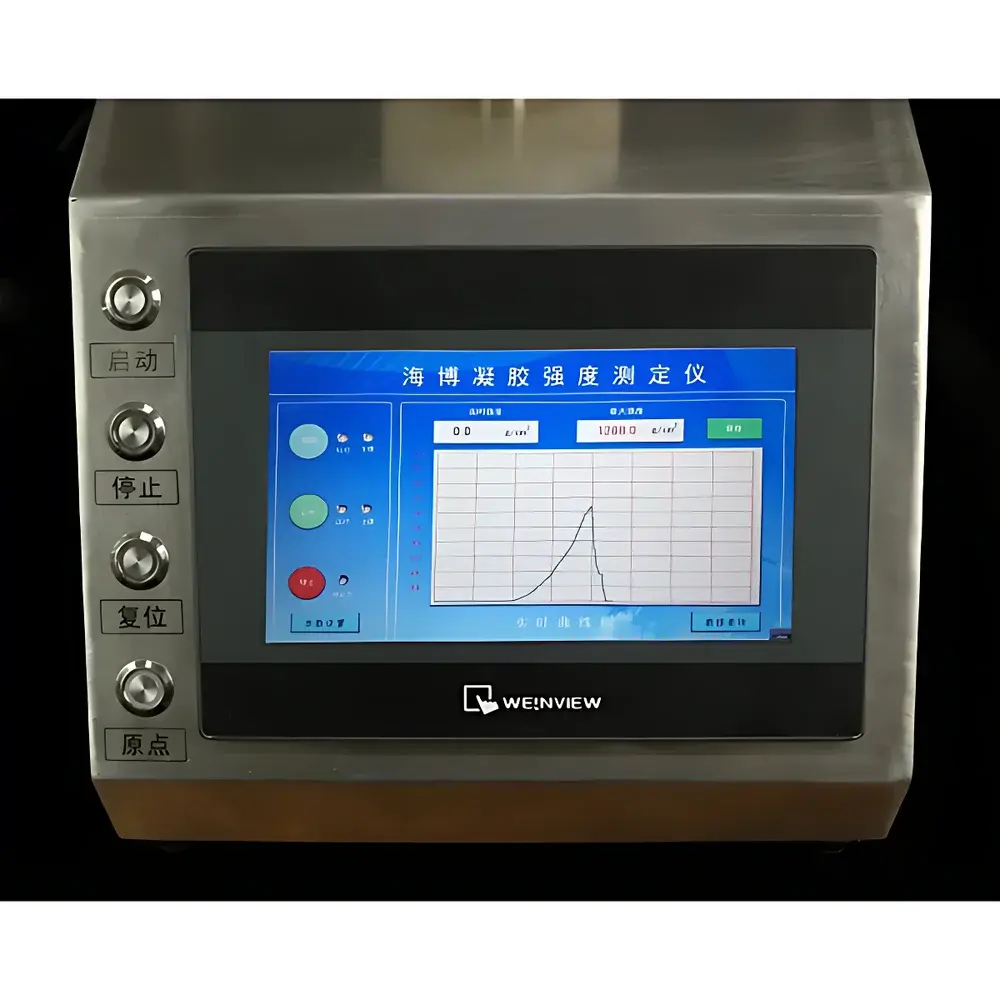
| Control System | PLC-based with 7-inch industrial touchscreen interface |
| Compliance | ISO 9665, GB 28304-2012, GB 6783-2013 |
Overview
The Hopebio HBS-NJ01 Gel Strength Tester is a dedicated mechanical compression instrument engineered for standardized quantification of gel rigidity in hydrocolloid systems. It operates on the principle of controlled axial compression using a precision-machined stainless-steel probe (11.28 mm diameter, 1 cm² cross-section) driven at programmable linear velocity against a stabilized gel sample. Force response is captured in real time via a high-stability load cell with 0.1 g resolution and full-scale capacity of 3000 g/cm²—enabling direct reporting of maximum compressive resistance in units of g/cm², the industry-standard metric for gel strength in food science and regulatory testing. The instrument is designed for compliance-driven laboratories requiring traceable, repeatable measurements under ISO 9665 (adhesives – animal glues), GB 28304-2012 (curdlan gel strength), and GB 6783-2013 (gelatin bloom strength). Its robust architecture—featuring a fully stainless-steel enclosure, PLC-based motion control, and temperature/humidity-stable operating envelope (10–40 °C, <90% RH)—ensures long-term metrological integrity in QC environments.
Key Features
- High-fidelity load measurement with ±0.1 g resolution and calibrated range up to 3000 g/cm²
- Interchangeable probe geometry adhering strictly to ISO/GB-defined cross-sectional area (1 cm²)
- Fully programmable test parameters: compression speed (0.01–5.0 mm/s), retraction speed, and displacement distance (0.01–40 mm)
- Real-time force–displacement curve acquisition with automatic peak detection and 2-second post-peak data capture
- 7-inch industrial-grade touchscreen interface with intuitive icon-driven workflow; redundant physical push-button controls for fail-safe operation
- Onboard data management: cyclic buffer for 36 recent tests, persistent 60-day history storage, and USB export (FAT32, ≤32 GB, CSV format)
- GLP-aligned operational safeguards: automatic zero calibration upon startup (with 60 g tare threshold), mechanical end-stop limits, and vibration-dampened base design
Sample Compatibility & Compliance
The HBS-NJ01 is validated for quantitative strength assessment of thermoreversible and thermoirreversible hydrogels commonly used in food formulation and functional ingredient evaluation. Compatible matrices include agar, carrageenan, pectin, alginates, locust bean gum, guar gum, xanthan gum, gelatin, konjac glucomannan, curdlan, superabsorbent polymers, and synthetic hydrogels. Sample preparation must follow standardized conditioning protocols: gels shall be equilibrated at 10–25 °C for ≥90 minutes prior to testing; refrigerated plates (2–8 °C) must be acclimated to ambient temperature before measurement. Minimum specimen dimensions are 40 mm diameter and 3 mm thickness to prevent edge effects and probe bottoming. All test methods align with internationally recognized specifications—including ISO 9665 for animal glue characterization, GB 28304-2012 for curdlan, and GB 6783-2013 for gelatin bloom—supporting audit-ready documentation in FDA-regulated or ISO/IEC 17025-accredited facilities.
Software & Data Management
The embedded firmware implements deterministic real-time data acquisition synchronized with motor position feedback. Each test generates a timestamped record containing raw force vs. displacement values, derived maximum strength (g/cm²), and metadata (test speed, retraction settings, operator ID if configured). Data reside in non-volatile memory with automatic overwrite protection for the most recent 36 cycles. Historical records persist for 60 days unless manually cleared. Export functionality supports FAT32-formatted USB drives (≤32 GB), generating comma-separated value (.csv) files compatible with Excel, Origin, or statistical analysis platforms. While the system does not implement FDA 21 CFR Part 11 electronic signature controls natively, its audit trail—comprising timestamps, parameter logs, and uneditable raw curves—meets baseline GLP data integrity requirements when paired with procedural SOPs governing user access and data handling.
Applications
- Quality control of commercial hydrocolloids during inbound raw material inspection
- Formulation development for texture-modified foods, dairy analogs, plant-based meats, and confectionery gummies
- Stability monitoring of gels subjected to thermal cycling, pH shifts, or enzymatic treatment
- Comparative evaluation of gelation kinetics across batch lots or supplier alternatives
- Regulatory submission support for novel food ingredients requiring mechanical property characterization
- Academic research in soft matter physics, polymer rheology, and food colloid science
FAQ
What is the recommended sample preparation protocol for accurate gel strength measurement?
Gel specimens must be cast in standard cylindrical molds (≥40 mm diameter, ≥3 mm thickness), cooled and equilibrated at 10–25 °C for ≥90 minutes. Refrigerated samples require full thermal equilibration to room temperature before testing.
Does the instrument support automated calibration verification?
Yes—users may perform routine verification using certified reference weights placed directly on the platen; the system displays real-time measured force for comparison against nominal values.
Can test parameters be locked to prevent unauthorized modification?
Parameter editing requires active touchscreen navigation; no password protection is built-in, but operational discipline can be enforced via site-specific SOPs and supervised access.
Is the USB data export function compatible with LIMS integration?
CSV output is structured for direct ingestion into common LIMS platforms via scheduled import scripts; column headers follow ISO/IEC 17025-compliant labeling conventions (e.g., “Test_ID”, “Max_Force_g_per_cm2”, “Timestamp”).
What maintenance is required to sustain measurement accuracy over time?
Annual verification of load cell linearity and probe alignment is recommended; cleaning should be limited to alcohol-wipe disinfection of the stainless-steel platen and probe—no lubricants or solvents permitted.





