
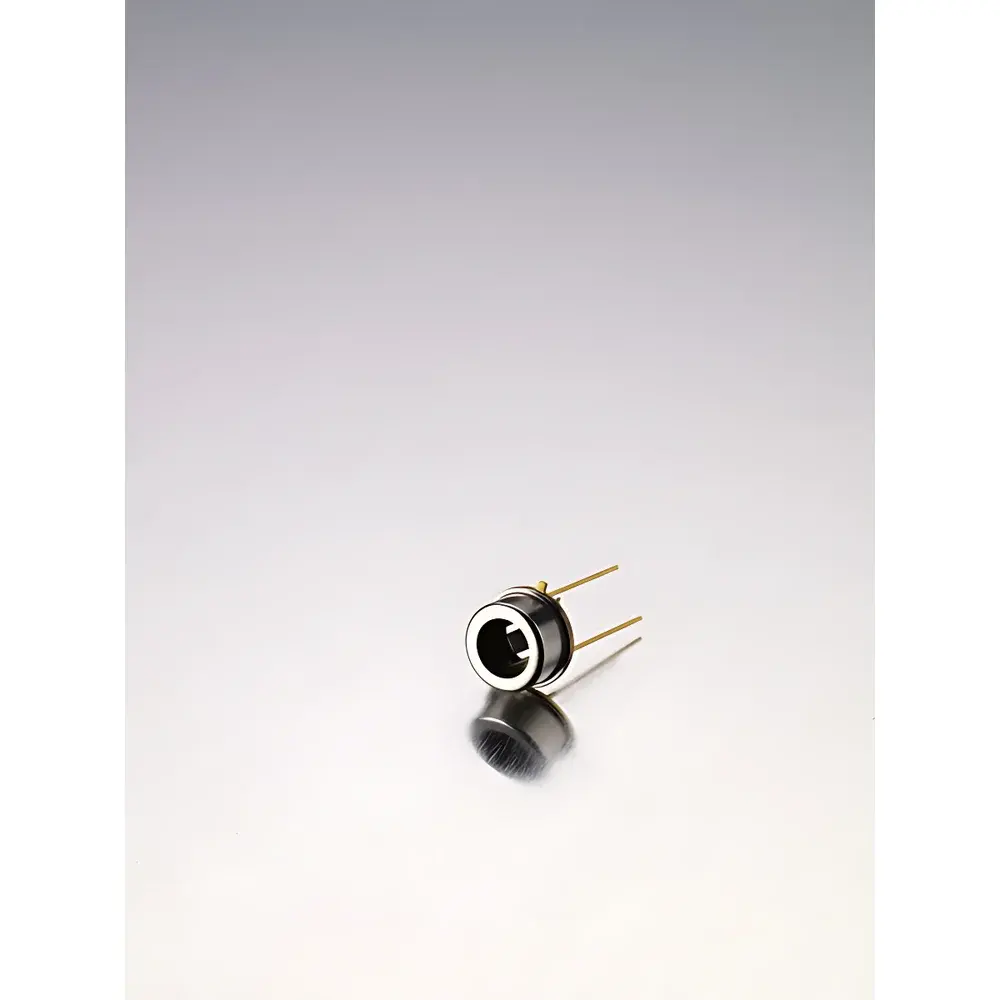
Axetris EMIRS Series Infrared Thermal Source
| Brand | Axetris |
|---|---|
| Origin | Switzerland |
| Model | EMIRS Series |
| Housing | TO-39 metal can |
| Emission Spectrum | 2–16 µm (blackbody-like) |
| Emissivity | >0.95 (typical) |
| Modulation Speed | up to 100 Hz (electrical, chopper-free) |
| Power Consumption | <150 mW (steady-state) |
| Window Options | Sapphire, CaF₂, BaF₂, Ge |
| MEMS Certification | IEC 6721-3-7 Class 7M3 (excluding CaF₂/BaF₂ window variants) |
| Lifetime | >50,000 hours (L₅₀ at rated power) |
Overview
The Axetris EMIRS Series Infrared Thermal Source is a micro-electro-mechanical systems (MEMS)-based broadband infrared emitter engineered for precision gas sensing applications requiring stable, high-emissivity thermal radiation across the mid-infrared spectral range (2–16 µm). Unlike conventional filament-based or ceramic IR sources, the EMIRS leverages a thin-film resistive heater patterned on a single-crystal silicon membrane, coated with a dielectric layer to enhance spectral emissivity and thermal stability. This architecture enables true blackbody-like radiance with minimal spectral deviation—critical for quantitative absorption spectroscopy in non-dispersive infrared (NDIR), photoacoustic spectroscopy (PAS), and attenuated total reflectance Fourier-transform infrared (ATR-FTIR) configurations. Its compact TO-39 hermetic package supports integration into space-constrained optical benches and portable analyzers without compromising thermal uniformity or long-term output stability.
Key Features
- High spectral emissivity (>0.95 across 2–16 µm), validated against calibrated blackbody references per ISO/IEC 17025-accredited procedures
- Chopper-free electrical modulation capability up to 100 Hz—eliminates mechanical wear, phase jitter, and alignment drift associated with rotating choppers
- Low steady-state power consumption (<150 mW), enabling battery-operated and low-heat-load instrument designs
- Hermetically sealed TO-39 metal-can housing with optional integrated reflective cavity or protective cap for beam shaping and contamination mitigation
- Interchangeable infrared-transmissive windows: sapphire (broadband durability), calcium fluoride (CaF₂, UV–MIR), barium fluoride (BaF₂, extended MIR), and germanium (Ge, high-index NIR–MIR)
- Robust MEMS platform qualified to IEC 6721-3-7 Class 7M3 for mechanical shock and vibration resilience—validated for automotive-grade deployment (excluding CaF₂/BaF₂ window variants due to material brittleness)
- Proven operational lifetime exceeding 50,000 hours (L₅₀ metric at nominal drive conditions), supported by accelerated life testing per JEDEC JESD22-A108
Sample Compatibility & Compliance
The EMIRS Series is compatible with standard optical interfaces used in industrial and medical gas analyzers, including collimated free-space coupling, fiber-coupled input (with appropriate IR-transmitting fibers), and direct mounting onto ATR crystal assemblies. It meets essential requirements for regulatory compliance in multiple sectors: its stable output profile supports traceable calibration protocols aligned with ASTM E1421 (standard practice for infrared spectrophotometry) and ISO 8573-5 (compressed air purity—gas detection). For medical devices, the source’s repeatability and low drift support design controls under ISO 13485 and FDA 21 CFR Part 820. While not intrinsically certified for hazardous locations, its low-power operation and solid-state construction facilitate integration into UL/CSA Class I, Division 2–compliant analyzer enclosures when paired with appropriate system-level safety design.
Software & Data Management
As a hardware-level component—not a standalone instrument—the EMIRS does not include embedded firmware or native software drivers. However, its analog-compatible drive interface (constant-current or PWM-controlled) ensures seamless integration with industry-standard signal conditioning modules (e.g., TI AFE032, Analog Devices ADuCM360) and data acquisition platforms (NI CompactDAQ, Keysight DAQ970A). When deployed in regulated environments (e.g., clinical CO₂ monitors or automotive emissions testers), system integrators implement audit-trail-capable control logic compliant with FDA 21 CFR Part 11, including timestamped drive parameter logging, calibration event tracking, and firmware versioning. Axetris provides comprehensive electrical characterization reports—including current–radiance linearity, thermal time constants, and spectral radiant exitance curves—for inclusion in Design History Files (DHF) and Risk Management Files (RMF).
Applications
- Medical Diagnostics: Capnography (end-tidal CO₂ monitoring), anesthetic agent analysis (sevoflurane, isoflurane), breath alcohol screening (ethanol quantification), and pulmonary function testing via NDIR-based spirometry modules
- Automotive & Transportation: Onboard OBD-II-compliant exhaust gas monitoring (CO, NOₓ, CO₂), ignition-interlocked breath alcohol detection (IID systems), and cabin air quality control via VOC and humidity sensing
- HVAC & Building Automation: Demand-controlled ventilation (DCV) using CO₂ feedback, refrigerant leak detection (R-134a, R-410A, R-32), and indoor air quality (IAQ) index computation
- Industrial Safety & Process Monitoring: Fixed and portable combustible gas detectors (CH₄, H₂, C₃H₈), SF₆ monitoring in high-voltage switchgear, and fermentation off-gas analysis in bioreactors
- Environmental & Research: Ambient air quality stations (PM₂.₅ co-monitoring with IR-absorbing gases), soil respiration studies (CO₂ efflux), and laboratory-grade PAS cell development
FAQ
What spectral range does the EMIRS emit, and how is its blackbody behavior verified?
The EMIRS delivers broadband thermal radiation from 2 µm to 16 µm. Spectral emissivity is characterized using FTIR spectroradiometry traceable to NIST SRM 2241, confirming >0.95 average emissivity across the band.
Can the EMIRS be driven with AC or pulsed DC signals?
Yes—it is designed for constant-current or PWM-driven operation; sinusoidal AC drive is not recommended due to thermal inertia limitations.
Is the TO-39 package hermetically sealed?
Yes, all standard EMIRS variants use welded-metal TO-39 housings meeting MIL-STD-883 Method 1014 hermeticity requirements (leak rate <1×10⁻⁸ atm·cc/s He).
Does Axetris provide calibration certificates with each unit?
No—calibration is performed at the system level. Axetris supplies full spectral radiance datasets and drive-characterization reports for OEM integration validation.
Are there RoHS and REACH declarations available?
Yes—full substance compliance documentation, including SVHC screening reports, is provided upon request under NDA.




