
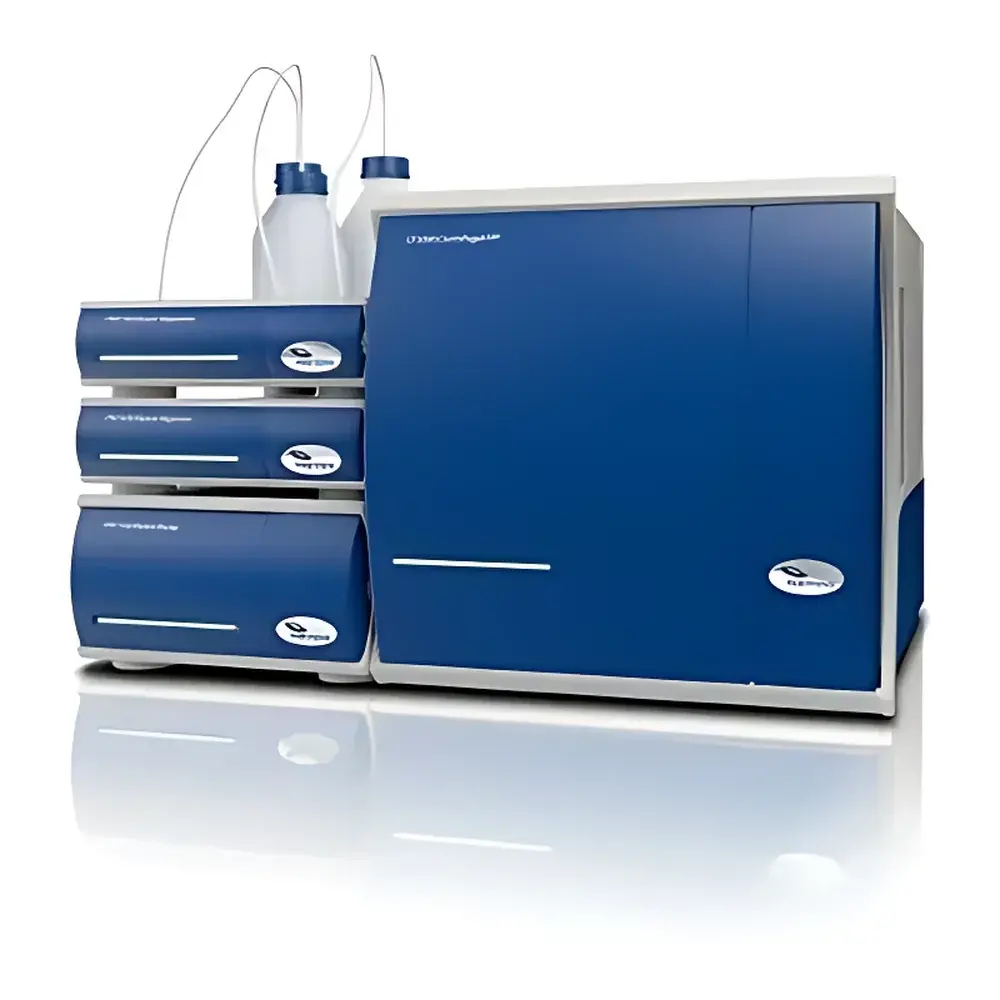
POSTNOVA CF2000 Centrifugal Field Flow Fractionation (Centrifugal FFF) System
| Brand | POSTNOVA |
|---|---|
| Origin | Germany |
| Model | CF2000 |
| Maximum Rotational Speed | 6500 rpm |
| Separation Mechanism | Size-based and Density-based Fractionation |
| Application Focus | Nanomaterial Sizing, Branched vs. Linear Polymer Analysis in Aqueous and Organic Solvents |
| Instrument Type | Centrifugal Field Flow Fractionation System |
Overview
The POSTNOVA CF2000 Centrifugal Field Flow Fractionation (Centrifugal FFF) System is a high-precision, modular separation platform engineered for the orthogonal characterization of macromolecules, nanoparticles, and colloidal dispersions. Unlike conventional chromatographic techniques such as Gel Permeation Chromatography (GPC), Centrifugal FFF operates on a flow-field fractionation principle—where separation occurs in an open, channel-based geometry under the influence of a perpendicular centrifugal force field. This physical separation mechanism avoids stationary-phase interactions, eliminating shear-induced degradation, adsorption artifacts, and column clogging commonly observed in packed-bed systems. The CF2000 generates a precisely controllable radial force gradient via a motor-driven rotor, enabling tunable retention and resolution across a broad dynamic range—from sub-10 nm nanoparticles to micrometer-scale aggregates. Its dual-mode separation capability—governed simultaneously by hydrodynamic size (diffusion coefficient) and particle density relative to the carrier liquid—provides unique selectivity for complex samples where compositional heterogeneity coexists with structural polydispersity.
Key Features
- High-speed centrifugal field generation up to 6500 rpm, delivering adjustable g-forces from ~100 × g to >4000 × g depending on channel radius and rotational speed
- Modular channel design compatible with both aqueous and organic mobile phases—including THF, DMF, chloroform, and aqueous buffers—enabling analysis of water-soluble polymers, liposomes, protein complexes, and synthetic nanomaterials
- Integrated temperature-controlled sample introduction and detector interface, supporting coupling with multi-angle light scattering (MALS), dynamic light scattering (DLS), UV-Vis, and ICP-MS detectors
- Robust architecture with precision-machined stainless steel and PEEK fluidic components, ensuring long-term chemical resistance and mechanical stability under high rotational loads
- Automated method development software for rapid optimization of cross-flow rate, focus time, and elution ramp profiles
Sample Compatibility & Compliance
The CF2000 demonstrates exceptional versatility across diverse sample classes: synthetic and natural polymers (e.g., PEG, dextran, cellulose derivatives), dendrimers, viral vectors, exosomes, metal oxide nanoparticles (TiO₂, SiO₂), quantum dots, and polymer blends. It accommodates both low-viscosity solutions and moderately viscous formulations (up to ~50 mPa·s), provided appropriate channel dimensions and flow rates are selected. The system supports compliance with internationally recognized analytical guidelines: methods developed on the CF2000 align with ISO 22412 (DLS), ISO 13321 (photon correlation spectroscopy), and ASTM D8287 (nanoparticle size distribution by FFF-MALS). When operated under documented SOPs with audit-trail-enabled software, the platform meets GLP and GMP data integrity requirements per FDA 21 CFR Part 11 for regulated environments.
Software & Data Management
Operation and data acquisition are managed through POSTNOVA’s proprietary FFF Manager software, a Windows-based application designed for instrument control, real-time monitoring, and post-run deconvolution. The software provides full traceability of all acquisition parameters—including rotor speed, cross-flow profile, detector integration times, and temperature logs—with timestamped electronic signatures. Raw fractograms are exportable in ASCII or CSV format for third-party analysis (e.g., MATLAB, Origin, or custom Python scripts). Batch processing tools support automated peak identification, retention time calibration using certified standards (e.g., NIST SRM 1963), and calculation of hydrodynamic radius distributions based on first-principles FFF theory. All data files include embedded metadata compliant with FAIR principles (Findable, Accessible, Interoperable, Reusable).
Applications
- Distinguishing linear versus branched polyethylene oxide (PEO) or poly(methyl methacrylate) (PMMA) in organic solvents—leveraging differential migration due to conformational compactness and density contrast
- Resolving multimodal size distributions of gold nanoparticles stabilized in citrate or PVP matrices without aggregation artifacts
- Characterizing protein–polymer conjugates (e.g., PEGylated interferon) by simultaneous assessment of hydrodynamic size and mass distribution via online MALS coupling
- Quantifying residual catalyst nanoparticles in polymerization reaction mixtures prior to final product purification
- Studying aggregation kinetics of monoclonal antibodies under thermal or pH stress, with fraction-specific offline analysis (e.g., SDS-PAGE, TEM)
FAQ
How does centrifugal FFF differ from sedimentation velocity analytical ultracentrifugation (SV-AUC)?
Centrifugal FFF separates particles while they remain suspended in laminar flow within a thin, ribbon-like channel; SV-AUC measures sedimentation in bulk solution under uniform centrifugal force. FFF offers higher throughput, direct coupling to online detectors, and superior resolution for polydisperse samples above ~5 nm.
Can the CF2000 analyze samples in highly viscous solvents?
Yes—within practical limits. Viscosities up to ~50 mPa·s are supported using wider channels and reduced flow rates; however, optimal resolution is achieved in low-to-moderate viscosity media (<20 mPa·s) to maintain parabolic flow profiles and predictable diffusion-limited band broadening.
Is method transfer between different CF2000 instruments reproducible?
Yes—provided identical channel geometry, rotor radius, and calibrated flow controllers are used. POSTNOVA supplies NIST-traceable flow and rotational speed verification protocols to ensure inter-instrument comparability across laboratories.
Does the system require specialized training for routine operation?
Basic operation can be mastered in under two days with POSTNOVA’s certified training program; advanced method development and troubleshooting are covered in a separate three-day application workshop focused on polymer and nanomaterial case studies.
Related Products




