
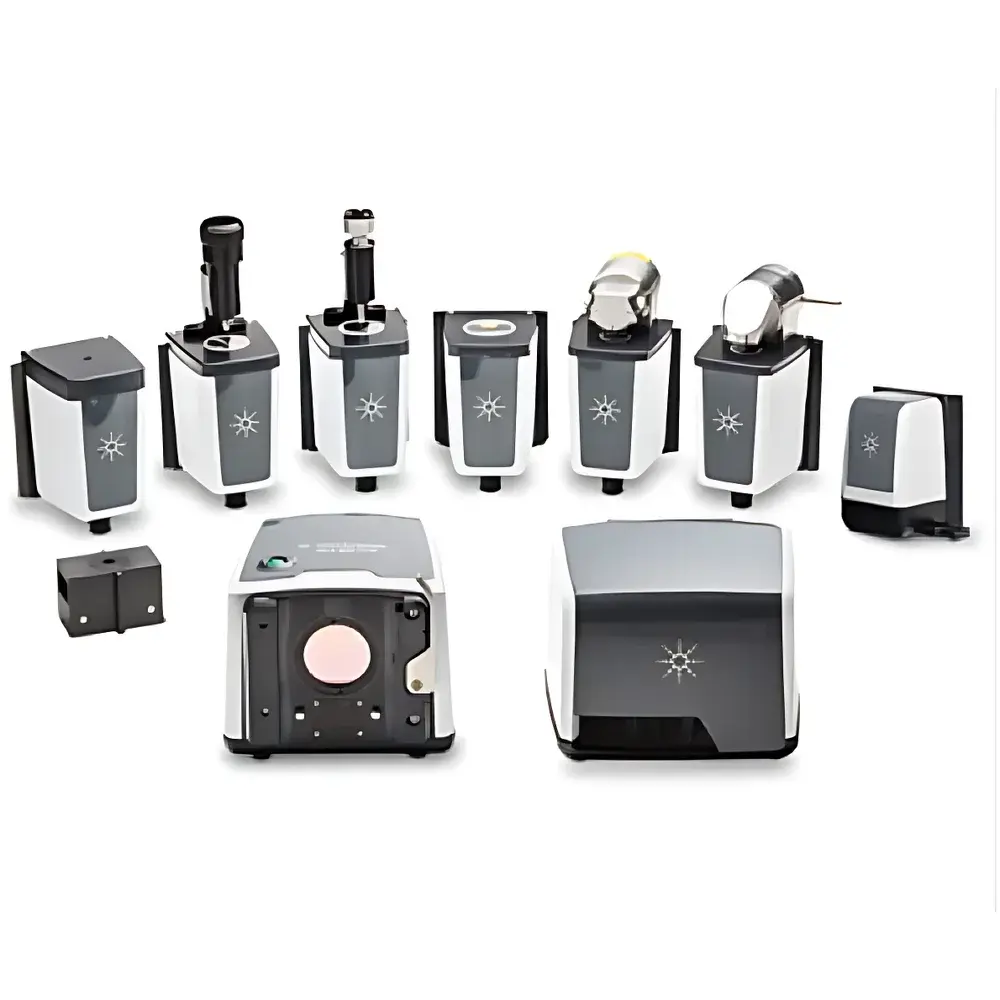
Agilent Cary 630 FTIR Spectrometer
| Brand | Agilent Technologies |
|---|---|
| Origin | Malaysia |
| Instrument Type | Benchtop Fourier Transform Infrared (FTIR) Spectrometer |
| Form Factor | Compact Portable |
| Model | Cary 630 |
| Dimensions | 20 × 20 cm footprint, Height: <15 cm |
| Weight | 3.6 kg |
| Optical Design | Permanently Aligned Interferometer with Solid-State Laser Reference |
| Detector | High-Sensitivity DTGS or Optional MCT |
| Source | Silicon Carbide Globar |
| Typical Wavenumber Range | 4000–400 cm⁻¹ (configurable per module) |
| Resolution | Up to 0.5 cm⁻¹ (software-selectable) |
| Scan Speed | Up to 10 spectra/sec (at 4 cm⁻¹ resolution) |
| Signal-to-Noise Ratio | >40,000:1 (peak-to-peak, 100 scans, 4 cm⁻¹) |
| Wavenumber Accuracy | ±0.05 cm⁻¹ (NIST-traceable calibration) |
Overview
The Agilent Cary 630 FTIR Spectrometer is a benchtop Fourier Transform Infrared spectrometer engineered for precision, reproducibility, and operational flexibility in regulated and non-regulated laboratory environments. Built upon Agilent’s legacy of robust interferometric design, the Cary 630 employs a permanently aligned Michelson interferometer with a solid-state laser reference for intrinsic wavelength stability and long-term wavenumber accuracy. Its compact architecture—measuring just 20 × 20 cm with a mass of 3.6 kg—delivers full-spectrum FTIR performance without compromising optical throughput or signal fidelity. Unlike conventional FTIR systems requiring extensive alignment or environmental stabilization, the Cary 630 maintains consistent spectral integrity across ambient temperature fluctuations (15–35 °C) and relative humidity up to 80% non-condensing, making it suitable for QC labs, field-deployable analysis, and teaching laboratories where space and infrastructure are constrained.
Key Features
- Ultra-compact benchtop form factor—world’s smallest FTIR spectrometer by footprint, enabling deployment on crowded workbenches, fume hoods, or mobile carts.
- Modular sampling interface supporting rapid, tool-free interchange of application-optimized modules: DialPath (for liquid films and polymer sheets), TumblIR (for homogeneous liquid mixing and pathlength control), ATR (ZnSe or diamond crystal options), transmission cells, gas cells, and reflectance accessories.
- Permanently aligned optics eliminate routine recalibration; each module retains factory traceable wavenumber and photometric accuracy without user intervention.
- High-energy optical path delivering up to 30% greater radiant flux compared to standard benchtop FTIR platforms—critical for low-concentration detection and thin-film characterization.
- Integrated thermal management system ensures detector stability during extended acquisition sequences, minimizing baseline drift over multi-hour experiments.
- Front-panel status indicators and USB-C connectivity simplify integration into automated workflows and networked lab environments.
Sample Compatibility & Compliance
The Cary 630 accommodates diverse sample physical states—including solids (KBr pellets, powders, tablets), liquids (neat, diluted, volatile), gels, polymers, and gases—via its interchangeable module ecosystem. The DialPath module enables precise, repeatable pathlength selection (10–200 µm) for quantitative liquid analysis without cell disassembly; TumblIR provides dynamic mixing and uniform film formation for heterogeneous solutions. All sampling interfaces comply with ISO 17025 requirements for method validation, and optional MicroLab Pharma software supports audit-trail generation, electronic signatures, role-based user permissions, and data integrity controls aligned with FDA 21 CFR Part 11, EU GMP Annex 11, and ICH Q5A/Q5B guidelines. Hardware-level security includes tamper-evident firmware signing and secure boot protocols.
Software & Data Management
Agilent MicroLab software serves as the unified analytical interface, offering guided workflows with annotated visual prompts, real-time spectral preview, and one-click library search (including NIST, Polymer, Pharmaceutical, and Forensic databases). Quantitative analysis leverages peak-area normalization, multivariate regression (PLS), and spectral subtraction algorithms validated per ASTM E1655 and USP . Raw interferograms and processed spectra are stored in vendor-neutral .spa and .csv formats, with metadata embedded per ASTM E1421. For regulated environments, MicroLab Pharma extends functionality with electronic batch records, change control logs, and 21 CFR Part 11-compliant audit trails—including timestamped operator actions, parameter modifications, and report revisions. Data export supports LIMS integration via ASTM E1578-compliant XML schema.
Applications
The Cary 630 is routinely deployed in pharmaceutical raw material identification (USP ), polymer degradation monitoring (ASTM D3418), counterfeit drug screening (ICH Q5C), lubricant oxidation analysis (ASTM D2443), food authenticity verification (e.g., olive oil adulteration per AOAC 2010.01), and forensic fiber comparison (SWGMAT standards). Its portability supports in-line process monitoring when paired with fiber-optic probes, while its modular ATR capability enables direct tablet assay without sample preparation. Academic users apply it for reaction kinetics studies (time-resolved FTIR), surface adsorption characterization, and teaching spectral interpretation fundamentals with immediate visual feedback.
FAQ
What is the typical wavenumber range supported by the Cary 630?
The standard configuration covers 4000–400 cm⁻¹; extended-range modules (e.g., with CaF₂ beamsplitter) support down to 500 cm⁻¹, while mid-IR upgrades enable operation up to 7500 cm⁻¹.
Is external vibration isolation required?
No—its monolithic interferometer housing and passive damping design meet ISO 14644 Class 8 cleanroom vibration tolerance without active isolation tables.
Can the Cary 630 be integrated into an automated sample handling system?
Yes—RS-232, USB, and Ethernet interfaces support OEM integration; Agilent provides SDK documentation for custom API development.
How is wavenumber accuracy verified and maintained?
Factory calibration uses NIST-traceable polystyrene film; users may perform periodic verification using built-in reference peaks (e.g., 1601 cm⁻¹ aromatic C=C stretch) without external standards.
Does the system support hyphenated techniques such as GC-FTIR?
While not a dedicated hyphenated platform, the Cary 630 accepts fiber-optic input from commercial GC-FTIR interfaces (e.g., LightPipe™) with appropriate spectral averaging and purge synchronization.






