
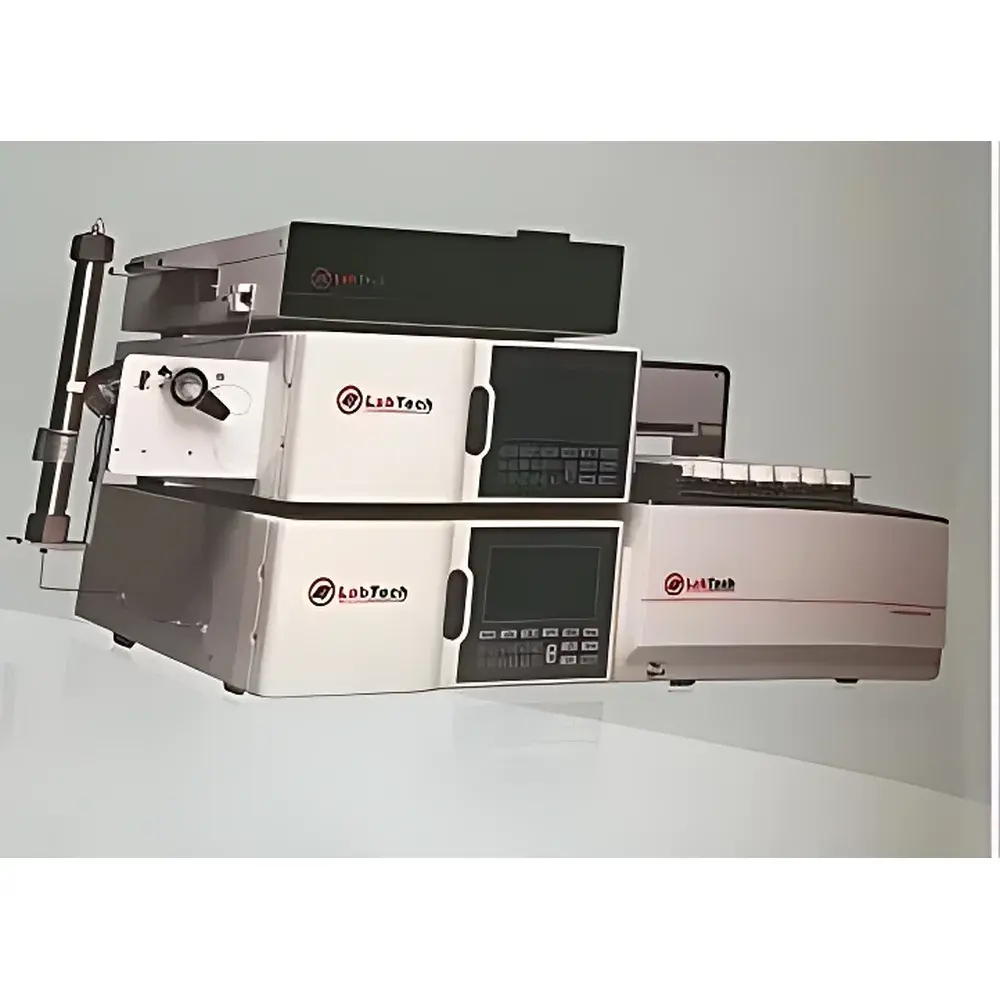
LabTech GPC600 UP Semi-Automatic Gel Permeation Chromatography (GPC) Purification System
| Brand | LabTech |
|---|---|
| Origin | Beijing, China |
| Model | GPC600 UP |
| Pump Type | High-Precision Dual-Piston Solvent Delivery Pump |
| Detection | Variable-Wavelength UV Detector (190–400 nm) |
| Fraction Collection | XYZ Triaxial Robotic Arm with Septum-Piercing Capability |
| Column | Stainless-Steel GPC Column with Integrated Inlet Filter |
| Software | Graphical Control Interface with Audit Trail, User Permissions, and 6 Collection Modes (Time-Based, Peak-Triggered, Threshold, Volume, Manual, and Multi-Threshold) |
| Compliance | Designed for GLP/GMP environments |
Overview
The LabTech GPC600 UP is a semi-automatic gel permeation chromatography (GPC) purification system engineered for precise, reproducible removal of macromolecular matrix interferences and low-molecular-weight contaminants from complex environmental, food, agricultural, and biological extracts. Operating on the fundamental principle of size-exclusion chromatography—where analytes are separated based on hydrodynamic volume in solution—the system delivers high-resolution fractionation across a defined molecular weight range. Unlike conventional liquid chromatography systems, GPC employs porous cross-linked polymer packing (e.g., styrene-divinylbenzene gels) to achieve differential elution: large molecules elute first (excluded from pores), while smaller species penetrate deeper into the pore network and elute later. This orthogonal separation mechanism significantly enhances downstream analytical performance in GC, GC-MS, LC-MS, and ICP-MS by reducing column fouling, suppressing ion suppression, and improving signal-to-noise ratios. The GPC600 UP integrates robust fluidic architecture, real-time UV monitoring, and programmable robotic fraction collection—enabling method-driven purification without full automation overhead.
Key Features
- Stainless-steel GPC column assembly with integrated sintered stainless-steel inlet filter—designed for high-pressure stability (up to 15 MPa), resistance to aggressive organic solvents (e.g., hexane, DCM, THF), and long-term reproducibility across hundreds of runs.
- XYZ triaxial robotic fraction collector featuring septum-piercing needle technology—ensures hermetic sample containment during collection, minimizes solvent evaporation losses (critical for volatile analytes), and eliminates manual vial handling errors.
- Dual-piston high-precision solvent delivery pump incorporating diaphragm pressure-damping technology—delivers flow rate stability ≤ ±0.2% RSD and pressure pulsation < 0.5% peak-to-peak, supporting baseline-resolved detection and gradient compatibility.
- Variable-wavelength UV detector (190–400 nm) with 10-mm pathlength flow cell—provides real-time chromatographic monitoring, enabling dynamic peak recognition and adaptive fraction triggering.
- Graphical control software with role-based user access, electronic audit trail, and six configurable collection modes: time-based, peak-threshold, multi-threshold, volume-triggered, manual override, and composite logic sequencing.
- Modular scalability: The base GP600 mini configuration (manual fraction collection via rotary evaporator ports) can be upgraded in-field to GPC600 UP or GPC1000 platforms via hardware retrofit and software license activation.
Sample Compatibility & Compliance
The GPC600 UP accommodates a broad range of sample matrices—including soil extracts, sediment digests, edible oil samples, pesticide-spiked fruit homogenates, and tissue lipid fractions—when dissolved in compatible GPC eluents (e.g., cyclohexane/ethyl acetate, tetrahydrofuran). Its stainless-steel fluidic path ensures compatibility with chlorinated solvents and prevents metal-catalyzed degradation of labile compounds. The system meets essential design criteria for regulated laboratories: software supports ALCOA+ data integrity principles (Attributable, Legible, Contemporaneous, Original, Accurate, Complete, Consistent, Enduring, Available); audit trails record all parameter changes, user logins, and collection events; and optional 21 CFR Part 11 compliance packages include electronic signatures, system validation documentation, and change control protocols. It aligns with ASTM D5292 (determination of polymer molecular weight distribution), ISO 11348 (toxicity testing sample cleanup), and USP chromatographic system suitability requirements.
Software & Data Management
The embedded graphical interface provides intuitive method setup, real-time chromatogram visualization, and synchronized device control (pump, detector, robotic arm). All acquisition and processing parameters—including UV wavelength, integration thresholds, collection logic rules, and pump gradient profiles—are stored as encrypted method files with version timestamps. Data files conform to AIA/ANDI standards for seamless import into third-party quantitation platforms (e.g., Chromeleon, OpenLab CDS). Raw detector signals and fraction metadata (vial position, collection time, UV absorbance integral) are written to timestamped .csv and .txt archives. System logs retain operator identity, session duration, error codes, and hardware status—facilitating internal audits and regulatory inspections under GLP or ISO/IEC 17025 frameworks.
Applications
The GPC600 UP is routinely deployed in accredited environmental testing labs for cleanup of PAHs, PCBs, organochlorine pesticides, and dioxin-like compounds prior to HRGC-HRMS analysis. In food safety laboratories, it removes triglycerides and phospholipids from animal fat extracts before multiresidue pesticide screening. Agricultural research facilities use it to isolate phytochemical fractions from plant matrices for metabolomic profiling. Its compatibility with parallel concentration platforms (e.g., M64 nitrogen-evaporation station) enables fully traceable sample-to-instrument workflows—reducing manual transfer steps, minimizing contamination risk, and preserving quantitative recovery of thermally sensitive analytes.
FAQ
What solvent systems are validated for use with the GPC600 UP?
Commonly validated eluents include tetrahydrofuran (THF), chloroform, cyclohexane/ethyl acetate (95:5 v/v), and dichloromethane—subject to column packing compatibility and detector wavelength settings.
Can the system be integrated with third-party concentrators or autosamplers?
Yes—the XYZ robotic arm uses standardized vial footprint dimensions (e.g., 12 × 32 mm, 16 × 40 mm), and the M64 parallel concentrator shares identical rack geometry for direct docking without intermediate transfer.
Is method validation support available from LabTech?
LabTech provides application notes, system suitability test protocols, and IQ/OQ documentation templates aligned with ISO/IEC 17025 and FDA guidance for chromatographic purification systems.
What maintenance intervals are recommended for the stainless-steel column and UV flow cell?
Column backflushing is advised after every 50 injections using filtered eluent; UV flow cell cleaning with methanol/water (1:1) is recommended weekly or after high-particulate samples.
Does the software support remote monitoring or networked deployment?
The control software operates on Windows OS and supports LAN-based client-server operation with role-limited remote desktop access for supervisory review—though full remote control requires local administrator privileges and firewall configuration per IT security policy.



