
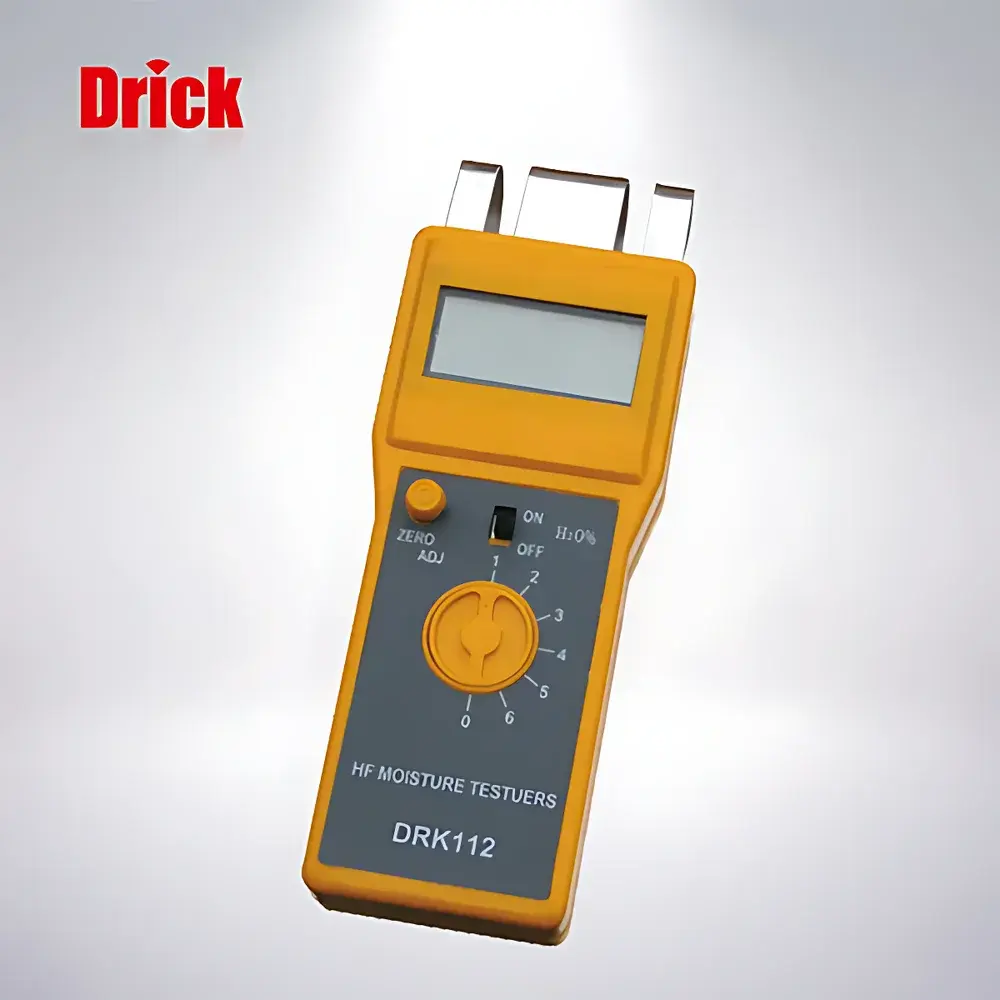
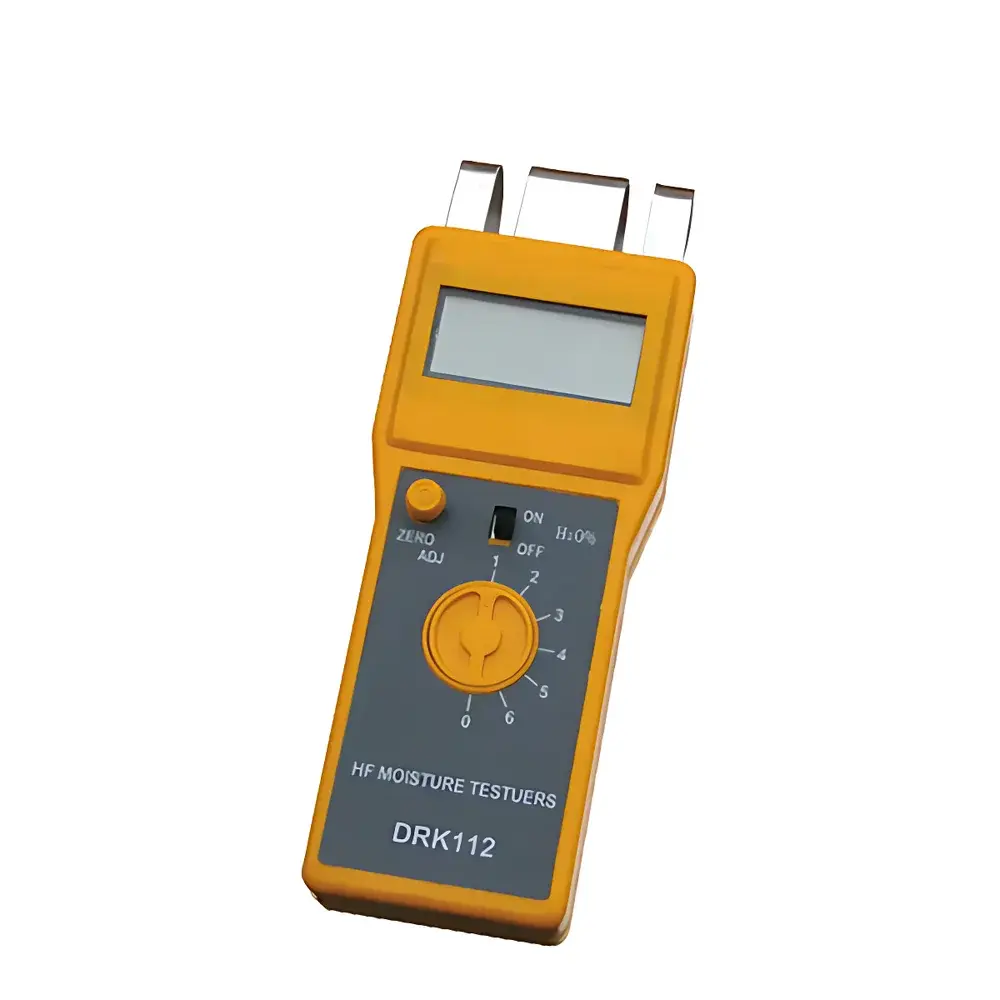
Drick DRK112 High-Frequency Three-Prong Digital Moisture Meter for Paper and Board
| Brand | Drick |
|---|---|
| Origin | Shandong, China |
| Manufacturer Type | Direct Manufacturer |
| Product Origin | Domestic (China) |
| Model | DRK112 |
| Price Range | USD 700 – 1,100 |
| Measurement Range | 0–40% w/w |
| Accuracy | ±0.5% |
| Display | 3.5-digit LCD |
| Operating Temperature | −5 to +60 °C |
| Power Supply | 9 V alkaline battery (6F22) |
| Weight | 0.2 kg |
| Dimensions | 165 × 60 × 27 mm (H×W×D) |
| Measurement Principle | High-frequency dielectric sensing (fixed-frequency resonant cavity method) |
| Calibration Method | Six-position material-specific gain switch (density-compensated scale selection) |
Overview
The Drick DRK112 High-Frequency Three-Prong Digital Moisture Meter is a portable, hand-held instrument engineered for rapid, non-destructive moisture content determination in fibrous sheet materials—primarily paper, cardboard, corrugated board, and kraft liner. It operates on the principle of high-frequency dielectric sensing: a fixed-frequency oscillator generates an electromagnetic field (typically in the 10–100 MHz range) that interacts with the dipole moment of water molecules within the sample. Variations in the dielectric constant—directly correlated with moisture concentration—are detected via frequency shift in a resonant sensor cavity. This analog frequency deviation is converted to current via an F/I converter, then digitized by a 12-bit ADC and displayed as a percentage (w/w) on a 3.5-digit LCD. Unlike capacitance-based meters, the DRK112 employs a three-prong electrode configuration that ensures consistent probe penetration depth and contact geometry across heterogeneous surfaces, minimizing air-gap errors and improving measurement repeatability on textured or layered substrates.
Key Features
- Three-prong high-frequency sensor head integrated with main unit—no external cables or calibration drift from connector wear
- Six-position material-select switch enabling density-compensated scaling for common paper grades (e.g., newsprint, coated offset, corrugated medium, linerboard, tissue, and kraft)
- Compact ergonomic design (165 × 60 × 27 mm) and ultra-lightweight construction (0.2 kg) for extended handheld use during production line audits or warehouse spot checks
- True in-situ capability: measures directly on moving web (e.g., at rewinder or slitter exit) or static stacks without sample conditioning or destructive sampling
- Low-power operation via standard 9 V alkaline battery (6F22), supporting >10,000 measurements per charge under typical usage conditions
- Wide operational temperature range (−5 to +60 °C) suitable for ambient factory floors, climate-controlled labs, and unheated storage areas
Sample Compatibility & Compliance
The DRK112 is validated for use on homogeneous cellulose-based materials with thicknesses between 0.08 mm and 6 mm and bulk densities ranging from 40 g/m² (tissue) to 800 g/m² (double-wall corrugated board). It is not intended for laminated composites, metallized papers, or substrates containing conductive fillers (e.g., carbon black or aluminum pigments), which may distort the high-frequency field. While not certified to ISO 287 (paper moisture—reference oven-drying method) or TAPPI T412 om-22, the instrument is routinely cross-validated against gravimetric standards per internal QA protocols. Its six-scale architecture aligns with common industry practice for empirical correction of density-related permittivity bias—a methodology referenced in ASTM D2865–20 (Standard Guide for Moisture Content Testing of Paper and Paperboard) as an acceptable field alternative when traceable oven calibration is impractical.
Software & Data Management
The DRK112 is a standalone hardware meter with no embedded memory, Bluetooth, or data export capability. All measurements are displayed in real time only; no audit trail, timestamping, or user ID logging is performed. As such, it complies with basic GLP documentation requirements only when paired with manual entry into controlled lab notebooks or LIMS-integrated spreadsheets. For regulated environments requiring 21 CFR Part 11 compliance (e.g., pharmaceutical packaging QC), users must implement procedural controls—including operator training records, daily verification using NIST-traceable moisture standards (e.g., certified paper reference materials from PTB or NPL), and documented deviation handling for out-of-spec readings. Firmware updates or software integration are not supported.
Applications
- Real-time moisture monitoring at paper machine dry end and reel-up stations to prevent curl, cockle, or caliper variation
- Quality gate inspection of incoming roll stock prior to converting operations (e.g., printing, laminating, or die-cutting)
- Warehouse humidity impact assessment on stored cartons and packaging blanks
- Process troubleshooting—correlating moisture gradients across sheet width or through stack layers to identify dryer profile imbalances or rewet issues
- Educational use in pulp & paper engineering labs for teaching dielectric property–moisture relationships
FAQ
What is the measurement principle used in the DRK112?
It utilizes high-frequency dielectric resonance sensing, where a fixed-frequency oscillator detects shifts in resonant frequency caused by changes in the sample’s dielectric constant due to water content.
Can the DRK112 measure moisture in coated or laminated paper?
No—coatings containing metallic pigments, barrier layers (e.g., PE or PVDC), or conductive additives interfere with the high-frequency field and invalidate readings.
How often should the instrument be verified?
Daily verification using a stable, low-moisture reference standard (e.g., conditioned blotting paper at 5.0 ± 0.2% RH-equilibrated moisture) is recommended before first use and after any temperature shock.
Is the six-position switch calibrated to specific paper grades?
Yes—the positions correspond to empirically derived gain factors for typical basis weights and densities; users must select the closest match based on product specification sheets or prior gravimetric correlation.
Does the DRK112 require periodic recalibration by the manufacturer?
No formal recalibration is specified; however, annual verification against traceable reference materials is advised for ISO 9001 or IATF 16949 auditable processes.




