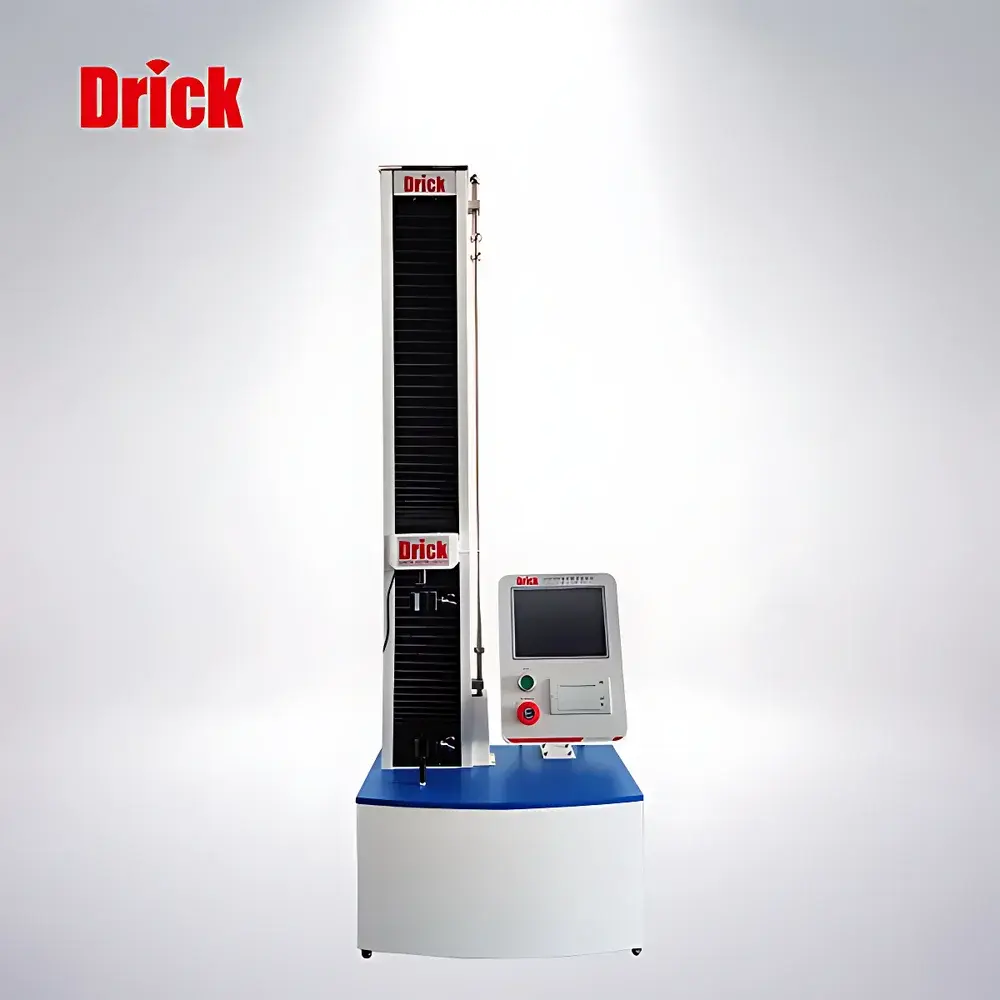
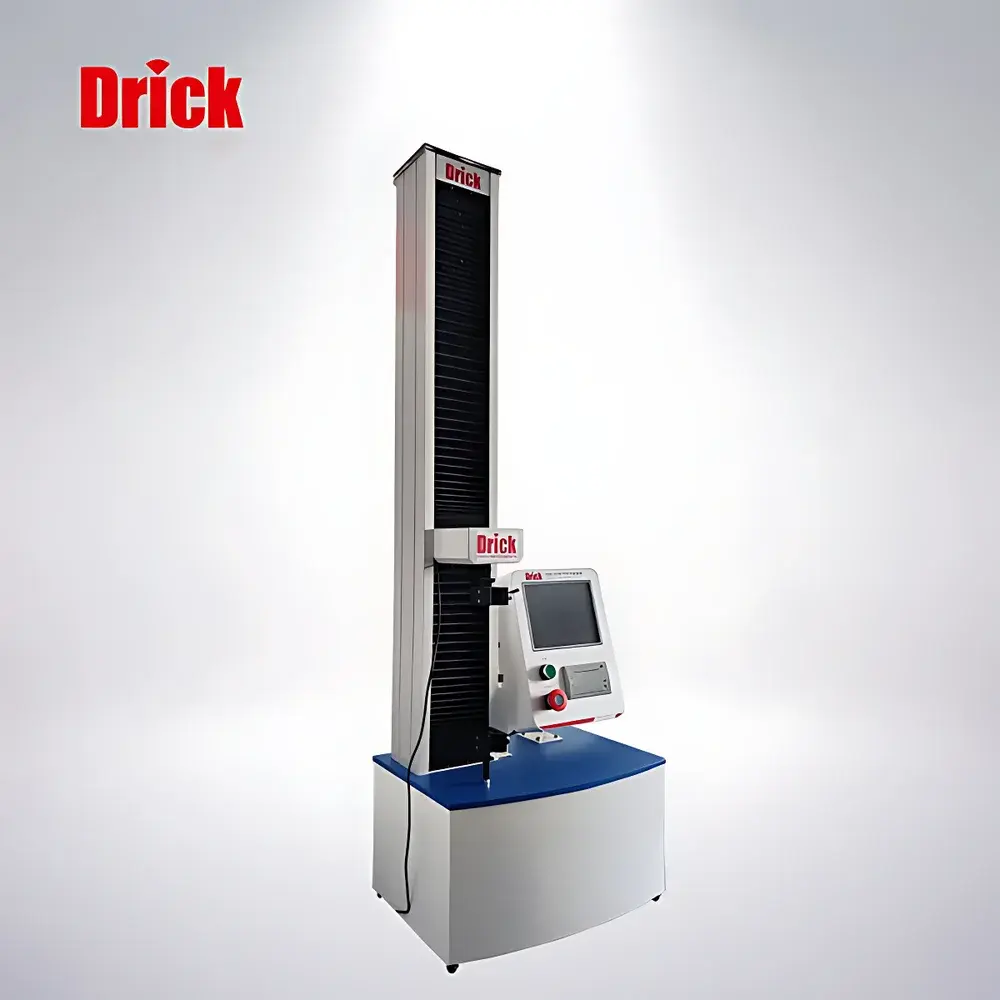
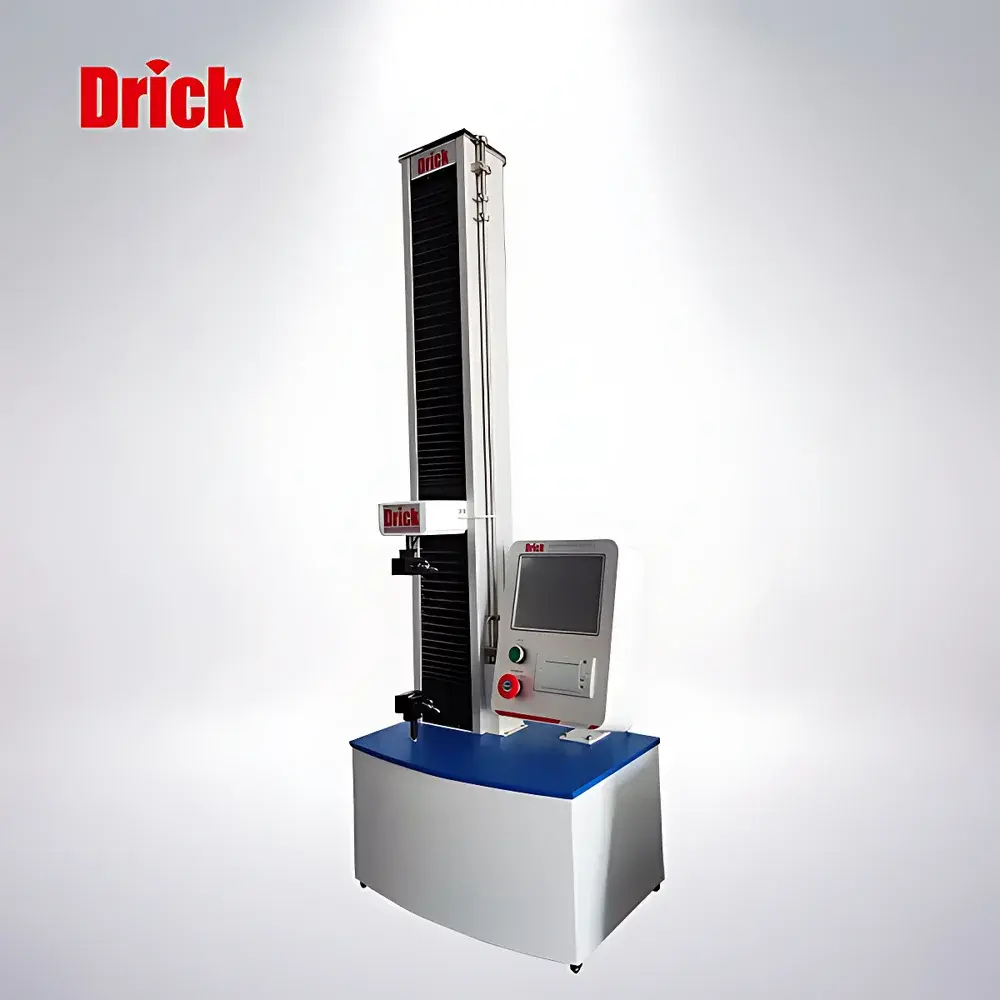
Drick DRK-101 Universal Tensile Testing Machine for Plastic Materials (Conforming to GB/T 1040.2–2022 and ISO 527-2)
| Key | Brand: Drick |
|---|---|
| Origin | Shandong, China |
| Manufacturer Type | Direct Manufacturer |
| Model | DRK-101 |
| Load Capacity Options | 100 N / 500 N / 1000 N / 5000 N (selectable) |
| Accuracy | ±1% of reading or ±0.5% (customer-specified) |
| Elongation Resolution | 0.001 mm |
| Speed Control | Continuous variable speed (0.01–500 mm/min) |
| Standard Grip Width | 30 mm |
| Optional Grip Width | 50 mm |
| Specimen Count per Test | 1 |
| Crosshead Travel | 700 mm (customizable) |
| Dimensions (L×W×H) | 500 × 300 × 1150 mm |
| Power Supply | AC 220 V, 50 Hz |
Overview
The Drick DRK-101 Universal Tensile Testing Machine is a precision-engineered electromechanical system designed for static mechanical property evaluation of polymeric and flexible materials in accordance with national and international standards—including GB/T 1040.2–2022 (Plastics — Determination of tensile properties — Part 2: Test conditions for moulding and extrusion plastics), ISO 527-2, ASTM D882, ASTM D638, and ISO 37. It operates on the principle of uniaxial force application via servo-controlled linear motion, measuring load (N) and displacement (mm) simultaneously to derive stress–strain curves, yield strength, tensile strength, elongation at break, modulus of elasticity, and Poisson’s ratio. The instrument employs a high-rigidity aluminum alloy frame—engineered for dimensional stability under sustained loading—and integrates a preloaded ball-screw transmission system coupled with a brushless AC servo motor to ensure smooth, low-noise actuation and minimal backlash across its full speed range (0.01–500 mm/min). All structural components comply with ISO 26203-1:2012 requirements for verification of static testing machines.
Key Features
- High-precision load cell with dual-range calibration options (±0.5% or ±1% full-scale accuracy), traceable to national metrological standards;
- Real-time digital display of load, displacement, and strain rate on integrated LCD interface; data synchronized with PC via RS232/USB;
- Modular grip system supporting standard 30 mm jaw width and optional 50 mm configuration; manual wedge-action clamping ensures uniform stress distribution without specimen slippage;
- Software-enabled automatic calculation of key mechanical parameters—including tensile strength (MPa), elongation at break (%), Young’s modulus (MPa), and yield point—per ISO 527-2 Annex B procedures;
- Compliance-ready test report generation with embedded metadata: operator ID, timestamp, environmental conditions (optional sensor input), sample ID, and test standard reference;
- Structural design certified under CNAS-accredited mechanical verification protocol; housing geometry protected by Chinese Utility Model Patent ZL2020XXXXXXX.X.
Sample Compatibility & Compliance
The DRK-101 accommodates flat, sheet-like specimens up to 700 mm travel length and ≤10 mm thickness, including thermoplastic films (LDPE, PP, PET), laminated packaging structures, woven/nonwoven textiles, elastomeric strips, paperboard substrates, pressure-sensitive adhesives (with peel fixtures), and rubber compounds. It supports standardized test geometries defined in GB/T 1040.2, ASTM D882 (thin plastic sheeting), ASTM D1938 (tear resistance), ASTM F88 (seal strength), and ISO 11607-2 (sterile barrier systems). All firmware and measurement algorithms are validated against ISO/IEC 17025:2017 clause 7.7 (uncertainty of measurement) and support audit trails required under GLP and GMP environments. Optional accessories—including pneumatic grips, floating roller fixtures, and shear test platens—extend compliance coverage to QB/T 2358 (heat seal strength), GB/T 2792 (peel adhesion), and ISO 8510-2 (adhesive bond strength).
Software & Data Management
The embedded control software (v3.2.1) provides real-time plotting of force–displacement and stress–strain curves with adjustable scaling, curve smoothing filters, and breakpoint detection for yield onset and necking initiation. Raw data export is supported in CSV, XLSX, and XML formats compliant with ASTM E1447 and ISO/IEC 17025 data integrity guidelines. Audit trail functionality records all user actions—including parameter modification, calibration events, and report generation—with timestamps and operator authentication. Software architecture conforms to FDA 21 CFR Part 11 requirements when deployed with Windows-based host systems featuring electronic signature modules and role-based access control. Calibration certificates include uncertainty budgets calculated per GUM (JCGM 100:2008) methodology.
Applications
This system is routinely deployed in QC laboratories of polymer compounders, flexible packaging converters, medical device manufacturers, and adhesive formulators for routine conformance testing and material qualification. Typical use cases include: tensile characterization of blown film extrudates prior to lamination; peel strength validation of pouch seals in pharmaceutical blister packaging; elongation consistency checks across production batches of stretch wrap; tear propagation analysis in geotextiles; and modulus verification of biodegradable PLA films under ambient and elevated temperature conditions (when paired with environmental chamber). Its modular design also enables adaptation for ISO 1133 melt flow index correlation studies via custom fixture integration.
FAQ
Does the DRK-101 meet ISO/IEC 17025 accreditation requirements for accredited testing labs?
Yes—the machine’s measurement uncertainty profile, calibration traceability chain, and software audit trail capabilities align with ISO/IEC 17025:2017 clauses 6.4, 6.5, and 7.7.
Can the system perform tests beyond GB/T 1040—such as ASTM D882 or ISO 527?
Yes—test method templates for ASTM D882, ISO 527-2, and EN 13130-1 are preloaded and configurable via software interface.
Is third-party calibration certification available?
Yes—Drick offers optional CNAS-accredited calibration services with certificate valid for 12 months.
What is the maximum specimen thickness supported with standard grips?
Standard manual wedge grips accommodate specimens up to 10 mm thick; custom high-capacity grips support up to 25 mm.
How is compliance with FDA 21 CFR Part 11 ensured?
When operated with validated Windows OS and configured with electronic signature modules, the system meets Part 11 requirements for electronic records and signatures.