
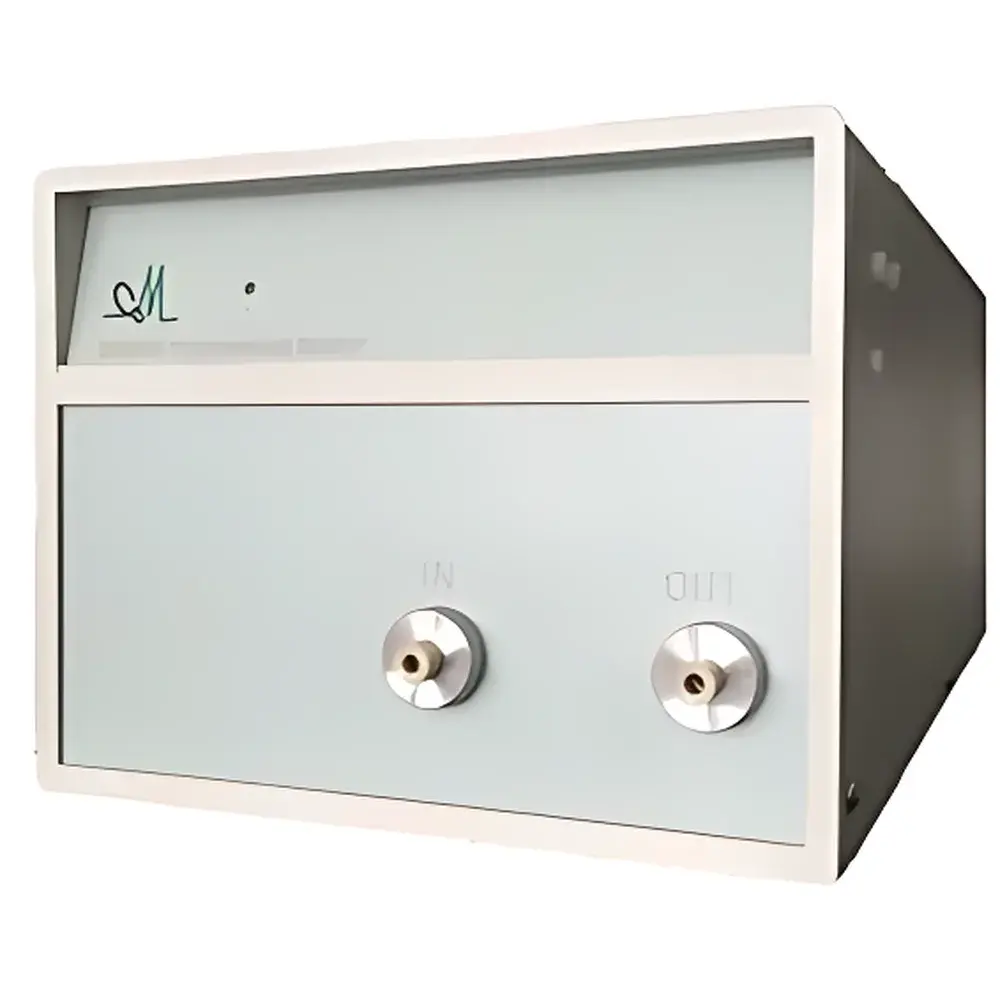
CoMetro 6000PER Photochemical Post-Column Derivatization System
| Brand | CoMetro |
|---|---|
| Origin | Imported |
| Manufacturer Type | Authorized Distributor |
| Model | 6000PER |
| Light Source | Cold UV LED |
| Output Power | 8 mW |
| Wavelength | 254 nm |
| Reactor Design | Köhler Illumination Optics |
| Max Flow Rate | 3 mL/min |
| Cooling Method | Forced Air Convection |
| Derivatization Principle | In-line UV-mediated photochemical activation |
Overview
The CoMetro 6000PER Photochemical Post-Column Derivatization System is an engineered solution for enhancing the sensitivity and selectivity of high-performance liquid chromatography (HPLC) detection—specifically for analytes requiring UV-induced structural activation prior to fluorescence or absorbance measurement. Unlike conventional chemical derivatization methods, the 6000PER employs a solid-state, cold UV LED light source operating at a precisely stabilized 254 nm wavelength to drive post-column photochemical reactions in real time. This principle leverages the photolysis of specific functional groups (e.g., lactone rings in aflatoxins or sulfonamide moieties), generating highly fluorescent or chromophoric derivatives without reagent addition, mixing, or solvent-phase interference. Designed for seamless integration between the HPLC column outlet and the detector inlet, the system maintains hydraulic continuity and preserves chromatographic integrity—eliminating extra-column band broadening, dead volume accumulation, or backpressure fluctuations commonly associated with reactor-based derivatization modules.
Key Features
- Cold UV LED light source (254 nm) with stable 8 mW output—no warm-up time, minimal thermal load on the flow path, and extended diode lifetime (>10,000 h)
- Köhler illumination optics ensuring uniform photon flux across the fused-silica reaction coil—critical for reproducible derivatization efficiency and inter-run precision
- Zero-reagent operation: eliminates pump synchronization, reagent degradation, baseline drift, and waste stream generation
- No mixing tee, no valve switching, no post-derivatization wash cycle—reducing system complexity and operator intervention
- Forced-air convection cooling maintaining reactor temperature within ±2 °C of ambient—preventing thermal degradation of labile derivatives and preserving retention time stability
- Compact, modular design with standard 1/16″ stainless steel and PEEK fluidic connections compatible with all major HPLC platforms (Agilent, Waters, Shimadzu, Thermo)
Sample Compatibility & Compliance
The 6000PER is validated for regulatory-compliant analysis of aflatoxin B₁ and G₁ in food, feed, and pharmaceutical raw materials per AOAC Official Method 2005.08 and EU Commission Regulation (EC) No. 401/2006. It also supports quantification of sulfonamide antibiotics (e.g., sulfamethazine, sulfadimethoxine) in veterinary tissue matrices under USDA FSIS Directive 10050.0 and FDA CVM Guidance for Industry #120. The system’s reagent-free architecture inherently avoids contamination risks and simplifies method validation for GLP- and GMP-regulated laboratories. All wetted components comply with USP Class VI biocompatibility standards; optical housing meets IEC 61000-6-3 EMC emission requirements. Full audit trail support—including lamp runtime logging, flow verification timestamps, and user-access records—is available when integrated with compliant LIMS or chromatography data systems adhering to 21 CFR Part 11.
Software & Data Management
While the 6000PER operates as a standalone hardware module, its performance metrics are fully traceable via optional digital interface modules (RS-485 or USB-C). Lamp operational hours, real-time temperature monitoring, and flow confirmation signals can be logged into third-party CDS platforms (e.g., Empower 3, Chromeleon, OpenLab CDS) using configurable Modbus RTU registers. All firmware updates follow ISO/IEC 17025-aligned change control procedures, with version history and calibration certificate references archived per instrument serial number. No proprietary software installation is required—configuration is performed through hardware DIP switches or external trigger logic synchronized to the HPLC pump start signal.
Applications
- Quantitative determination of aflatoxin B₁ and G₁ in corn, peanuts, pistachios, and dairy products with LODs ≤50 pg on-column (using fluorescence detection at λex/λem = 365/425 nm)
- Routine screening of sulfonamide residues in porcine muscle, bovine kidney, and aquaculture samples per multi-residue LC-FLD workflows
- Support of ISO 15741:2022-compliant mycotoxin testing in accredited reference laboratories
- Method transfer between research, QC, and contract testing labs—enabled by identical photochemical reaction kinetics across instrument units
- Integration into automated HPLC-MS/MS workflows where pre-ionization derivatization improves ionization efficiency for low-response analytes
FAQ
Does the 6000PER require routine lamp replacement or recalibration?
No. The UV LED is rated for ≥10,000 hours of continuous operation with negligible spectral shift. No scheduled recalibration is needed; performance verification is conducted annually using NIST-traceable aflatoxin B₁ reference standards.
Can it be used with UHPLC systems operating above 1000 bar?
Yes—provided the downstream detector and connecting tubing are pressure-rated. The 6000PER itself has no active pressure containment; it sits in-line at atmospheric pressure post-column and pre-detector.
Is the Köhler reactor compatible with gradient elution methods?
Yes. Optical uniformity ensures consistent derivatization yield across changing mobile phase compositions, including acetonitrile/water and methanol/water gradients.
What maintenance is required beyond routine system flushing?
None. There are no consumables, seals, or moving parts. Visual inspection of the quartz reaction coil for particulate buildup every 6 months is recommended.
How does it compare to electrochemical or thermal derivatization systems?
It offers superior specificity for UV-labile targets, eliminates redox interference, avoids thermal decomposition of heat-sensitive analytes, and requires no auxiliary power supplies or gas lines—reducing footprint and operational overhead.




