
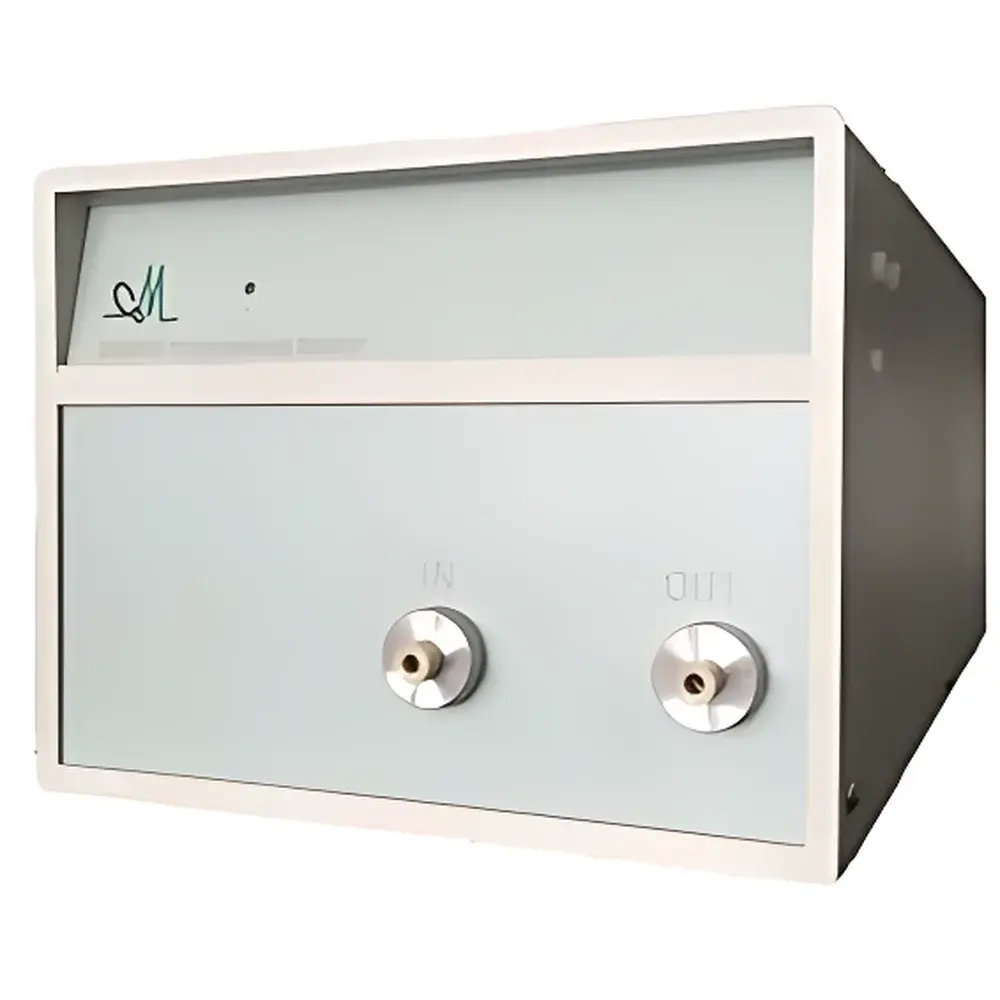
CoMetro 6000PER Photochemical Post-Column Derivatization System
| Brand | CoMetro |
|---|---|
| Origin | Imported |
| Model Series | 6000PER |
| Derivatization Flow Rate | 3 mL/min |
| Light Source | Cold UV Lamp (254 nm, 8 mW output) |
| Reaction Coil | Stainless Steel |
| Temperature Control | Forced-Air Cooling |
| Compliance | Designed for HPLC-integrated post-column derivatization |
Overview
The CoMetro 6000PER Photochemical Post-Column Derivatization System is an engineered solution for enhancing detection sensitivity in high-performance liquid chromatography (HPLC) applications requiring selective and stable fluorescence signal amplification. It operates on the principle of controlled ultraviolet photochemical activation—exposing eluting analytes to monochromatic 254 nm UV radiation within a precisely dimensioned stainless-steel reaction coil. This process induces structural photoconversion in target compounds—including aflatoxin B₁ and G₁, as well as sulfonamide antibiotics—without chemical reagent addition. Unlike thermal or chemical derivatization methods, the 6000PER eliminates reagent delivery pumps, mixing tees, and post-reaction wash cycles, thereby preserving chromatographic integrity, minimizing system dead volume, and preventing peak broadening or column backpressure fluctuations. Its integration between the HPLC column outlet and the fluorescence detector enables real-time, continuous derivatization under ambient or forced-air–stabilized thermal conditions.
Key Features
- Cold UV light source emitting at 254 nm with stable 8 mW optical output—optimized for photolysis-driven derivatization without thermal degradation
- Stainless-steel reaction coil with fixed internal geometry, ensuring reproducible residence time and photon exposure across flow rates up to 3 mL/min
- Forced-air cooling system maintaining coil surface temperature within ±2 °C over extended operation—critical for retention time stability and photoreaction consistency
- No reagent handling: eliminates risks of clogging, baseline drift, or carryover associated with chemical derivatization reagents
- Zero additional dead volume design: coaxial flow path minimizes extra-column band broadening and preserves chromatographic resolution
- Plug-and-play mechanical interface compatible with standard 1/16″ OD PEEK or stainless-steel HPLC tubing and common detector inlet ports
Sample Compatibility & Compliance
The 6000PER is validated for use in regulatory-compliant workflows targeting mycotoxins (e.g., aflatoxins per AOAC Official Method 2005.08 and EU Commission Regulation (EC) No 401/2006) and veterinary drug residues (e.g., sulfonamides per ISO 14501:2009). Its reagent-free operation supports GLP- and GMP-aligned laboratories by removing variables associated with reagent lot variability, expiration, or pH-dependent reaction kinetics. The system’s passive, non-invasive architecture ensures full compatibility with gradient elution, low-UV-cutoff mobile phases (e.g., acetonitrile/water), and reversed-phase C18 columns. No modifications to existing HPLC hardware or software are required; method transfer from legacy derivatization setups is achieved via simple flow-path rerouting.
Software & Data Management
As a hardware-only derivatization module, the 6000PER does not include embedded firmware or proprietary control software. It functions transparently within any vendor-neutral HPLC data system (e.g., Waters Empower, Thermo Chromeleon, Agilent OpenLab CDS). All operational parameters—including flow rate, column temperature, and detector gain—are managed externally through the host chromatography platform. Audit trails, electronic signatures, and 21 CFR Part 11 compliance are maintained entirely by the connected CDS. Routine performance verification is conducted using certified reference standards (e.g., AFB₁ at 0.1–5 ng/mL), with derivatization efficiency assessed via signal-to-noise ratio (S/N) improvement and peak area reproducibility (RSD < 2.5% over n = 6 injections).
Applications
- Quantification of aflatoxin B₁ and G₁ in cereals, nuts, spices, and dairy products per FDA Action Levels and EU Maximum Limits
- Residue analysis of sulfonamide antibiotics in animal tissues, honey, and milk—supporting multi-residue LC-FLD workflows
- Method development for emerging mycotoxins (e.g., ochratoxin A derivatives) where UV-mediated ring cleavage enhances native fluorescence
- Reference laboratory validation studies requiring trace-level detection (sub-ppb) without derivatization-related matrix interference
- Academic and contract research settings prioritizing method robustness, inter-laboratory transferability, and long-term maintenance simplicity
FAQ
Does the 6000PER require calibration or routine lamp replacement?
The cold UV lamp is rated for ≥5,000 hours of continuous operation; no scheduled calibration is required. Output stability is verified annually using a NIST-traceable UV radiometer.
Can it be used with UHPLC systems operating above 600 bar?
Yes—the stainless-steel coil and fittings are rated to 700 bar; pressure drop at 3 mL/min is < 20 psi.
Is ozone generation a concern during operation?
No. The sealed lamp housing and 254 nm wavelength minimize ozone-producing <185 nm emission; no ventilation or scavenging is needed.
How does it compare to electrochemical or thermal derivatization for sulfonamides?
Photochemical derivatization provides superior selectivity for sulfonamide N⁴-acetyl derivatives and avoids electrode fouling or thermal decomposition observed in alternative approaches.
What maintenance is required beyond routine HPLC system cleaning?
None—no consumables, no fluidic valves, and no wetted parts other than the inert stainless-steel coil, which is cleaned in situ using standard HPLC solvent flush protocols.
Related Products





