
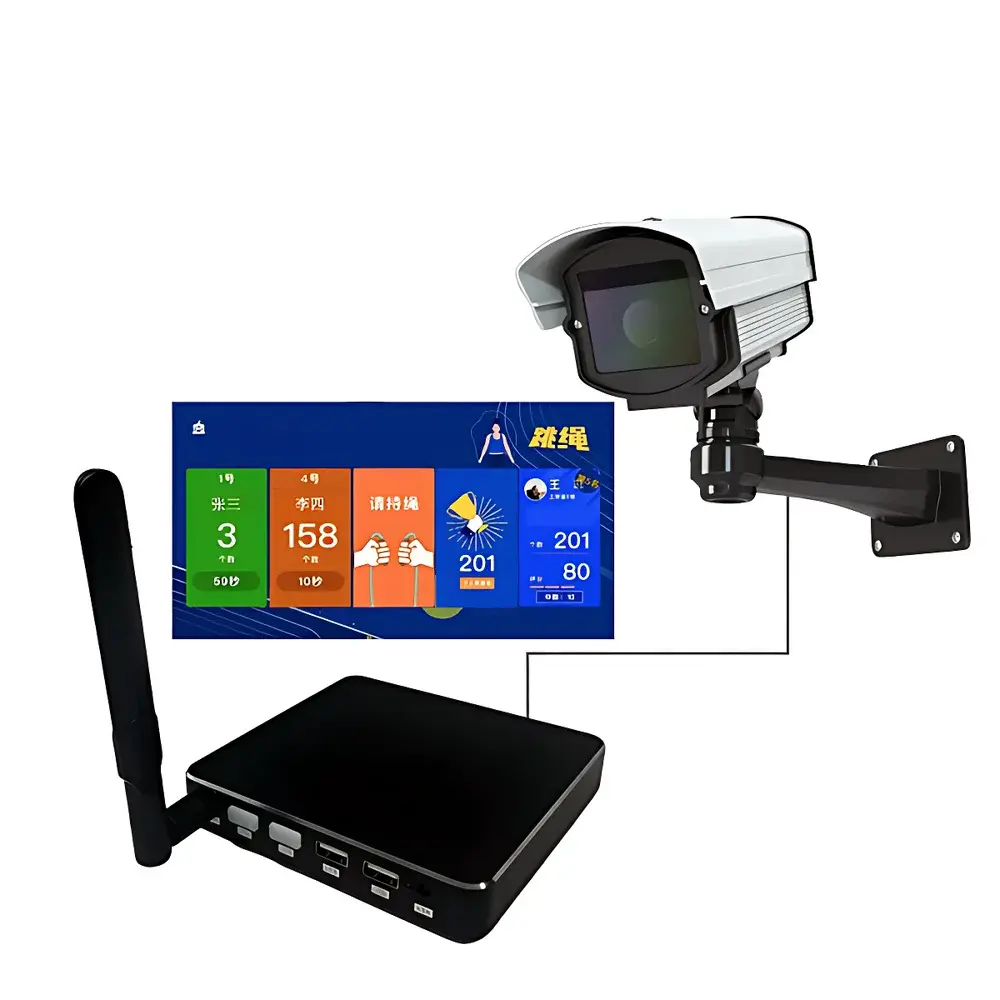
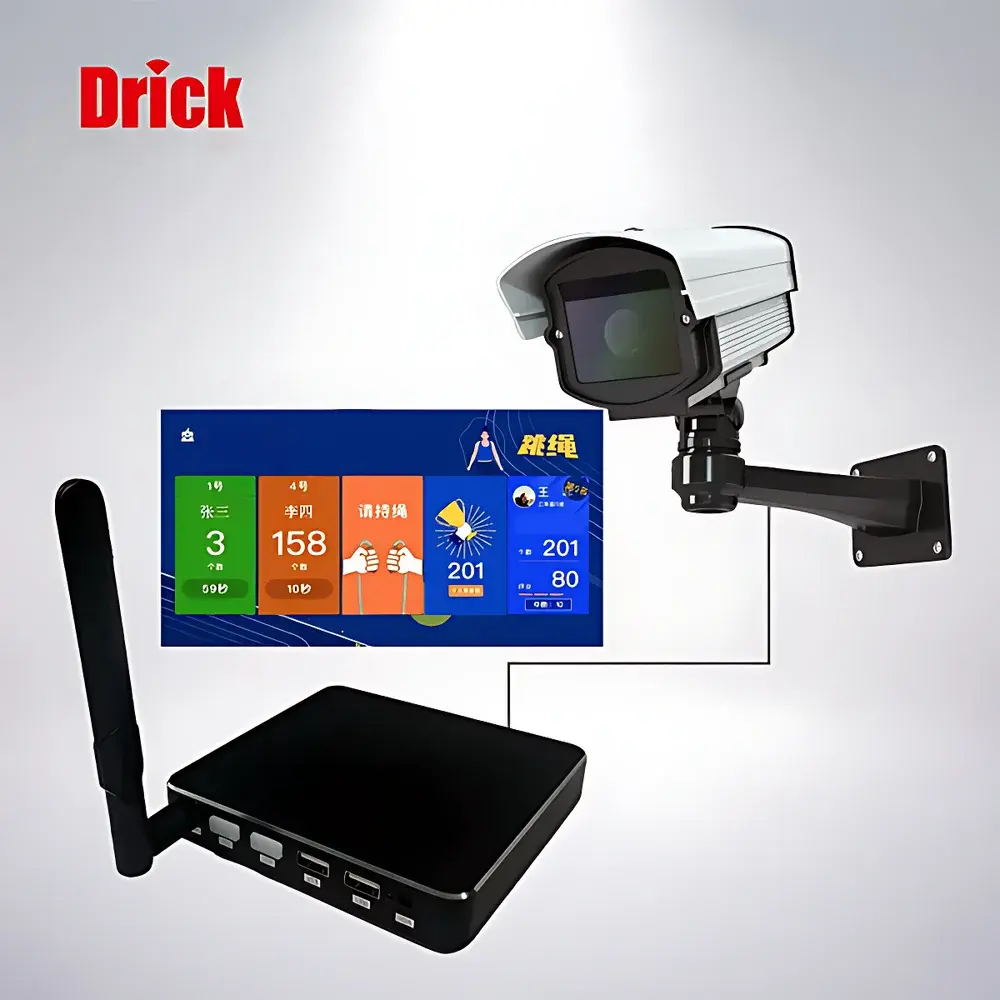
Drick AI Smart Sports Dashboard System
| Brand | Drick |
|---|---|
| Origin | Shandong, China |
| Manufacturer Type | Direct Manufacturer |
| Country of Origin | China |
| Model | Drick AI Smart Sports Dashboard |
| Price | USD 70,000 (FOB) |
Overview
The Drick AI Smart Sports Dashboard System is a turnkey, vision-based physical fitness assessment and training platform engineered for educational institutions seeking scalable, contactless, and standards-aligned student activity monitoring. Built on embedded GPU-accelerated computer vision architecture, the system performs real-time biomechanical motion analysis using multi-person pose estimation algorithms—eliminating the need for wearables, sensors, or manual timing devices. It operates on the principle of spatiotemporal skeletal keypoint tracking (based on OpenPose and custom CNN ensembles), calibrated against validated movement biomechanics benchmarks for common physical education metrics—including rope skipping rhythm, squat depth, jump takeoff/landing angles, and sit-up torso flexion range. Designed for integration into existing school infrastructure, the system supports concurrent assessment of up to five students across eight standardized physical fitness activities, delivering immediate quantitative feedback aligned with China’s National Student Physical Health Standard (GB/T 18833–2022) and adaptable to international PE curriculum frameworks.
Key Features
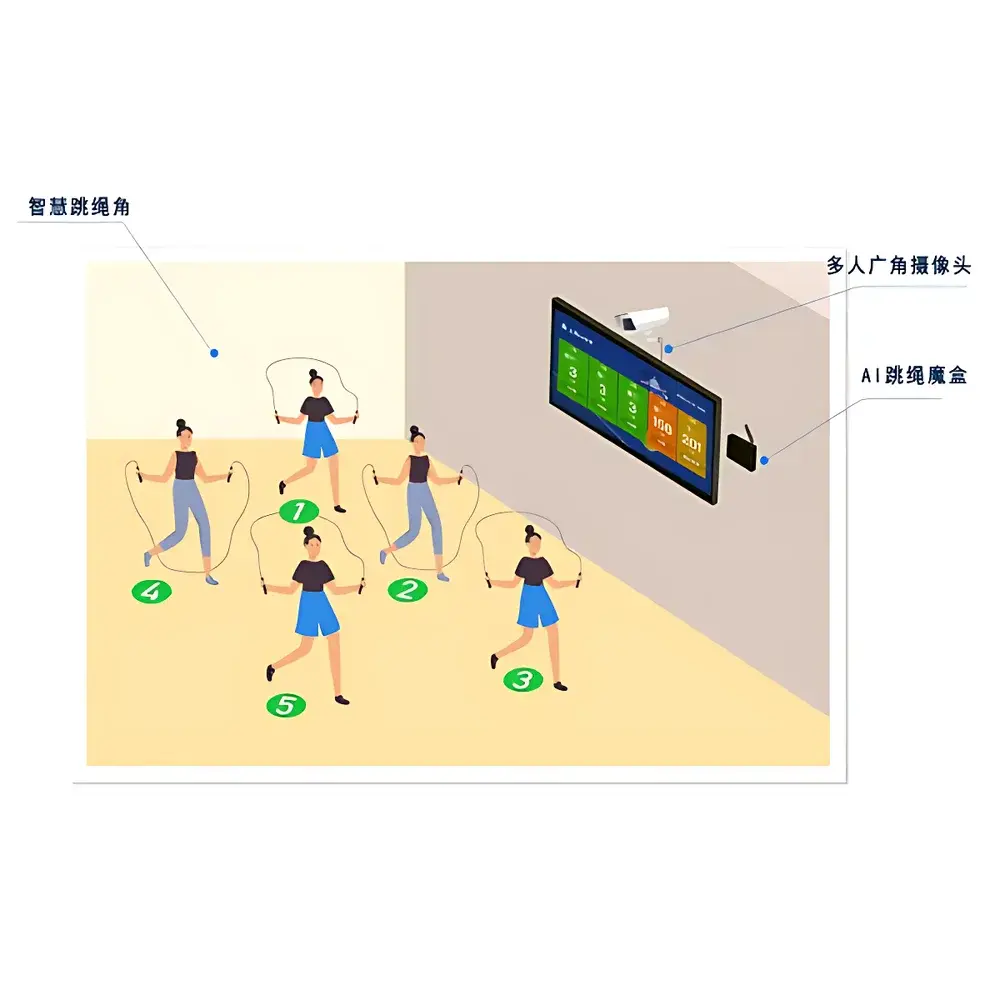
- Multi-person simultaneous assessment: Supports concurrent testing of 5 students in rope skipping, 3 in sit-ups, 2 in pull-ups, and 1 in standing long jump—each with activity-specific validity checks (e.g., foot-off detection for jump validation, arm flexion angle thresholds for sit-up scoring).
- Contactless operation: Facial recognition for identity authentication; gesture-based project switching (e.g., hand wave to toggle between rope skipping and squatting); no wearable hardware required.
- Real-time performance analytics: Instant display of repetitions, time-in-motion, cadence, estimated caloric expenditure (via MET-based modeling), and norm-referenced scoring per national physical fitness standards.
- Dynamic leaderboard visualization: On-screen ranking updated per session; exportable CSV reports with timestamps, participant IDs, raw counts, and compliance flags (e.g., “invalid takeoff,” “arm swing violation”).
- Cloud-integrated architecture: Synchronized data upload to Drick Cloud Sports Platform (HTTPS-encrypted REST API); supports role-based access control for teachers, administrators, and parents.
- HDMI-compatible display integration: Designed for seamless connection to standard commercial-grade 55″–86″ displays (4K resolution supported); wall-mount or freestanding deployment options.
Sample Compatibility & Compliance
The system is validated for use with K–12 student populations aged 6–18 years, accommodating height ranges from 110 cm to 190 cm and body mass indices (BMI) from 13 to 32 kg/m². All motion recognition logic adheres to ASTM F2476–22 (Standard Practice for Biomechanical Motion Capture in Physical Education Settings) and incorporates anti-bias calibration protocols for diverse anthropometric profiles. Video capture complies with ISO/IEC 27001:2022 for data handling security, and facial templates are stored locally on-device with zero cloud retention—meeting GDPR Article 9 and China’s PIPL requirements for biometric data minimization. System outputs support traceable audit logs required under GLP-aligned institutional PE assessment protocols.
Software & Data Management
The Drick Cloud Sports Platform provides web-based dashboard access for schools, enabling multi-level reporting (individual, class, grade, school-wide), longitudinal trend analysis, and automated generation of National Physical Fitness Standard-compliant summary reports. Backend APIs support integration with existing SIS/LMS platforms (e.g., Canvas, Moodle, DingTalk Edu) via SCIM and LTI 1.3. All test videos are retained for 90 days with configurable auto-purge; video metadata includes frame-accurate event tagging (start/stop, violation detection points). The platform maintains full audit trails for data edits, user logins, and report exports—satisfying 21 CFR Part 11 electronic record integrity requirements for institutional documentation. Mobile companion app (iOS/Android) enables teacher-led assignment distribution, parent-facing progress dashboards, and student-accessible historical performance graphs.
Applications
- Autonomous daily physical activity tracking: Students initiate sessions unattended during breaks or after-school hours within designated 6 m × 6 m zones (minimum ceiling height: 2.8 m).
- Structured PE assessment: Batch-mode testing for standardized physical fitness evaluations—supporting synchronized start/stop commands and group-based result aggregation.
- Competitive event management: Configurable tournament modes for inter-class rope skipping challenges, with live scoreboards and post-event video review portals.
- Personalized exercise prescription: Algorithmic generation of adaptive workout plans based on longitudinal performance trends and percentile rankings relative to age/gender norms.
- Curriculum-aligned instruction: Real-time visual feedback overlays (e.g., joint angle indicators, rhythm metronomes) assist teachers in correcting form during skill acquisition phases.
FAQ
What is the minimum installation space requirement?
A clear floor area of 6 m × 6 m with ≥2.8 m ceiling height is required to ensure full-body motion capture coverage for all supported activities.
Does the system require internet connectivity during operation?
Local assessment functions operate offline; cloud synchronization occurs only during scheduled or manual upload windows—ensuring uninterrupted use in low-bandwidth environments.
How are movement violations detected and reported?
Violation logic is embedded in each activity model (e.g., foot contact detection for standing long jump, elbow extension threshold for sit-ups) and logged with frame-accurate timestamps in exported reports.
Can third-party displays be used?
Yes—the system outputs HDMI 2.0 (4K@60Hz) and is compatible with any commercial display supporting HDCP 2.2 and CEC-enabled remote control passthrough.
Is student biometric data stored permanently?
No. Facial embeddings are processed on-device and discarded immediately after session authentication; no biometric templates are transmitted to or retained in the cloud.





