
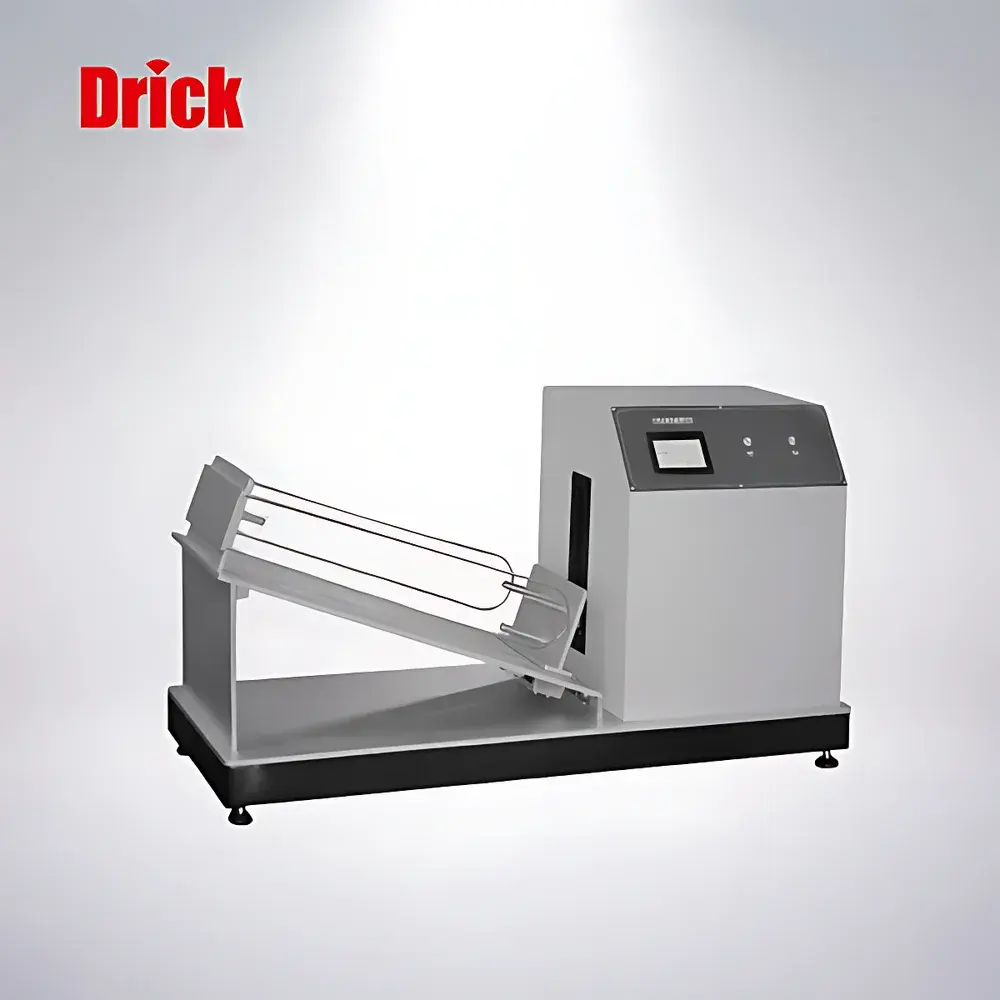

Drick DRK819G Down Migration Resistance Tester
| Brand | Drick |
|---|---|
| Origin | Shandong, China |
| Manufacturer Type | Direct Manufacturer |
| Country of Origin | China |
| Model | DRK819G |
| Power Supply | 220 V, 50 Hz |
| Impact Stroke | 500 ± 5 mm |
| Impact Frequency | 35 cycles/min |
| Cycle Count Range | 0–999,999 |
| Dimensions (L×W×H) | 1200 × 380 × 660 mm |
| Weight | ~50 kg |
| Control System | STMicroelectronics 32-bit embedded motherboard |
| Housing Material | Anodized aluminum front panel with metal tactile keys |
| Surface Finish | Electrostatic powder coating |
| Display Language | Switchable Chinese/English UI |
| Compliance | BS EN 12132-2:2003 |
Overview
The Drick DRK819G Down Migration Resistance Tester is an electromechanical test instrument engineered for quantitative assessment of down migration—commonly referred to as “down leakage” or “feather poke-through”—in woven and knitted fabrics used in down-filled apparel, bedding, and outdoor gear. It operates on the principle of standardized mechanical agitation: a fabric specimen is clamped over a perforated drum containing loose down or feather fill, then subjected to repeated vertical impacts simulating real-world wear, compression, and flexing. The number of down clusters or individual filaments penetrating the fabric surface after a defined cycle count is quantified visually or via digital imaging, enabling objective evaluation of fabric barrier integrity. This method directly supports quality assurance protocols in textile R&D labs, contract manufacturing facilities, and third-party testing institutes where compliance with international performance benchmarks is mandatory.
Key Features
- Robust mechanical architecture featuring eccentric cam-driven impact mechanism ensuring consistent stroke amplitude (500 ± 5 mm) and repeatable frequency (35 cycles/min) across extended operation.
- Industrial-grade 32-bit embedded control board from STMicroelectronics, delivering stable timing accuracy, low-latency response, and long-term firmware reliability without PC dependency.
- Front-panel interface constructed from anodized aluminum with sealed metal membrane keys—resistant to abrasion, chemical exposure, and mechanical fatigue typical in high-throughput lab environments.
- Dual-language (Chinese/English) graphical user interface with intuitive menu navigation, parameter lockout options, and real-time cycle counter display—designed for multilingual technical staff and audit-ready operation.
- Electrostatically powder-coated steel chassis providing corrosion resistance, EMI shielding, and uniform aesthetic finish compliant with ISO 14644-1 Class 8 cleanroom-adjacent lab requirements.
Sample Compatibility & Compliance
The DRK819G accommodates standard test specimens measuring 200 mm × 200 mm (per BS EN 12132-2:2003), compatible with plain weaves, twills, satin finishes, micro-denier synthetics, coated textiles, and laminated composites used in sleeping bags, parkas, and insulated vests. Specimen mounting employs spring-loaded clamping bars to ensure uniform tension without edge distortion. The instrument satisfies the full mechanical specification of BS EN 12132-2:2003 (“Textiles — Down and Feather — Part 2: Test method for determination of down migration resistance”), including tolerance limits for stroke, frequency, and structural rigidity. While not certified to ISO/IEC 17025 by default, its design enables traceable calibration using NIST-traceable displacement and timing standards—supporting GLP documentation workflows and internal method validation per ASTM D737 and ISO 9277 alignment.
Software & Data Management
The DRK819G operates as a standalone hardware platform with no external software dependency; all test parameters and cycle logs are stored locally in non-volatile memory. Each test session records start time, total cycles executed, and operator ID (manually entered). Data export is supported via USB port to CSV format for integration into LIMS or statistical process control (SPC) platforms. Audit trail functionality includes timestamped event logging (e.g., power-on, parameter change, test completion) meeting baseline requirements for FDA 21 CFR Part 11–aligned environments when paired with procedural SOPs and electronic signature protocols. Firmware updates are delivered via encrypted USB key with version checksum verification.
Applications
- Pre-production validation of shell fabric barrier performance prior to bulk garment assembly.
- Comparative evaluation of finishing treatments (e.g., resin coatings, plasma surface modification, nanoscale polymer impregnation) on down containment efficacy.
- Quality conformance testing for OEM suppliers submitting materials to brands enforcing EN 12132-2–based specifications (e.g., European outdoor equipment manufacturers).
- Root-cause analysis of field failures involving thermal insulation degradation due to fiber migration-induced cold spots.
- Research into structure–property relationships between yarn twist, weave density, thread count, and down penetration resistance.
FAQ
What standard does the DRK819G strictly adhere to?
It fully implements the mechanical and procedural requirements of BS EN 12132-2:2003, including impact stroke tolerance, frequency stability, and specimen mounting geometry.
Is calibration certification included with delivery?
A factory calibration report referencing traceable displacement and timing standards is supplied; users must perform periodic verification per their internal QA schedule.
Can the instrument be integrated into automated test lines?
No native industrial bus interface (e.g., Modbus, EtherCAT) is provided; integration requires external PLC-level signal bridging via dry-contact I/O terminals.
Does it support testing of non-down fill alternatives such as synthetic insulation?
Yes—while optimized for natural down clusters, the test principle applies equivalently to polyester, PrimaLoft®, and other staple-fiber insulations when loaded at equivalent mass/volume ratios.
What maintenance intervals are recommended?
Lubrication of eccentric cam bearings every 6 months and visual inspection of clamping bar elastomers every 2000 cycles; no consumables beyond standard electrical safety checks.







