
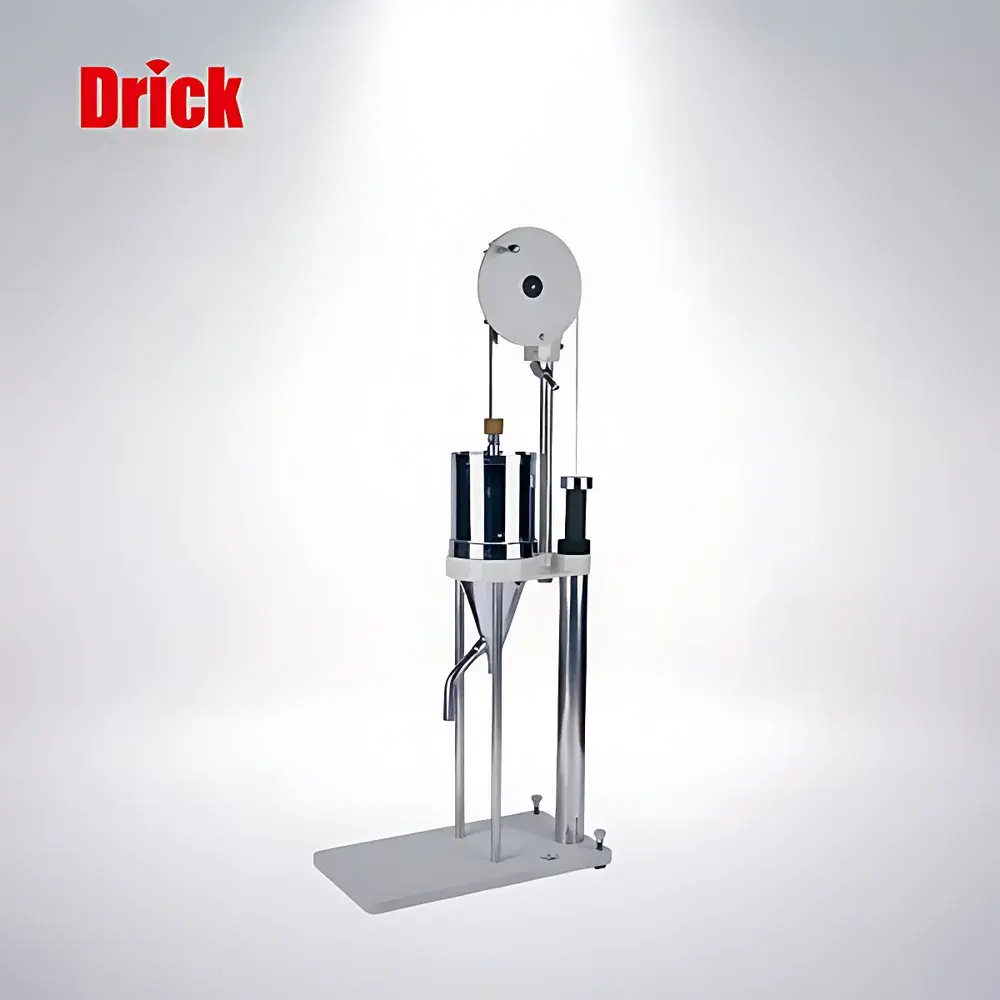
Drick DRK116 Schopper-Riegler Consistency Tester (Pulp Drainage Analyzer)
| Brand | Drick |
|---|---|
| Origin | Shandong, China |
| Manufacturer Type | Direct Manufacturer |
| Country of Origin | China |
| Model | DRK116 |
| Measurement Range | 1–100 °SR |
| Graduation of Measuring Cylinder | 1 °SR |
| Overflow Drain Time | 149 ± 1 s |
| Residual Volume | 7.5–8.0 mL |
| Compliance | ISO 5267-1, GB/T 3332, QB/T 1054 |
Overview
The Drick DRK116 Schopper-Riegler Consistency Tester is a precision laboratory instrument engineered for the quantitative assessment of pulp drainage behavior in diluted fiber suspensions—a critical parameter directly correlated with fiber fibrillation, cutting, and overall refining degree. Based on the classical Schopper-Riegler (SR) principle, the device measures the time-dependent volume of filtrate collected under standardized gravitational drainage through a defined orifice in a calibrated brass screen, while simultaneously capturing residual suspension volume. This hydrodynamic resistance metric—expressed in degrees Schopper-Riegler (°SR)—provides a reproducible, internationally recognized index of pulp consistency, refining progress, and fiber morphology changes during mechanical treatment. Designed for routine quality control and process development in pulp & paper R&D labs, production QC environments, and technical service centers, the DRK116 delivers stable, operator-independent results when operated in accordance with ISO 5267-1 and GB/T 3332 protocols.
Key Features
- Robust brass body construction with precision-machined Schopper-Riegler drainage chamber, ensuring long-term dimensional stability and resistance to corrosion from aqueous pulp suspensions.
- Calibrated 149 ± 1 s overflow drain timing mechanism—verified against traceable reference standards—to maintain strict adherence to ISO 5267-1 hydraulic conditions.
- High-accuracy measuring cylinder with 1 °SR graduation, enabling direct visual readout of drainage volume without interpolation error.
- Fixed geometry: 0.125 mm slit width, 101.6 mm screen diameter, and standardized 1000 mL sample volume—fully compliant with SR method requirements.
- Integrated residual volume collection reservoir (7.5–8.0 mL capacity), facilitating concurrent measurement of retained fiber mass and drainage kinetics.
- Self-contained mechanical design requiring no external power supply or vacuum source—optimized for reliability in high-throughput lab settings.
Sample Compatibility & Compliance
The DRK116 accepts standard laboratory-prepared pulp suspensions at concentrations of 0.3–0.5% w/w, compatible with hardwood, softwood, recycled, and non-wood pulps—including bleached and unbleached kraft, sulfite, and mechanical grades. All operational parameters—including orifice geometry, screen mesh specification (80 mesh, 0.177 mm wire diameter), and drainage head height—are rigorously aligned with ISO 5267-1:2019, GB/T 3332–2016, and QB/T 1054–2018. The instrument supports GLP-compliant documentation workflows when paired with validated SOPs and manual logbook entries; though inherently analog, its output is fully auditable and traceable for internal QA reviews or third-party certification audits.
Software & Data Management
As a manually operated, gravity-driven mechanical tester, the DRK116 does not incorporate embedded electronics or digital interfaces. Data acquisition follows traditional wet-lab methodology: operators record °SR values, ambient temperature (19–21 °C recommended), and suspension temperature directly into laboratory notebooks or LIMS-integrated spreadsheets. To support regulatory traceability, users are advised to implement dual-operator verification, calibration log maintenance (including annual verification of overflow time and residual volume), and retention of raw test records per ISO/IEC 17025 clause 7.5. While no proprietary software is bundled, the °SR output integrates natively with statistical process control (SPC) platforms such as Minitab or JMP for trend analysis, capability studies (Cp/Cpk), and multivariate correlation with tensile strength, burst index, or freeness-related paper properties.
Applications
- Monitoring refining efficiency across disk refiner, conical refiner, and PFI mill trials.
- Correlating SR values with fiber length distribution (via fiber analyzer), fines content, and specific surface area (BET or permeability methods).
- Supporting pulp blending optimization by quantifying drainage differences between furnish components.
- Validating pulp storage stability—detecting enzymatic or oxidative degradation via SR drift over time.
- Training laboratory personnel in fundamental pulp physics and ISO-standardized testing methodology.
- Providing reference data for predictive modeling of sheet formation behavior on pilot paper machines.
FAQ
What standards does the DRK116 comply with?
ISO 5267-1:2019, GB/T 3332–2016, and QB/T 1054–2018.
Is calibration required before each test?
Daily verification of overflow drain time (149 ± 1 s) and residual volume (7.5–8.0 mL) is recommended; full recalibration by an accredited metrology lab is advised annually.
Can the DRK116 be used for high-consistency pulps?
No—it is strictly designed for low-consistency suspensions (≤0.5% w/w) as specified in ISO 5267-1.
Does the instrument include a thermometer or temperature control?
No—ambient and pulp suspension temperature must be monitored externally using a calibrated thermometer per ISO 5267-1 section 6.2.
How is repeatability ensured across operators?
Through strict adherence to standardized sample preparation (e.g., disintegration time, dilution protocol), consistent pouring technique, and dual-operator verification of final °SR reading.





