
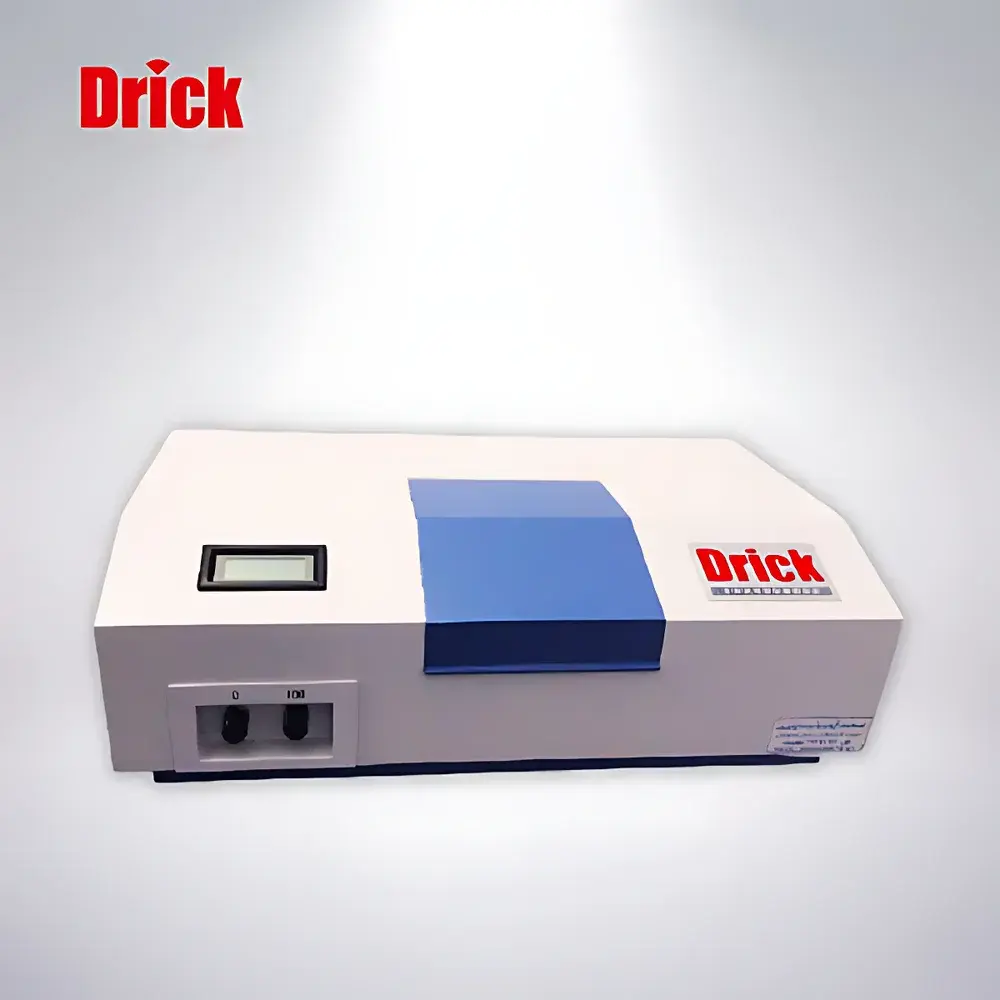
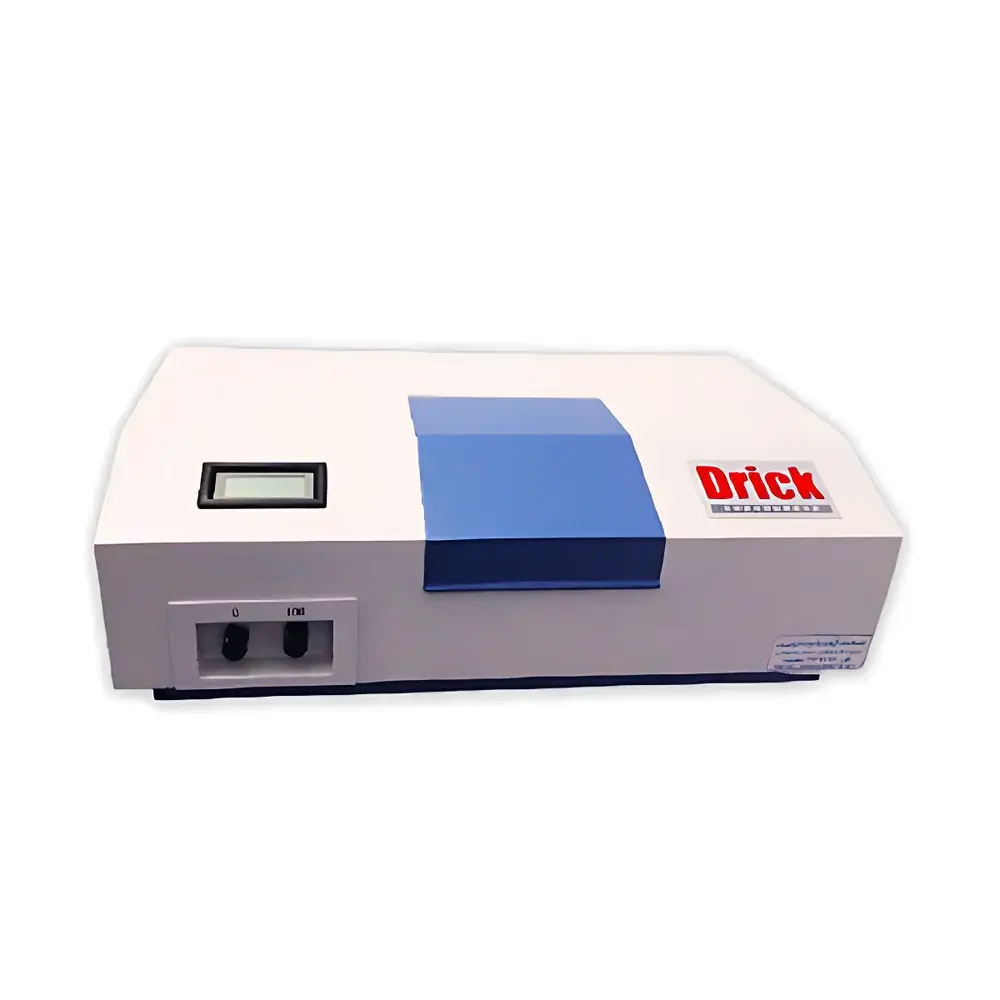
Drick DRK122A C-Illuminant Haze and Luminous Transmittance Meter for Transparent Packaging Films
| Brand | Drick |
|---|---|
| Origin | Shandong, China |
| Manufacturer Type | Direct Manufacturer |
| Region Classification | Domestic (China) |
| Model | DRK122A |
| Type | Manual Operation |
| Haze Range | 0–30% |
| Transmittance Range | 0–100% |
| Haze Repeatability | ±0.2% |
| Transmittance Repeatability | ±0.5% |
| Light Source | C-illuminant (CIE Standard Illuminant C) |
| Sample Chamber | Closed, 50 mm × 50 mm max sample size |
| Display | LCD, 3-digit resolution (0.1% increment) |
| Accuracy | ±1.5% for transmittance, ±0.5% for haze |
| Power Supply | AC 220 V ± 22 V, 50 Hz ± 1 Hz |
| Dimensions (L×W×H) | 470 × 270 × 160 mm |
| Weight | 7 kg |
Overview
The Drick DRK122A C-Illuminant Haze and Luminous Transmittance Meter is a precision optical measurement instrument engineered for quantitative evaluation of haze and luminous transmittance in flat, transparent, or semi-transparent sheet materials—particularly polymeric packaging films, rigid plastic plates, optical-grade glass, and photographic film bases. It operates in strict accordance with the geometric and photometric requirements defined in ASTM D1003–00 (Reapproved 2022) and GB/T 2410–2008, both of which specify the use of C-illuminant (CIE Standard Illuminant C, approx. 6774 K correlated color temperature) and a 2° standard observer to ensure metrological traceability and inter-laboratory comparability. The instrument employs the principle of total integrated sphere transmission measurement: incident light from the C-source passes through the sample, and detectors separately quantify the directly transmitted (specular + diffuse) component for transmittance, and the forward-scattered component (at angles >2.5° from the incident beam axis) for haze calculation per ISO 14782:2015 definitions. Its compact closed-chamber design minimizes ambient light interference and ensures stable thermal and mechanical conditions during manual single-point measurement cycles.
Key Features
- Compliant C-illuminant optical system calibrated to meet ASTM D1003 and GB/T 2410 spectral power distribution requirements
- Manual zeroing and calibration procedure with dual reference standards (100% transmittance white tile and 0% haze black trap), enabling rapid setup without software dependency
- Closed sample chamber with fixed 50 mm × 50 mm aperture—designed to eliminate stray light and enforce consistent beam geometry across measurements
- LCD display with 3-digit resolution (0.1% step size) for both haze (%) and transmittance (%), supporting real-time readout without external interface
- Robust mechanical architecture with aluminum alloy housing and vibration-damped base, optimized for benchtop deployment in QC laboratories and production floors
- No moving parts in optical path—ensures long-term stability and minimal drift between scheduled recalibrations
Sample Compatibility & Compliance
The DRK122A is validated for planar specimens with uniform thickness and parallel surfaces, including biaxially oriented polypropylene (BOPP), polyester (PET), polyethylene (PE), cellulose acetate, polycarbonate sheets, float glass, and acrylic (PMMA) substrates. It accommodates samples up to 3 mm thick and requires no mounting adhesive or vacuum fixation—samples are secured manually using included dual-film clamps. Instrument compliance extends beyond ASTM D1003 and GB/T 2410 to include foundational principles referenced in ISO 9050:2003 (glass optical properties), ISO 13468–1:1996 (plastic transmittance), and USP (pharmaceutical packaging material clarity testing). While not inherently 21 CFR Part 11 compliant due to its manual operation and absence of electronic audit trail, it supports GLP-aligned documentation when paired with controlled lab notebooks and periodic verification against NIST-traceable reference standards.
Software & Data Management
The DRK122A operates as a standalone hardware meter with no embedded firmware or digital connectivity. All measurement data are recorded manually by the operator. This design intentionally eliminates software validation overhead, making it suitable for environments where regulatory documentation focuses on procedural control rather than electronic records—e.g., ISO 9001-certified manufacturing QA labs or academic research settings requiring basic optical characterization. For users requiring digital capture, third-party USB-connected data loggers or camera-based image acquisition systems may be integrated externally; however, such configurations fall outside the manufacturer’s stated performance specifications and do not extend instrument calibration validity.
Applications
- Quality control of food and pharmaceutical packaging films where haze 88% are critical for visual inspection and shelf appeal
- Batch-to-batch consistency verification of extruded polymer films during blown or cast line commissioning
- Raw material screening of recycled PET flake blends prior to melt filtration and reprocessing
- Evaluation of anti-fog coating efficacy on greenhouse films and medical device pouches
- Optical qualification of automotive interior trim laminates and HUD (head-up display) combiner substrates
- Academic studies on light scattering mechanisms in nanostructured polymer composites
FAQ
What standards does the DRK122A comply with?
It conforms to ASTM D1003–00 (Reapproved 2022) and GB/T 2410–2008 for haze and luminous transmittance measurement of transparent plastics and flat optical materials.
Can the DRK122A measure curved or textured surfaces?
No—it is strictly limited to flat, parallel-surface specimens. Curved, embossed, or matte-finished samples violate the collimated beam assumption and invalidate ASTM D1003 geometry requirements.
Is the C-illuminant source replaceable or user-calibratable?
The tungsten-halogen lamp assembly is factory-aligned and sealed; replacement requires return to authorized service center with post-replacement recalibration against certified reference standards.
Does the instrument support automatic averaging or statistical reporting?
No—measurements are single-point readings. Operators must perform manual repeatability checks (minimum n=3 per sample) and compute mean/standard deviation externally.
What maintenance is required for long-term accuracy?
Monthly cleaning of the integrating sphere interior with lint-free optical tissue and isopropyl alcohol; annual verification using supplied calibration standards; lamp output monitoring every 500 operating hours.




