
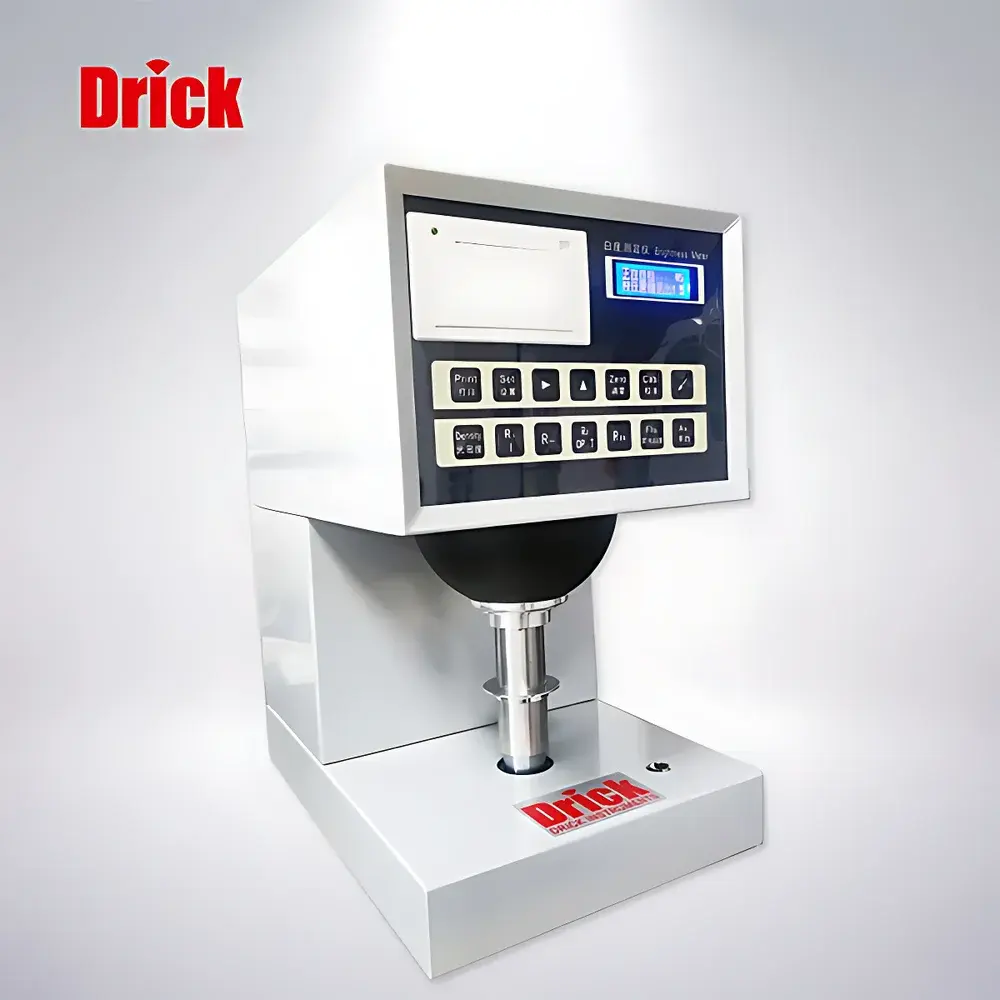
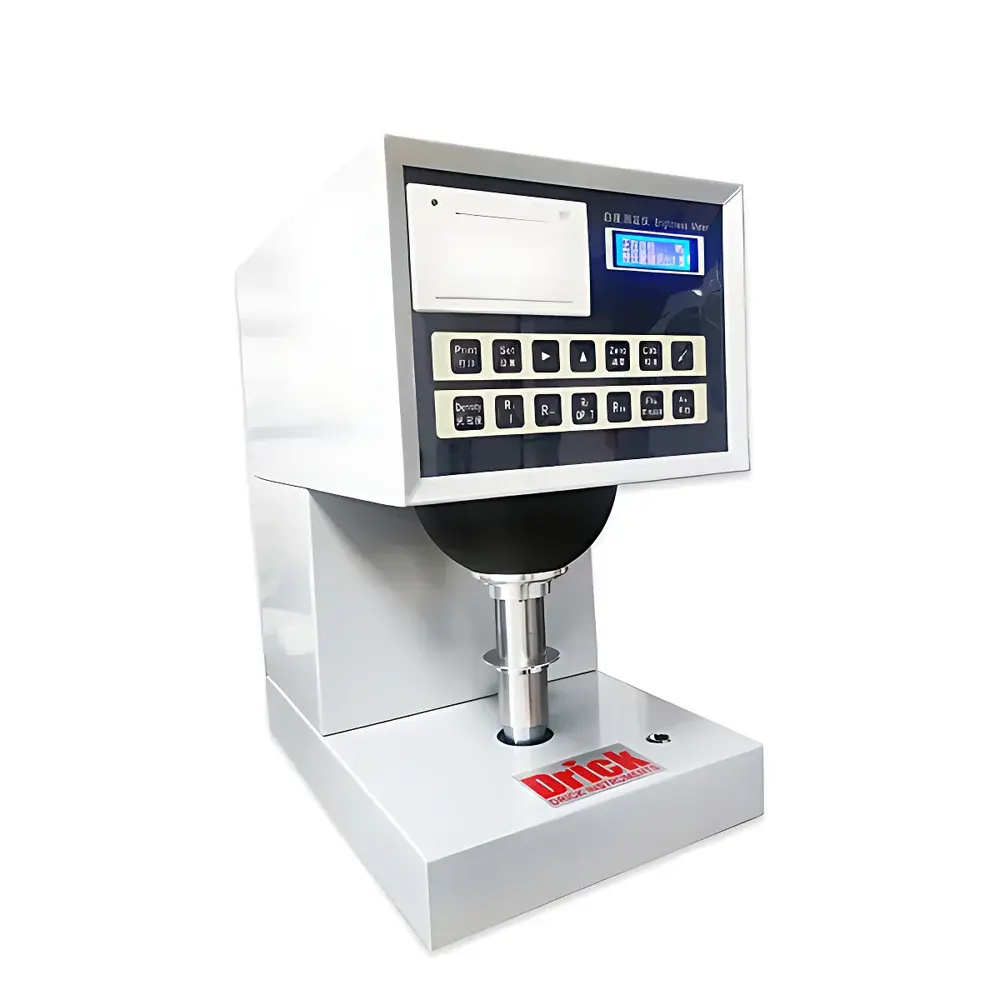
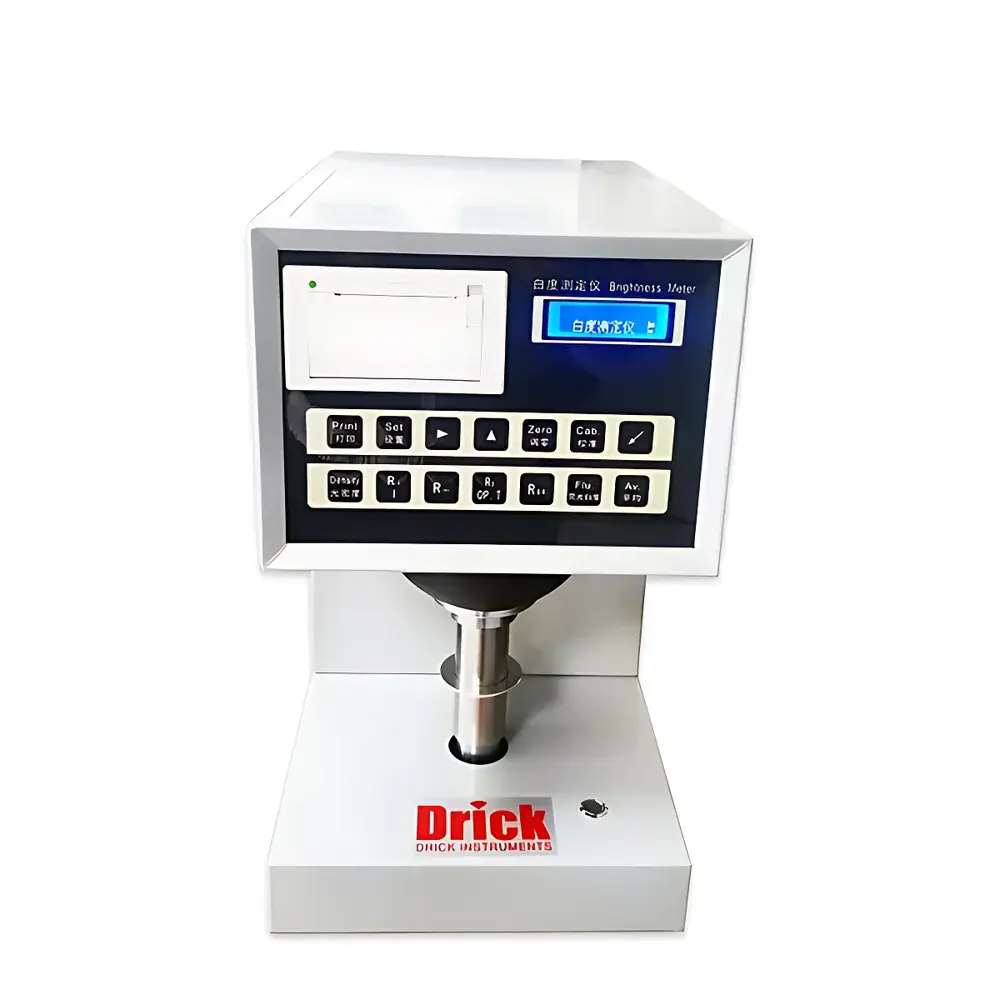
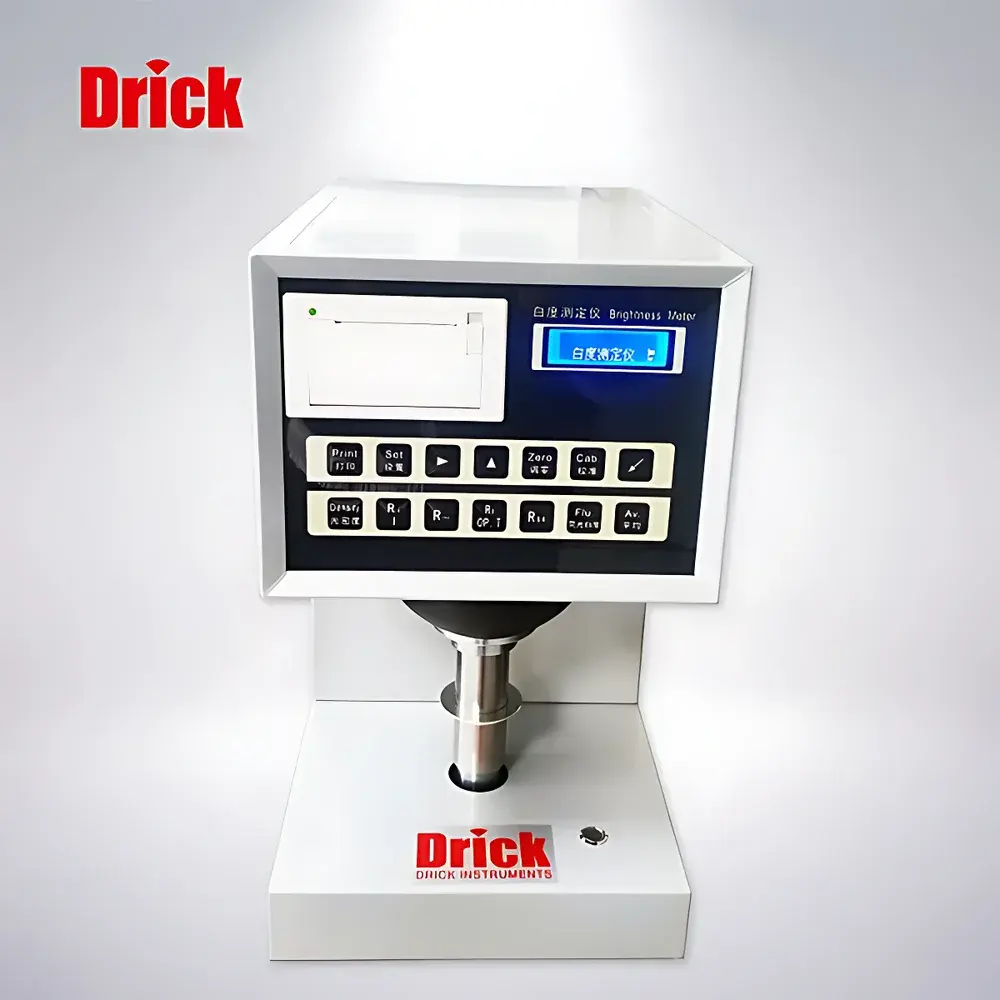
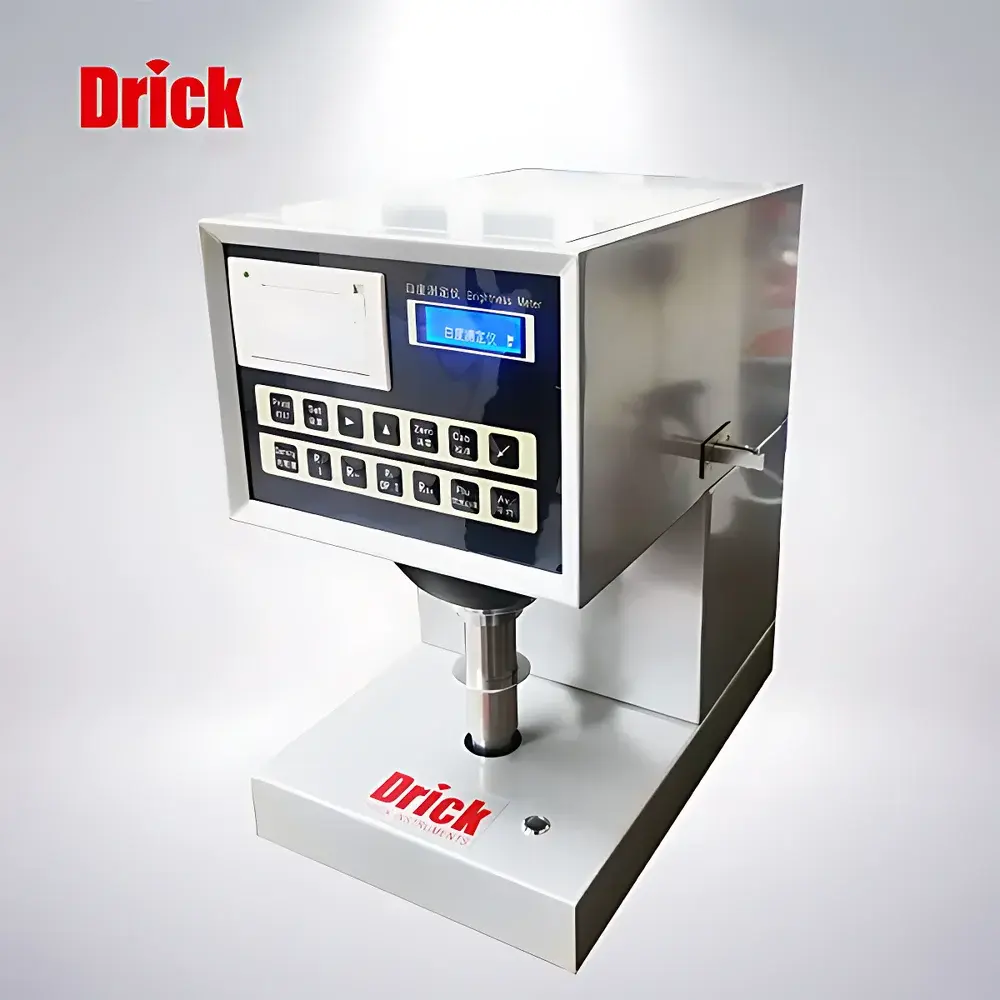
Drick DRK103A Whiteness Meter
| Brand | Drick |
|---|---|
| Model | DRK103A |
| Measurement Principle | d/0 (diffuse illumination / 0° viewing) geometry per ISO 2469 & GB/T 7974 |
| Illuminant | Simulated D65 |
| Spectral Peak | 457 nm (R₄₅₇), FWHM: 44 nm |
| Color Space | CIE 1964 Supplementary Observer (10°), CIE 1976 L*a*b* |
| Integrating Sphere Diameter | Φ150 mm |
| Aperture Options | Φ30 mm and Φ19 mm |
| Mirror Reflection Compensation | Integrated light absorber |
| Zero Drift | ≤0.1% |
| Indication Drift | ≤0.1% |
| Accuracy Error | ≤0.5% |
| Repeatability | ≤0.1% |
| Specular Reflection Error | ≤0.1% |
| Sample Thickness Limit | ≤40 mm |
| Power Supply | AC 220 V ±5%, 50 Hz, 0.4 A |
| Operating Environment | 0–40 °C, RH <85% |
| Dimensions (W×D×H) | 310×380×400 mm |
| Weight | 16 kg |
| Compliance | GB/T 7974, GB/T 7973, GB/T 1543, GB/T 2409, GB/T 2913, ISO 2470, ISO 2471, ISO 2469, GB/T 10336, GB/T 5950, GB/T 13025.2, GB/T 8904.2 |
Overview
The Drick DRK103A Whiteness Meter is a precision optical instrument engineered for the quantitative assessment of whiteness, brightness, and related optical properties of planar and powdered solid materials. It operates on the d/0 (diffuse illumination / 0° viewing) geometry in strict accordance with ISO 2469 and GB/T 7974, ensuring metrological traceability to national and international standards. The system employs a high-stability simulated D65 illuminant—spectrally calibrated to peak at 457 nm with a full-width-at-half-maximum (FWHM) of 44 nm—to deliver accurate R₄₅₇ whiteness values (ISO Brightness), as well as Y₁₀ tristimulus values, opacity, transparency, and derived optical coefficients including the light scattering coefficient (S) and absorption coefficient (K) per GB/T 10336. An integrated integrating sphere (Φ150 mm) with dual aperture options (Φ30 mm and Φ19 mm) and a built-in specular reflectance trap eliminates interference from surface gloss, enabling true diffuse reflectance measurement essential for quality control in regulated manufacturing environments.
Key Features
- Simultaneous determination of ISO whiteness (R₄₅₇), fluorescence-enhanced whiteness (for optically brightened samples), Y₁₀ luminance factor, opacity, transparency, and K/S optical coefficients
- Dual-aperture configuration (Φ30 mm and Φ19 mm) accommodates diverse sample formats—from large paper sheets to small ceramic tiles or compressed powder pellets
- CIE 1964 (10° observer) colorimetric foundation with optional CIE 1976 L*a*b* color space output for comprehensive chromaticity analysis
- High-stability solid-state optical path and temperature-compensated photodetector array ensure long-term repeatability (≤0.1% RSD) and minimal zero/indication drift (≤0.1% over 8 h)
- Integrated RS232 serial interface supports bidirectional communication with laboratory PCs for automated data logging, statistical reporting, and audit-ready record retention
- Non-volatile memory preserves calibration constants and user settings during power interruption, satisfying GLP-relevant continuity requirements
- Backlit LCD with Chinese-language UI provides real-time guidance, measurement validation prompts, and on-screen statistics (mean, SD, min/max) without external software dependency
Sample Compatibility & Compliance
The DRK103A is validated for use across a broad spectrum of industrial and regulatory contexts—including pulp & paper (GB/T 7974, ISO 2470), plastics (GB/T 2913), ceramics and building materials (GB/T 5950), food-grade starches (GB/T 1840), salt products (GB/T 13025.2), and pharmaceutical excipients where whiteness serves as a critical quality attribute. Its d/0 optical design complies fully with ISO 2469, GB/T 7973 (diffuse reflectance factor), GB/T 1543/ISO 2471 (opacity), and GB/T 10336 (K and S coefficient derivation). For GMP-aligned operations, the instrument’s deterministic measurement protocol, stable calibration hierarchy (using NIST-traceable non-fluorescent and fluorescent white standards), and RS232 data export capability support 21 CFR Part 11-compliant workflows when paired with validated third-party LIMS or ELN platforms.
Software & Data Management
While the DRK103A functions autonomously via its embedded firmware, its standard RS232 interface enables seamless integration with Windows-based host applications. Raw spectral reflectance data (where applicable), calculated whiteness indices, opacity ratios, and K/S values are transmitted in ASCII format with timestamp and operator ID fields. Exported datasets conform to ASTM E1763-18 structured reporting conventions, facilitating direct import into statistical process control (SPC) tools such as Minitab or JMP. Audit trails—including calibration history, date/time stamps, and user-initiated measurement events—are retained in non-volatile memory and retrievable via serial query, supporting GLP documentation requirements for method validation and equipment qualification (IQ/OQ).
Applications
This instrument is routinely deployed in QC laboratories for batch release testing of paper grades (e.g., office paper, packaging board, tissue), textile substrates (cotton, polyester blends), plastic resins (PVC, PP, PE masterbatches), mineral fillers (CaCO₃, TiO₂), ceramic glazes, pharmaceutical tablet coatings, and food additives (e.g., starch, citric acid). Its capacity to resolve fluorescence contribution allows differentiation between intrinsic whiteness and optically brightened performance—critical for compliance with EU REACH restrictions on fluorescent whitening agents (FWAs). In R&D settings, the K/S output enables predictive modeling of pigment dispersion efficiency and opacity optimization in coating formulations.
FAQ
What standards does the DRK103A comply with for ISO whiteness measurement?
It conforms to ISO 2470 (paper and board), ISO 2469 (instrument geometry), and GB/T 7974—ensuring equivalence with accredited reference laboratories.
Can the DRK103A measure samples with surface texture or curvature?
It requires flat, matte-surfaced specimens ≥Φ19 mm; curved or highly textured samples must be prepared as flat compression pellets using the optional constant-pressure powder press.
Is fluorescence compensation automatic or manual?
Fluorescence-enhanced whiteness is calculated automatically by comparing measurements under UV-filtered and UV-inclusive D65 simulation—no user intervention required.
How often must calibration be performed?
Daily verification with certified white and black standards is recommended; full recalibration against primary standards is advised every 6 months or after lamp replacement.
Does the instrument support L*a*b* color difference reporting?
Yes—via CIE 1976 L*a*b* transformation of measured tristimulus values, enabling ΔE*ab calculation against master standards for batch-to-batch consistency tracking.



