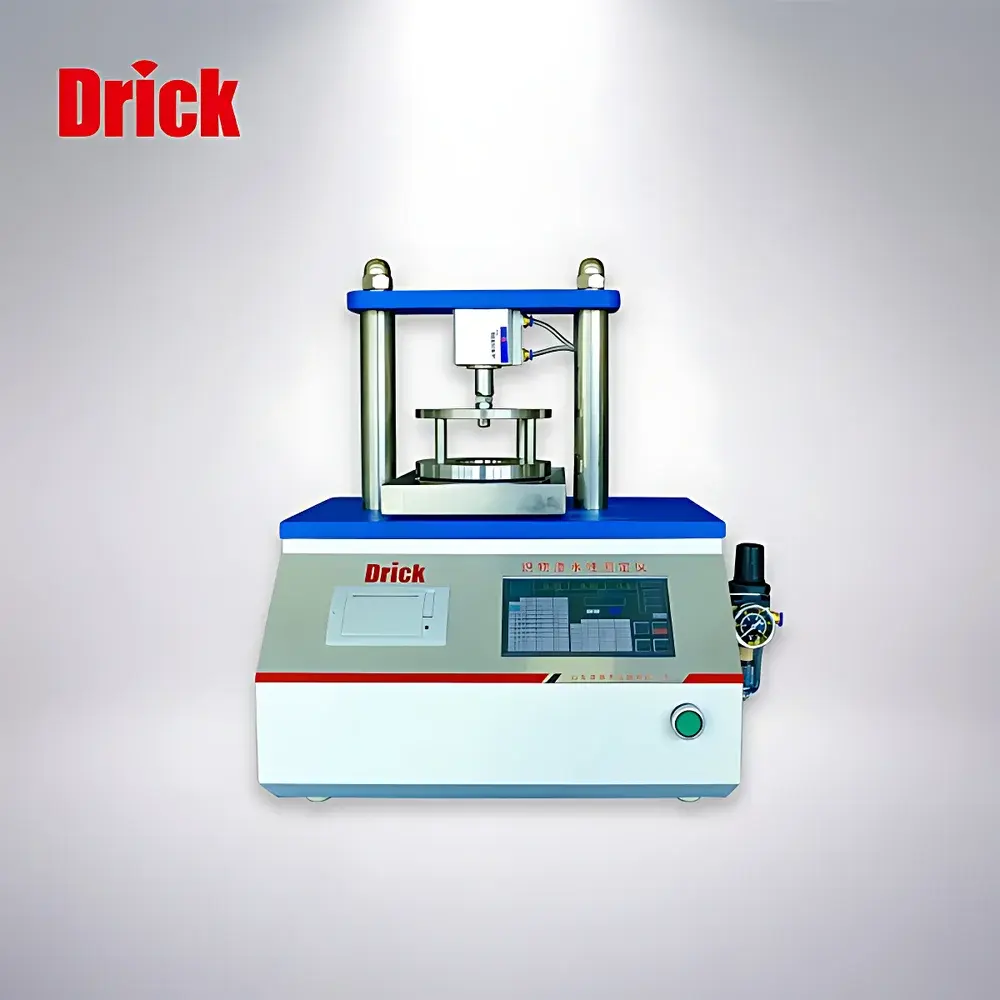
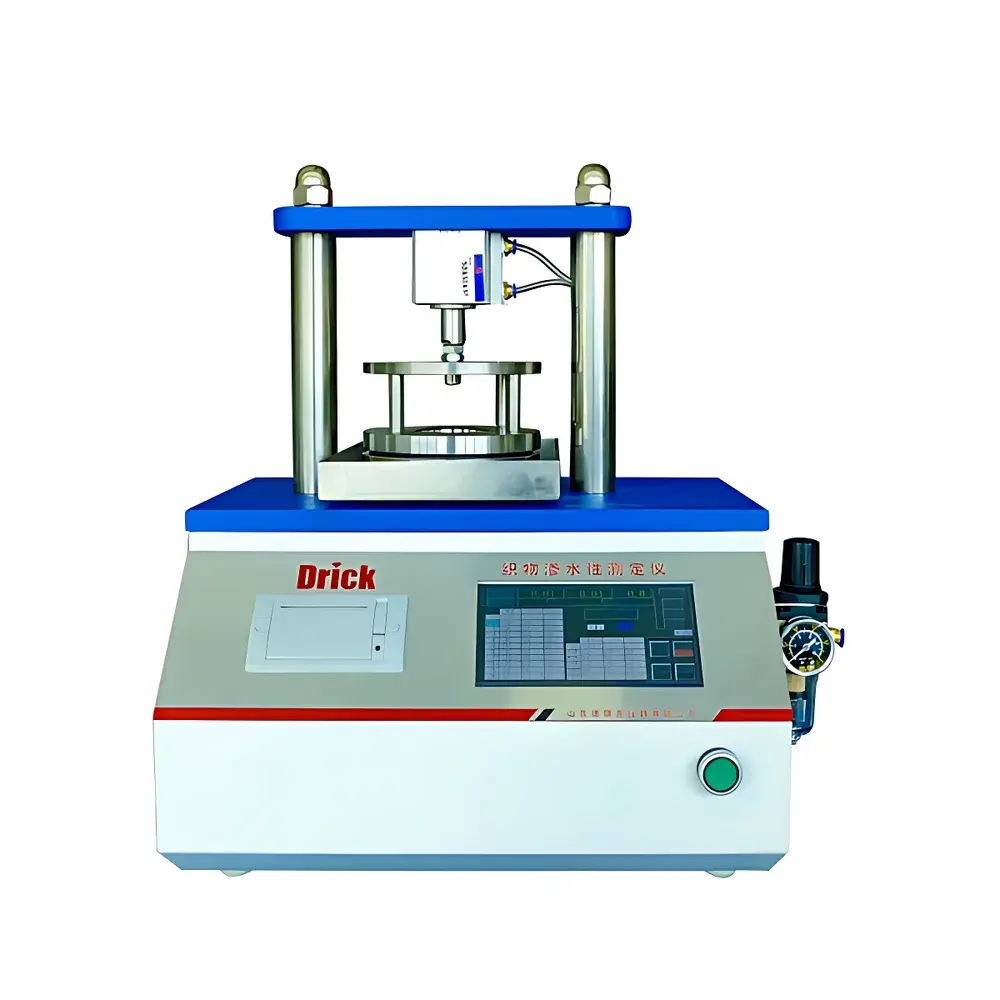
Drick DRK308 Digital Fabric Hydrostatic Pressure Tester
| Brand | Drick |
|---|---|
| Origin | Shandong, China |
| Manufacturer Type | Direct Manufacturer |
| Country of Origin | China |
| Model | DRK308 |
| Price | USD 7,000 (FOB Qingdao) |
| Test Area | 100 cm² |
| Specimen Clamp Diameter | 113 mm |
| Pressure Range | 5–700 kPa |
| Pressure Ramp Rate | 1–200 kPa/min (digitally adjustable) |
| Resolution | 10 Pa |
| Display | LCD with real-time pressure and ramp rate |
| Dimensions | 550 × 400 × 600 mm |
| Weight | ~50 kg |
| Power Supply | AC 220 V, 200 W |
| Compliance Standards | GB/T 4744, ISO 811, AATCC 127, YY/T 1498, GB 19082 |
Overview
The Drick DRK308 Digital Fabric Hydrostatic Pressure Tester is a precision-engineered instrument designed for quantitative evaluation of textile resistance to water penetration under controlled static hydraulic pressure. It operates on the hydrostatic head principle—applying incremental water pressure to the reverse side of a clamped fabric specimen until leakage is detected at the surface—enabling objective assessment of barrier performance in medical gowns, protective workwear, outdoor apparel, and technical textiles. The system integrates a high-accuracy piezoresistive pressure transducer, a 16-bit analog-to-digital converter (ADC), and an embedded microcontroller architecture to ensure repeatable, traceable, and low-drift pressure generation and measurement. Unlike mechanical or analog alternatives, the DRK308 delivers digital control over pressure ramp profiles, eliminating operator-dependent variability and supporting standardized test execution per international regulatory frameworks.
Key Features
- Five programmable test modes: pressure ramp (linear increase), constant-pressure hold with timer, constant-pressure duration control, flex-relax cycling (to simulate dynamic wear conditions), and leak/penetration detection mode.
- Wide operational pressure range (5–700 kPa) accommodates both lightweight breathable membranes and heavy-duty impermeable laminates—covering applications from surgical isolation gowns (per GB 19082–2009) to industrial chemical protection suits.
- Digital ramp rate adjustment (1–200 kPa/min) enables precise alignment with standard requirements—e.g., ISO 811 specifies 10 kPa/min for routine screening, while AATCC 127 permits variable rates depending on material class.
- 100 cm² effective test area defined by a rigid 113 mm diameter clamping ring ensures consistent sample exposure and minimizes edge effects during pressure transmission.
- LCD interface displays real-time pressure value, ramp rate, elapsed time, and test status—no external PC required for basic operation; all parameters are stored in non-volatile memory for auditability.
- Robust stainless-steel frame and sealed hydraulic manifold minimize maintenance, support long-term calibration stability, and resist corrosion from repeated water exposure.
Sample Compatibility & Compliance
The DRK308 accepts flat, non-stretchable or moderately extensible woven, knitted, and laminated textile specimens up to 20 mm thick. Samples must be free of folds, wrinkles, or surface contaminants prior to clamping. The instrument meets essential metrological and functional requirements of multiple harmonized standards: GB/T 4744–2013 (China’s national standard for textile hydrostatic resistance), ISO 811:2018 (determination of resistance to water penetration—hydrostatic pressure method), AATCC Test Method 127–2021, and YY/T 1498–2016 (guidance for selection of medical protective clothing). While not certified to ISO/IEC 17025 as a standalone testing laboratory, the DRK308 is engineered to support GLP-compliant data acquisition when used within validated internal quality systems—including documented calibration intervals, operator training records, and equipment maintenance logs.
Software & Data Management
The DRK308 operates autonomously via its onboard firmware but supports optional RS-232 or USB serial output for integration with third-party LIMS or QA software platforms. Exported data includes timestamp, test mode, target pressure, actual pressure curve (sampled at 10 Hz), onset of first droplet, and final pass/fail determination. All measurements are referenced to local atmospheric pressure and automatically compensated for temperature-induced fluid density variation within ±2 °C ambient tolerance. Audit trails—comprising user ID, parameter settings, and result flags—are retained for ≥1,000 test cycles. For regulated environments requiring FDA 21 CFR Part 11 compliance, external validation of the communication interface and electronic record retention protocol is recommended during IQ/OQ/PQ qualification.
Applications
- Quality assurance of single-use medical gowns and drapes per GB 19082–2009 and ASTM F1670/F1671 surrogate testing protocols.
- R&D evaluation of hydrophobic coatings, microporous membranes (e.g., ePTFE), and multilayer laminates for outdoor gear manufacturers.
- Supplier qualification testing for automotive interior fabrics exposed to condensation or splash environments.
- Regulatory submission support for Class I/II medical devices where barrier integrity is a critical design input.
- Educational use in textile engineering labs for teaching fundamentals of capillary action, pore structure analysis, and pressure-driven permeation kinetics.
FAQ
What calibration standards are recommended for the DRK308?
NIST-traceable deadweight testers or certified pressure calibrators (Class 0.1% FS accuracy minimum) should be used annually—or per internal SOP—to verify sensor linearity across the full 5–700 kPa range.
Can the DRK308 test coated nonwovens used in hygiene products?
Yes, provided the specimen remains dimensionally stable under pressure and does not delaminate during clamping; pre-conditioning at 20 °C / 65% RH for 4 hours is advised per ISO 139.
Is the 113 mm clamp compatible with ISO 811 sample size requirements?
Yes—the 113 mm diameter yields exactly 100 cm² test area, matching the nominal requirement in ISO 811, AATCC 127, and GB/T 4744.
Does the instrument include automatic leak detection logic?
Yes—visual detection mode triggers pass/fail based on operator-defined droplet count threshold (configurable from 1–5 droplets); optional camera-based add-on modules are available for automated image recognition.
What maintenance is required to sustain measurement accuracy?
Monthly inspection of O-rings and sealing surfaces, quarterly flushing of the water manifold with deionized water, and annual recalibration of the pressure sensor and ADC subsystem.
Related Products