
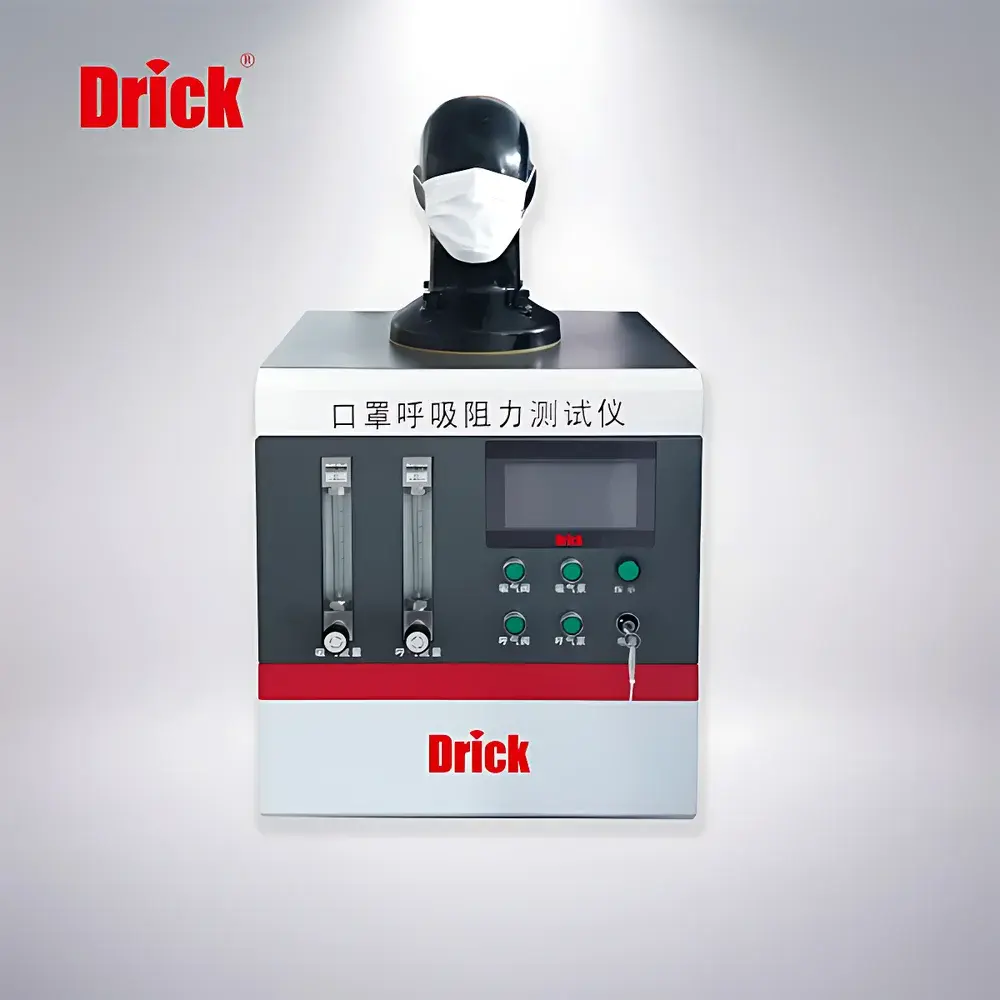
Drick DRK-260 Respiratory Protective Equipment Breathing Resistance Tester
| Brand | Drick |
|---|---|
| Origin | Shandong, China |
| Manufacturer Type | Direct Manufacturer |
| Country of Origin | China |
| Model | DRK-260 |
| Flow Rate Range | 0–100 L/min (±3% accuracy) |
| Differential Pressure Range | 0–2000 Pa (±1 Pa resolution) |
| Pump Flow Capacity | ≥100 L/min |
| Dimensions | 460 × 1080 × 670 mm |
| Power Supply | AC 220 V, 50 Hz, 650 W |
| Weight | 55 kg |
Overview
The Drick DRK-260 Respiratory Protective Equipment Breathing Resistance Tester is an engineered instrument designed for precise, repeatable measurement of inhalation and exhalation resistance in respiratory protective devices—including medical masks, particulate-filtering half-masks (e.g., N95/KN95 equivalents), anti-smog respirators, and industrial dust masks. It operates on the principle of controlled airflow generation across a test specimen under standardized flow conditions, quantifying the pressure differential (ΔP) across the mask material or full-facepiece assembly. This differential—expressed in pascals (Pa)—directly reflects breathing effort and serves as a critical performance indicator for regulatory compliance, quality assurance, and R&D validation. The system conforms to internationally aligned national standards including GB 19083–2010 (Technical Requirements for Medical Protective Masks), GB 2626–2006 (Respiratory Protective Devices – Self-Contained Filtering Respirators Against Particulates), and GB/T 32610–2016 (Technical Specifications for Daily Protective Masks). Its architecture integrates pneumatic control, high-fidelity sensor acquisition, and automated valve sequencing to eliminate operator-induced variability during dual-mode (inhalation/exhalation) testing.
Key Features
- Automated bidirectional airflow path switching via integrated solenoid-valve manifold—eliminates manual tubing reconfiguration and prevents misconnection errors during mode transition.
- High-accuracy digital differential pressure transducer with ±1 Pa resolution and full-scale range of 0–2000 Pa, calibrated traceably to national metrological standards.
- Precision mass flow meter (0–100 L/min, ±3% full-scale accuracy), featuring thermal-based sensing technology for stable output across ambient temperature fluctuations.
- Backlit high-resolution LCD interface with intuitive menu navigation, real-time waveform display, and on-screen parameter configuration (target flow rate, test duration, pass/fail thresholds).
- Dual-test mode selection: independent inhalation-resistance and exhalation-resistance protocols, each configurable with user-defined flow setpoints and dwell times.
- Integrated high-capacity vacuum pump (≥100 L/min free-air displacement) with thermally protected motor and acoustic damping enclosure for sustained operation at rated load.
Sample Compatibility & Compliance
The DRK-260 accommodates flat-panel filter media, molded cup-style masks, foldable surgical masks, and full-face respirator assemblies via standardized fixture adapters compliant with ISO 16900-1:2015 (Respiratory protective devices — Methods of test — Part 1: Determination of breathing resistance). All test fixtures maintain consistent sealing geometry and clamping force per GB 2626–2006 Annex B. The instrument supports both single-layer and multi-layer composite constructions, including electrostatically charged melt-blown nonwovens and activated carbon laminates. Regulatory alignment extends beyond Chinese national standards: its measurement methodology and uncertainty budget are compatible with ASTM F2299/F2299M (Standard Test Method for Determining the Initial Efficiency of Materials Used in Medical Face Masks to Penetration by Particulates Using Latex Spheres) and EN 149:2001+A1:2009 (Respiratory protective devices — Filtering half masks to protect against particles — Requirements, testing, marking). Data records meet GLP audit requirements for traceability, including timestamped test logs, operator ID, environmental temperature/humidity metadata (when externally interfaced), and raw sensor outputs.
Software & Data Management
The DRK-260 operates in standalone mode with embedded firmware supporting local data storage (≥1000 test records) and USB export in CSV format. Optional PC-based software (DRK-TestSuite v3.x) enables advanced functionality: automated report generation per GB 19083–2010 Clause 4.3.2; statistical process control (SPC) charts for batch-to-batch resistance trending; comparative overlay of inhalation vs. exhalation curves; and audit-trail-enabled user access logging. All exported datasets include instrument serial number, calibration due date, sensor drift compensation flags, and NIST-traceable certificate references. Software complies with FDA 21 CFR Part 11 requirements when deployed in validated environments—supporting electronic signatures, role-based permissions, and immutable record retention.
Applications
- Quality control laboratories in PPE manufacturing facilities verifying conformance to GB/T 32610–2016 Class A/B/C filtration efficiency and breathability limits.
- National and provincial labor protection product inspection institutes conducting type approval and market surveillance testing.
- R&D departments optimizing filter media basis weight, fiber diameter distribution, and pleat geometry for balanced filtration-efficiency/resistance trade-offs.
- Hospital infection control units validating reprocessed or extended-use respirators under institutional reuse protocols.
- Third-party certification bodies performing CB Scheme or CCC-mark related testing for domestic and export markets.
FAQ
What standards does the DRK-260 directly support out-of-the-box?
It is pre-configured for GB 19083–2010, GB 2626–2006, and GB/T 32610–2016 test sequences, including automatic flow ramping, dwell timing, and pass/fail logic per specified pressure thresholds.
Can the instrument be used for exhalation valve leakage testing?
No—the DRK-260 measures only static breathing resistance under steady-state flow. Exhalation valve integrity requires separate dynamic leakage assessment per GB 2626–2006 Annex D, using a dedicated leakage tester.
Is calibration documentation provided with shipment?
Yes—each unit ships with a factory calibration certificate covering pressure and flow sensors, valid for 12 months from date of issue, referencing CNAS-accredited reference standards.
Does the system support external environmental monitoring integration?
Yes—via RS-232 or optional analog input module, enabling synchronized logging of ambient temperature and relative humidity per ISO 16900-1:2015 Section 6.2 requirements.
What maintenance intervals are recommended for long-term accuracy?
Pressure sensor zero calibration every 30 days; full recalibration annually or after any impact event; pump oil replacement every 2000 operating hours; flow meter verification quarterly using certified dry-calibration rig.






